How to Build Local Citations: A Step-by-Step Guide (2026)
Lock in one exact name, address, and phone number, claim the core map platforms, add relevant directories, and fix old listings that disagree.
To build local citations, first lock in one exact version of your business name, address, and phone number (NAP), then list it on Google Business Profile, the major data platforms, and the directories your customers and industry use, and fix any old listings that disagree. Consistency matters more than volume: a few accurate, relevant citations beat hundreds of random ones.
Key takeaways
- A local citation is any online mention of your business name, address, and phone number, with or without a link.
- Google says local ranking depends on relevance, distance, and prominence, and prominence draws on information from across the web.
- In BrightLocal's 2023 research, 62% of consumers said they would avoid a business if they found incorrect information online.
- BrightLocal's 2024 study found business directories made up about 31% of local-intent organic search results.
- Start with Google Business Profile, Apple Business Connect, Bing Places, and the top directories in your country and industry.
What a local citation is
A local citation is an online mention of your business's name, address, and phone number. Citations appear on directories, review sites, maps, social profiles, and local websites.
There are 2 types:
- Structured citations: listings on directories and data platforms with fields for NAP, hours, and categories.
- Unstructured citations: mentions in news articles, blog posts, or event pages.
Many citations do not include a followed link, but they still help. Moz's local SEO guide explains how citations fit with reviews and Google Business Profile. For the bigger picture, see what is citation building.
Why citations matter
Citations help search engines and customers trust that your business details are real and current.
Google's guide to improving local ranking says local results are based on relevance, distance, and prominence. It explains that prominence uses information Google has about a business from across the web, including links and articles.
Customers also notice errors. BrightLocal's guide to managing listings cites its 2023 report finding that 62% of consumers would avoid a business with incorrect information online.
Directories also appear in search. BrightLocal reports in its local SEO statistics that business directories made up about 31% of local-intent organic results in its 2024 study.
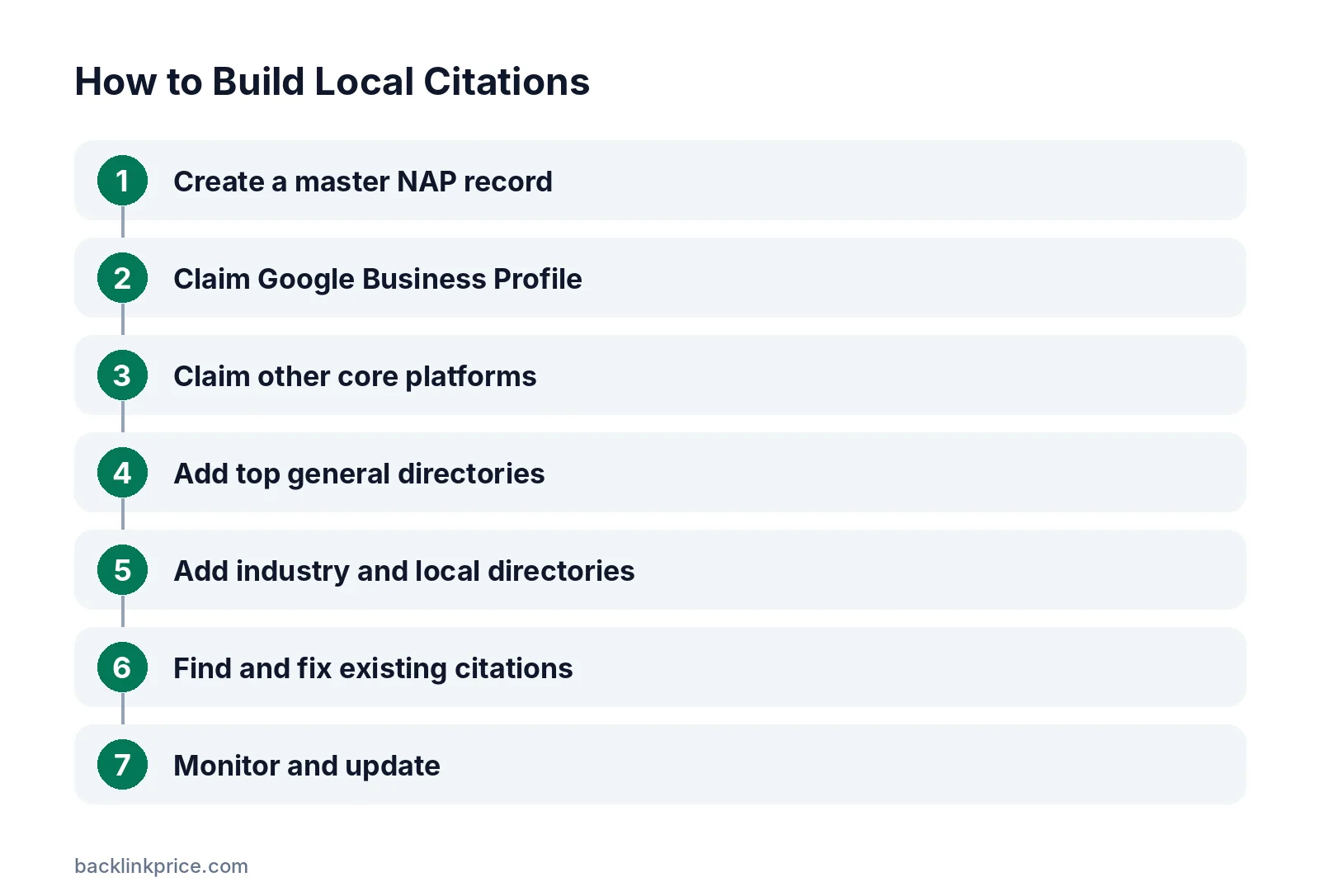
Step-by-step: how to build local citations
Follow these steps in order, so every listing uses the same data.
Step 1: Create a master NAP record
Write down the exact business name, address format, phone number, website URL, hours, and categories. Use this record for every listing.
Decide on small details, such as "Street" vs "St." and whether to include a suite number, and never change them.
Step 2: Claim Google Business Profile
Claim and verify your Google Business Profile. Fill every field, choose accurate categories, and add photos.
Step 3: Claim other core platforms
List your business on Apple Business Connect, Bing Places, and major map and data providers in your country. These feed many apps, maps, and voice assistants.
Use the same categories and hours you used on Google. Different categories across platforms can confuse both customers and search engines about what you do.
Step 4: Add top general directories
Add your business to well-known directories such as Yelp, Facebook, and country-specific business directories. Check that each is relevant to your market.
Step 5: Add industry and local directories
Find directories for your industry, such as legal, medical, or trades directories, and local ones, such as your chamber of commerce. These are often more relevant than generic lists.
See how to get local backlinks for local sources that may also link.
Step 6: Find and fix existing citations
Search your business name and phone number to find old listings. Update or claim them, and request removal of duplicates.
Our guide on what makes a bad backlink explains why spammy directories should be avoided.
Step 7: Monitor and update
Update every listing when hours, phone numbers, or addresses change. Review your main listings at least every quarter.
Keep a simple spreadsheet with every listing URL, login, and last-checked date. When something changes, you can update everything in one sitting instead of hunting for old profiles. For tracking links from these profiles, see how to track backlinks.
Where to build citations
Use this table to prioritize your effort.
| Priority | Platform type | Examples | Why it matters |
|---|---|---|---|
| 1 | Google Business Profile | Map pack and Google Maps | |
| 2 | Other maps | Apple Business Connect, Bing Places | Apple Maps, Bing, assistants |
| 3 | Major directories | Yelp, Facebook, country directories | High visibility, reviews |
| 4 | Industry directories | Legal, medical, trade sites | Relevance for your niche |
| 5 | Local sites | Chamber of commerce, local news directories | Local prominence |
| 6 | Data aggregators | Country-specific data providers | Spread data to other sites |
Citations for multiple locations
Businesses with several locations need one master record per location. Each location gets its own Google Business Profile, its own landing page on your website, and its own set of directory listings.
Never list several locations with the same phone number or a shared address. Give each landing page the exact NAP used in that location's listings, so search engines can match them.
Manual vs citation tools
You can build citations by hand or use a citation service. Manual work is cheaper but slow. Tools such as BrightLocal, Whitespark, and Yext automate submissions and tracking for a fee.
For tool overviews, see what is BrightLocal.
Common mistakes
These mistakes weaken local citations.
- Using different name or phone formats across listings.
- Listing on hundreds of low-quality directories.
- Leaving duplicate listings live.
- Forgetting to update listings after a move.
- Using a call-tracking number inconsistently.
- Ignoring industry-specific directories.
Frequently Asked Questions
How many citations does a local business need?
There is no fixed number. Focus on the core platforms, the major directories in your country, and the most relevant industry and local sites. Competitors in your area are a good guide to which listings matter in your market.
Do citations need to include a link?
No, a citation is a mention of your name, address, and phone number, and many do not include a link. They still help with consistency and prominence. Links from relevant local sites are a bonus.
What is NAP consistency?
NAP consistency means your business name, address, and phone number appear exactly the same way on every listing. Small differences, such as an old phone number or a different suite format, can confuse customers and search engines.
Should I pay for a citation-building service?
Paid services save time if you have many locations or little time. Small single-location businesses can often do it manually. Avoid services that promise hundreds of listings on unknown directories.
How long do citations take to have an effect?
New listings can take weeks to be found and processed. Fixing major errors, such as an old address, often has a clearer effect than adding many new listings. Keep records so you can update everything quickly.
Sources

The BacklinkPrice Team researches backlink prices, publisher sites and link building tools. We check prices and plans against each provider's own pages and date them, so you know how current the numbers are.
More from BacklinkPrice TeamRelated guides