Link Building in Japan: A Practical Guide for 2026
Write native Japanese content, plan for Bing on desktop and Yahoo Japan on mobile, follow the anti-spam email law, and label paid content to avoid stealth marketing rules.
Link building in Japan works best with native Japanese content, carefully localised data, and relationship-led outreach to Japanese media, industry sites, and communities. Japan has strict rules on hidden advertising: since October 1, 2023, stealth marketing is illegal, so paid placements must be clearly labelled. Commercial emails also have to identify the sender and stop when someone opts out.
Japan's search market is unusual, with Bing very strong on desktop and Yahoo Japan still present on mobile.
Key takeaways
- Statcounter put Google at 59.68%, Bing at 32.11%, and Yahoo at 6.56% of Japanese search in July 2026.
- On desktop, Bing reached 44.9% in July 2026, close to Google's 50.37%.
- On mobile, search.yahoo.co.jp held 13.55% of Japanese searches in July 2026.
- Japan's Act against Unjustifiable Premiums and Misleading Representations has banned stealth marketing since October 1, 2023.
- Japan's anti-spam email law requires commercial emails to show the sender's name and address and an address for opt-out requests.
How people in Japan search
Plan for Google, Bing, and Yahoo Japan.
Statcounter's Japan data showed Google at 59.68%, Bing at 32.11%, and Yahoo at 6.56% in July 2026.
On desktop, Bing held 44.9% against Google's 50.37%. That makes Bing visibility essential for B2B sites; see how to get your site indexed in Bing.
On mobile, google.com held 77.61% and Yahoo Japan's search.yahoo.co.jp 13.55%.
Language and site setup
Native Japanese is non-negotiable.
Japanese editors and readers expect natural Japanese, correct honorifics, and local formats for dates, prices, and addresses. Machine translation without native review rarely earns editorial links.
Use separate URLs for Japanese content with hreflang, as Google's guide to multi-regional and multilingual sites recommends.
Stealth marketing rules
Hidden advertising is illegal in Japan.
Law firm DLA Piper explains that from October 1, 2023, stealth marketing became illegal under the Act against Unjustifiable Premiums and Misleading Representations. The rule targets representations that consumers find hard to identify as a business's own advertising.
Japan's Consumer Affairs Agency states that hiding the fact that something is an advertisement is stealth marketing and violates the law.
The Japan Times reported that companies found in breach can be warned and publicly named.
For link building, this means sponsored articles, paid reviews, and influencer posts must be clearly marked as advertising. Google's spam policies also expect paid links to carry rel="sponsored" or nofollow; see are paid links against Google guidelines.
Outreach and the anti-spam email law
Commercial emails have clear labelling duties.
Japan's Act on Regulation of Transmission of Specified Electronic Mail requires senders of advertising emails to show the sender's name and address and an email address for receiving opt-out notices. It prohibits sending further emails to anyone who has asked you to stop.
The law defines these "specified" emails as advertising sent by businesses, and it treats people who have consented or who have a business relationship with the sender differently from cold recipients.
In practice:
- Prefer contact forms and press contacts that invite pitches.
- Identify yourself and your company clearly.
- Keep pitches relevant and non-promotional in tone.
- Honour any request to stop immediately.
For the wider legal picture, see is link building legal.
Where to get links in Japan
| Link source | Why it works | Typical angle |
|---|---|---|
| National news portals | High authority, large audiences | Japan-specific survey data |
| Industry and trade media | Relevant B2B readers | Benchmarks, expert commentary |
| Regional media | Prefecture-level audiences | Data by prefecture or city |
| Universities | Trusted academic domains | Research partnerships |
| Business associations | Local networks | Member listings, events |
| Japanese blogs and communities | Niche relevance | Guides, tools, templates |
With 47 prefectures, data broken down by prefecture can create many local stories from one study.
Step-by-step: building links in Japan
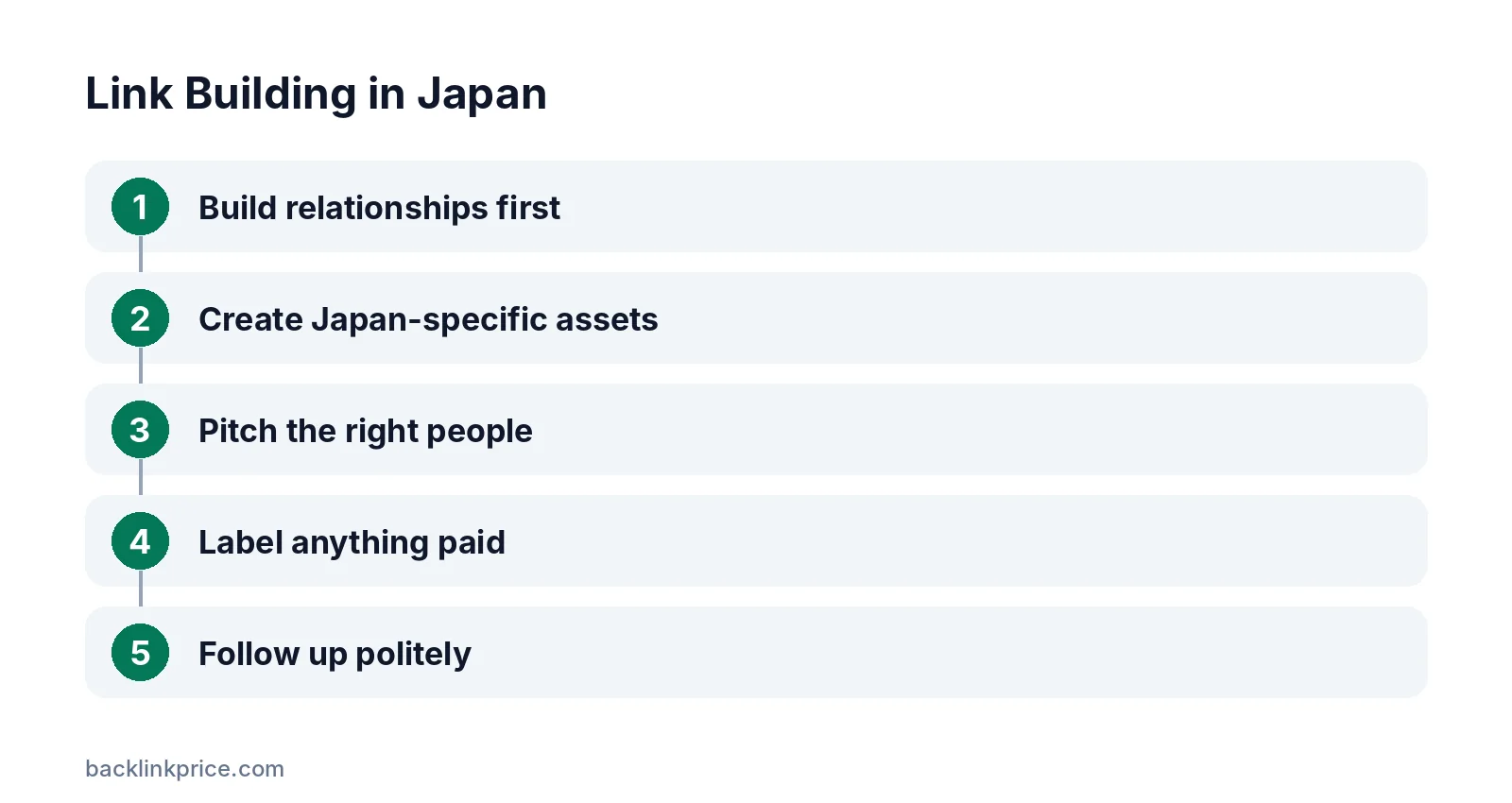
Step 1: Build relationships first
Trust comes before requests.
Japanese business culture values relationships and formality. Attend industry events, join associations, and engage with editors before pitching.
Step 2: Create Japan-specific assets
Localise the data, not just the language.
Survey Japanese consumers or businesses, use Japanese public statistics, and present results with local context.
Step 3: Pitch the right people
Use formal, concise Japanese.
Research the media outlet and the editor's coverage. Our guide to getting backlinks from journalists covers the basics.
Step 4: Label anything paid
Make advertising obvious.
Any sponsored placement must be clearly identified as advertising to comply with stealth marketing rules.
Step 5: Follow up politely
One courteous follow-up, then respect silence.
Wait about a week, then send a brief, polite note that adds something new, such as a prefecture-level figure relevant to the editor's readers. If there is still no reply, move on and keep the relationship warm through events and social channels.
Seasonal and cultural angles
Japan's calendar offers predictable news hooks.
The new fiscal and school year in April, Golden Week holidays, summer bonus season, and year-end gift-giving all shape consumer and business coverage. Time data releases to these moments so editors have a reason to run your story now.
Regional pride is strong, so comparisons between prefectures or cities often travel well in regional media.
Brand mentions and AI search
Mentions in Japanese media also help AI visibility.
An Ahrefs study of 75,000 brands found branded web mentions correlated 0.664 with AI Overview visibility, compared with 0.218 for backlinks. Read do brand mentions without links help AI search.
Common mistakes
- Machine-translated pitches. They signal low effort.
- Ignoring Bing. It holds nearly half of desktop search.
- Unlabelled sponsored posts. Stealth marketing is illegal.
- Mass cold emailing. It conflicts with both law and culture.
- No local data. Global statistics rarely interest Japanese editors.
Frequently Asked Questions
Does Bing matter in Japan?
Yes. Statcounter showed Bing at 32.11% of Japanese search overall and 44.9% on desktop in July 2026.
Is Yahoo Japan still important for SEO?
On mobile, search.yahoo.co.jp held 13.55% of Japanese searches in July 2026, so it is still a meaningful channel.
Do sponsored posts need labels in Japan?
Yes. Since October 1, 2023, hiding that content is advertising counts as stealth marketing and is illegal under Japan's misleading representations law.
Can I send cold outreach emails in Japan?
Japan's anti-spam law sets labelling duties and bans emails to people who opt out. Use clear identification, relevant pitches, and contact forms where possible, and seek advice for larger campaigns.
Do I need .jp links to rank in Japan?
No. Relevant Japanese sites matter more than the domain extension, though links from Japanese sites help show local relevance.
Sources
- Statcounter: Search engine market share in Japan
- Statcounter: Desktop search engine market share in Japan
- Statcounter: Mobile search engine host share in Japan
- DLA Piper: Japan's new law prohibits stealth marketing
- Consumer Affairs Agency: Stealth marketing
- The Japan Times: Stealth marketing rules
- Japanese Law Translation: Act on Regulation of Transmission of Specified Electronic Mail
- Google Search Central: Managing multi-regional and multilingual sites
- Google Search Central: Spam policies, link spam
- Ahrefs: AI Overview brand correlation study

The BacklinkPrice Team researches backlink prices, publisher sites and link building tools. We check prices and plans against each provider's own pages and date them, so you know how current the numbers are.
More from BacklinkPrice TeamRelated guides