Link Building in Spain: A Practical Guide for 2026
Write in native Spanish, earn links with Spanish and regional data, respect the LSSI's consent rules for commercial email, and label paid content clearly.
Link building in Spain works best with native Spanish content, data about Spain and its regions, and pitches to Spanish news, trade, university, and community sites. Be careful with cold email: Spain's LSSI generally bans unsolicited commercial email without prior consent, so relationships, contact forms, and genuinely useful non-promotional pitches matter more here than in many markets.
Google dominates Spanish search, so links from relevant Spanish sites carry real weight.
Key takeaways
- Statcounter put Google at 93.75% and Bing at 3.32% of Spanish search in July 2026.
- On desktop, Google held 87.82% and Bing 6.89% in July 2026.
- Article 21 of the LSSI prohibits commercial email that was not requested or expressly authorised, with an exception for prior contractual relationships.
- The LSSI also requires commercial communications to be clearly identifiable, along with the person or company behind them.
- Spain's regions, such as Catalonia, Andalusia, and the Basque Country, have strong regional media and some co-official languages.
How people in Spain search
Google is almost the whole market.
Statcounter's Spain data showed Google at 93.75%, Bing at 3.32%, and Yahoo at 2.07% in July 2026.
On desktop, Google held 87.82% and Bing 6.89%. For B2B sites, Bing visibility is still worth a check; see how to get your site indexed in Bing.
Language and site setup
Write for Spain, not just for Spanish speakers.
Spanish in Spain differs from Latin American Spanish in vocabulary, spelling conventions, and tone. If you target both, use separate pages with hreflang, as Google's guide to multi-regional and multilingual sites recommends.
Use prices in euros, Spanish sources, and local examples. In Catalonia, Galicia, and the Basque Country, regional-language versions can open extra local media doors.
Outreach rules: the LSSI
Spain is one of the stricter EU countries for cold email.
Spain's data protection agency, the AEPD, has stated in enforcement decisions that sending commercial messages without prior consent is prohibited under article 21 of the LSSI. The exception covers a prior contractual relationship and similar products.
Another AEPD decision describes this as the opt-in principle: email for commercial purposes depends on the recipient's prior consent.
Privacy consultancy Atico34 notes that, unlike data protection law, the LSSI applies to both individuals and companies. So the usual B2B exceptions found in the UK or France do not carry over.
What this means for link builders:
- Prefer contact forms and editorial submission channels where sites provide them.
- Build relationships first through social media, events, and genuine collaboration.
- Keep any email strictly relevant, non-promotional in tone, and easy to opt out of.
- Get legal advice before running email campaigns at scale.
For the EU-wide picture, see is link building legal.
Disclosing paid content
Paid content must be identifiable as advertising.
Spanish legal site Economist & Jurist summarises article 20 of the LSSI: commercial communications sent electronically must be clearly identifiable, and so must the person or company behind them.
Legal Today explains that this covers influencer content on social networks too.
For search, Google's spam policies apply everywhere: paid links should be marked rel="sponsored" or rel="nofollow". Read are paid links against Google guidelines.
Where to get links in Spain
Combine national, regional, and sector sources.
| Link source | Why it works | Typical angle |
|---|---|---|
| National news sites | High authority, wide reach | Spanish survey data, national rankings |
| Regional and local press | Strong readership in each autonomous community | Data by region, province, or city |
| Trade and sector media | Relevant B2B audiences | Benchmarks, expert commentary |
| Universities | Trusted academic domains | Research partnerships, scholarships |
| Chambers of commerce | Local business networks | Member listings, events |
| Spanish blogs and communities | Niche relevance | Guides, tools, templates |
Data split by autonomous community or province lets one study become many regional stories.
Step-by-step: building links in Spain
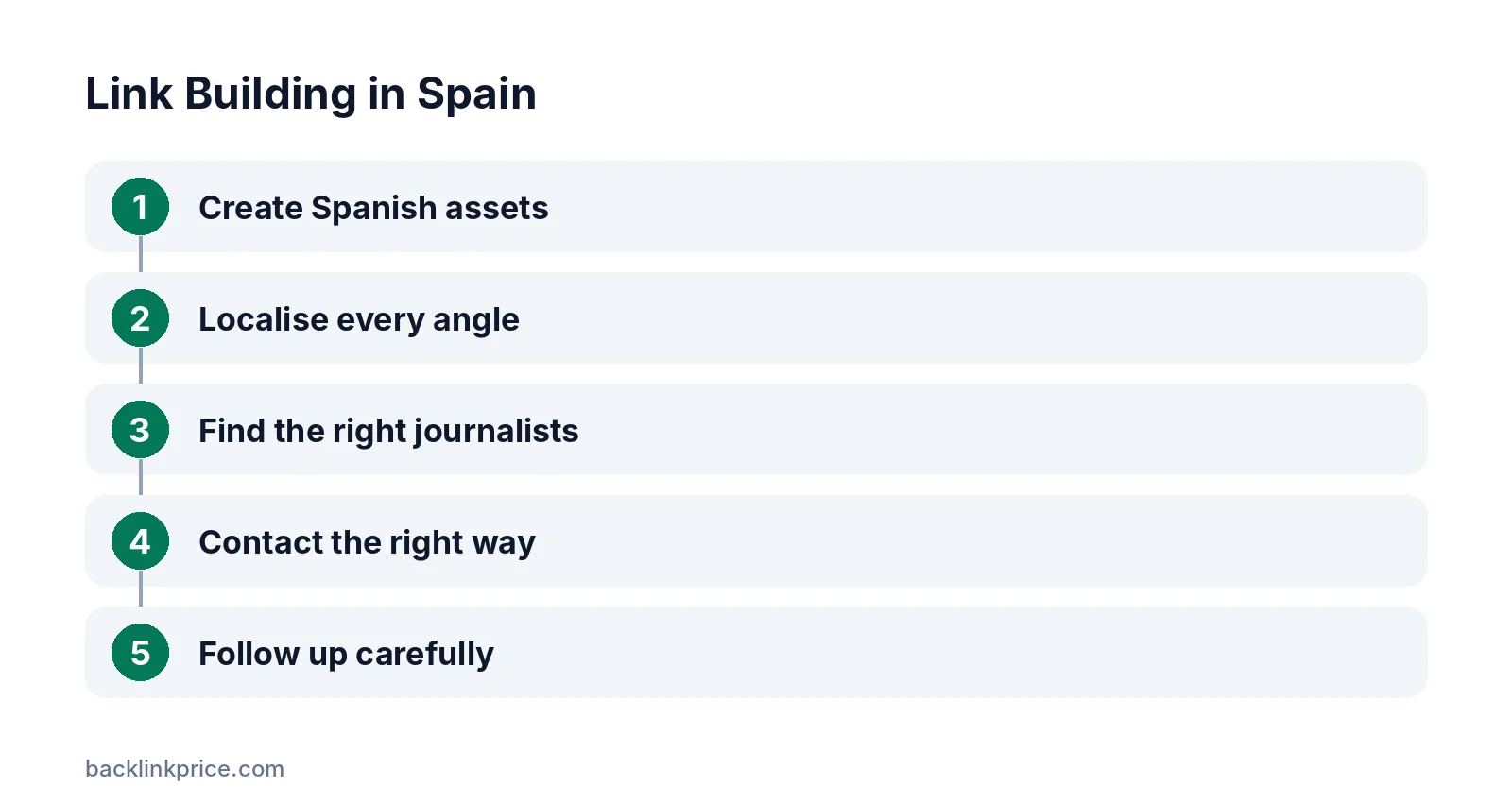
Step 1: Create Spanish assets
Give Spanish editors a reason to link.
Publish a resource built for Spain: a survey of Spanish consumers, a ranking of cities or regions, a calculator in euros, or a clear explainer of a Spanish rule.
Use official Spanish statistics so journalists can trust your numbers.
Step 2: Localise every angle
Lead with Spain's figures.
If you run a European study, headline the Spanish result first and compare it with other countries afterwards.
Step 3: Find the right journalists
Target people who already cover your topic.
Read recent articles in your sector and note the bylines. Regional papers often have dedicated economy and consumer reporters.
Our guide to getting backlinks from journalists covers research and approach.
Step 4: Contact the right way
Respect consent rules while still being useful.
Use press contact forms, newsroom addresses that invite tips, and social platforms where journalists ask for sources. Keep messages short, relevant, and in natural Spanish.
Step 5: Follow up carefully
One polite follow-up, then stop.
If you have no reply, do not chase repeatedly. Respect any request not to be contacted again.
Brand mentions and AI search in Spain
Coverage helps AI answers even without links.
An Ahrefs study of 75,000 brands found branded web mentions correlated 0.664 with AI Overview visibility, compared with 0.218 for backlinks.
Coverage in trusted Spanish publications can shape how AI tools describe your brand. Read do brand mentions without links help AI search.
Common mistakes
Avoid these when entering Spain.
- Mass cold emailing. The LSSI makes this risky.
- Latin American Spanish on a Spain-targeted page. Readers notice.
- Global data without a Spanish angle. Editors want Spanish figures.
- Ignoring regional media. It is often easier to win and very relevant.
- Unlabelled sponsored posts. Both Spanish law and Google expect disclosure.
How to measure results
Track links, mentions, and Spanish search visibility.
Record each placement, whether it links, and the link attribute. In Google Search Console, filter performance by country to watch Spanish queries and traffic.
For the wider campaign process, see how to run a digital PR campaign.
Frequently Asked Questions
Can I send cold link building emails to Spanish websites?
Be cautious. Spain's LSSI generally prohibits unsolicited commercial email without prior consent, and it applies to companies as well as individuals. Use contact forms and relationship-based outreach, and seek advice for larger campaigns.
Do I need .es links to rank in Spain?
No. Relevant, trusted links matter more than the domain extension, though links from Spanish sites help show relevance to Spanish readers.
Does Bing matter in Spain?
Very little overall. Statcounter showed Bing at 3.32% of Spanish search in July 2026, rising to 6.89% on desktop.
Should I translate content into Catalan or Basque?
For regional campaigns, yes, it can help with local media in those communities. For national campaigns, Spanish is usually enough.
Do I have to label sponsored posts in Spain?
Yes. The LSSI requires commercial communications to be clearly identifiable, and Google expects paid links to carry rel="sponsored" or nofollow.
Sources
- Statcounter: Search engine market share in Spain
- Statcounter: Desktop search engine market share in Spain
- AEPD: Decision on unsolicited commercial email under LSSI article 21
- AEPD: Report on commercial communications by email
- Atico34: LSSI and commercial communications
- Economist & Jurist: LSSI article 20 requirements
- Legal Today: Is influencer advertising legal?
- Google Search Central: Managing multi-regional and multilingual sites
- Google Search Central: Spam policies, link spam
- Ahrefs: AI Overview brand correlation study

The BacklinkPrice Team researches backlink prices, publisher sites and link building tools. We check prices and plans against each provider's own pages and date them, so you know how current the numbers are.
More from BacklinkPrice TeamRelated guides