Link Building in France: A Practical Guide for 2026
Write in native French, earn links with French data and regional angles, follow CNIL rules on B2B prospecting emails, and label paid content.
Link building in France works best when you publish native French content, earn links from French news, trade, regional, and education sites with data about France, follow CNIL rules when emailing prospects, and clearly label any paid placement. Translated English pitches and English-only pages rarely earn French editorial links.
France has strict, well-enforced rules on electronic prospecting and on commercial influence, so compliance is part of the strategy.
Key takeaways
- Statcounter put Google at 88.76%, Bing at 5.13%, and Qwant at 0.83% of French search in August 2026.
- On desktop, Bing reached 10.98% in August 2026, which matters for B2B sites.
- CNIL rules allow B2B prospecting emails without prior consent only when the message relates to the recipient's profession and they can opt out simply.
- Every prospecting email must identify the sender and offer an easy way to refuse further messages.
- France's 2023 influencer law requires paid promotions by influencers to carry the label "publicité" or "collaboration commerciale".
How people in France search
Google dominates, but Bing is worth a look for desktop audiences.
Statcounter's France data showed Google at 88.76%, Bing at 5.13%, and the French engine Qwant at 0.83% in August 2026.
On desktop, Google held 79.74% and Bing 10.98%. If you sell to businesses, make sure your pages are indexed in Bing too. See how to get your site indexed in Bing.
Language and site setup
French readers and editors expect French content.
Google's guide to multi-regional and multilingual sites recommends separate URLs for each language and clear signals such as hreflang annotations.
A .fr domain or a /fr/ folder both work. What matters more for links is that the page a French journalist lands on is written in natural French, with French sources, prices in euros, and local examples.
Machine translation without native review shows quickly in tone and vocabulary. Budget for a French writer or editor.
Outreach rules: CNIL and electronic prospecting
France separates B2C and B2B email rules.
The CNIL's guidance on commercial prospecting by email, updated June 10, 2026, starts from the general rule that individuals must give prior consent.
Its B2B answer explains the exception for professionals. The person must have been told their address could be used for prospecting and given a simple, free way to object.
The subject of the email must also relate to the person's profession. If it does not, consumer (B2C) rules apply.
The same CNIL answer says each message must:
- identify the sender (the advertiser);
- offer a simple way to refuse further messages, such as an unsubscribe link;
- link to the sender's privacy policy.
France's economy ministry Bercy Infos adds that generic business addresses such as contact@ or info@ also fall under the professional exception.
A link pitch to an editor about content in their field usually fits the B2B frame. A pitch to a hobby blogger's personal address may not.
Disclosing paid content
Paid placements in France must be identifiable as advertising.
The law of June 9, 2023 on commercial influence requires influencers to show the label "publicité" or "collaboration commerciale" on promotional content.
The economy ministry's guidance for influencers says the label must be clear, readable, and identifiable, and that the brand behind the content must be named.
For search, Google's spam policies apply everywhere: paid links should carry rel="sponsored" or rel="nofollow". For more detail, see are paid links against Google guidelines.
Where to get links in France
Think national, regional, and sector.
| Link source | Why it works | Typical angle |
|---|---|---|
| National news sites | High authority, wide reach | French survey data, national rankings |
| Regional daily press | Strong local readership in each region | Data broken down by region or city |
| Trade and sector media | Relevant audience for B2B | Industry benchmarks, expert commentary |
| Universities and grandes écoles | Trusted .fr and .edu-style domains | Scholarships, research partnerships, student guides |
| Chambers of commerce (CCI) | Local business networks | Member directories, events, case studies |
| French-language blogs | Niche relevance | Tools, guides, practical templates |
France has a strong regional press, so data split by region or city gives you many local stories from one study.
For the method behind this, read how to run a digital PR campaign.
Step-by-step: building links in France
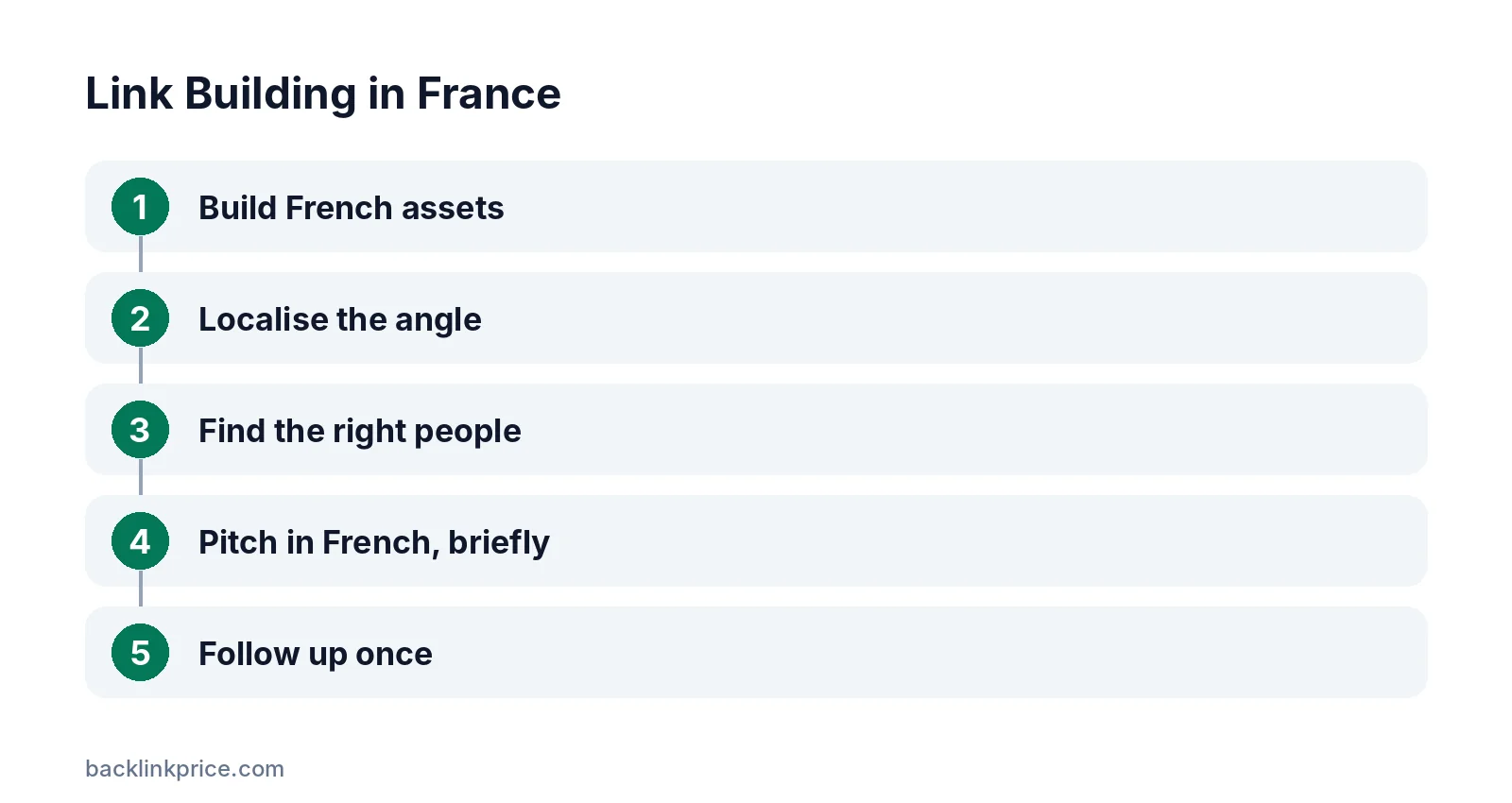
Step 1: Build French assets
Start with something worth linking to.
Create a French-language resource: a survey of French consumers, a city or regional ranking, a cost calculator in euros, or a guide that explains a French regulation clearly.
Use French public data, such as national statistics, so journalists can trust your numbers.
Step 2: Localise the angle
Make each pitch about France, not about your company.
A global study becomes a French story only when the French figures are the headline. Lead with the French result, then compare it with other countries.
Step 3: Find the right people
Target journalists and editors who cover your topic.
Read recent articles in your sector and note the bylines. Regional papers often have local business and consumer reporters.
Our guide to getting backlinks from journalists covers how to research and approach them.
Step 4: Pitch in French, briefly
Short, relevant, and professional wins.
Write a clear subject line, two or three sentences on the finding, one line on why it matters to their readers, and a link to the full data. Include your identity and an opt-out line to meet CNIL requirements.
Avoid mass sending. Personalise each message to the journalist's recent coverage.
Step 5: Follow up once
One polite follow-up is enough.
Wait several days, then send a short reminder with a new detail, such as a regional figure for their area. Stop if there is no reply.
Why brand mentions matter for AI search in France
Mentions in French media also feed AI answers.
An Ahrefs study of 75,000 brands found that branded web mentions correlated 0.664 with AI Overview visibility, compared with 0.218 for backlinks.
That makes coverage in trusted French publications valuable even when the mention has no link. Read more in do brand mentions without links help AI search.
Common mistakes in French link building
Most failures come from treating France like a translation job.
- English pitches to French editors. Many will not reply.
- Literal translation. Idioms, formality, and vocabulary give it away.
- Ignoring CNIL rules. Missing sender identity or opt-out is a compliance risk.
- Global data with no French angle. Editors want French figures first.
- Unlabelled paid posts. Both French law and Google expect paid content to be identified.
How to measure results
Track links, mentions, and French search visibility together.
Record each placement, whether it links, and whether the link is followed. Watch rankings and traffic for French queries in Google Search Console, filtered to France.
Also track unlinked mentions in French media, since they help both reputation and AI visibility.
Frequently Asked Questions
Do I need .fr links to rank in France?
No. Links from relevant, trusted sites matter more than the domain extension. Links from French sites do help show relevance to French readers, so aim for a healthy share of them.
Can I send cold link building emails to French businesses?
Yes, under the B2B exception, if the email relates to the recipient's profession, identifies you, and offers a simple way to opt out. Personal addresses unrelated to work fall under the stricter consumer rules.
Does Bing matter in France?
A little overall, more on desktop. Statcounter showed Bing at 5.13% of French search and 10.98% on desktop in August 2026.
Do I have to label sponsored posts in France?
Yes. Paid promotional content must be identifiable as advertising, and influencers must use "publicité" or "collaboration commerciale". For SEO, mark paid links with rel="sponsored".
Should I translate my English content into French?
Use your English content as a base, but have a native French writer adapt it, with French data, sources, and examples. A close translation rarely earns editorial links.
Sources
- Statcounter: Search engine market share in France
- Statcounter: Desktop search engine market share in France
- CNIL: Commercial prospecting by email, SMS and automated calls
- CNIL Direct: B2B email prospecting conditions
- Bercy Infos Entreprises: Commercial emails and consent
- Vie publique: Law of June 9, 2023 on commercial influence
- Ministère de l'Économie: Influencers, what are my duties?
- Google Search Central: Managing multi-regional and multilingual sites
- Google Search Central: Spam policies, link spam
- Ahrefs: AI Overview brand correlation study

The BacklinkPrice Team researches backlink prices, publisher sites and link building tools. We check prices and plans against each provider's own pages and date them, so you know how current the numbers are.
More from BacklinkPrice TeamRelated guides