Link Building in Canada: A Practical Guide for 2026
Target Google and desktop Bing, localise in English and French, follow CASL rules for outreach, and disclose paid content under the Competition Act.
Link building in Canada works best when you create content for Canadian readers in English and, where relevant, French, earn links from Canadian news, trade, education, and community sites with local data, follow Canada's anti-spam law (CASL) when emailing prospects, and clearly disclose any paid content.
CASL is stricter than US email law, so outreach to Canadian contacts needs extra care.
Key takeaways
- Statcounter put Google at 85.99% and Bing at 9.36% of Canadian search in July 2026.
- On desktop, Bing's share was 15.89% in August 2026, which matters for B2B audiences.
- CASL requires consent, sender identification, and an unsubscribe mechanism for commercial electronic messages.
- A publicly visible email address is not automatically implied consent under CASL; it must be conspicuously published and relevant to the person's role.
- The Competition Bureau says undisclosed material connections in promotions may be misleading.
How Canadians search
Google leads, with Bing stronger on desktop.
Statcounter's Canada data showed Google at 85.99% and Bing at 9.36% in July 2026. On desktop, Bing reached 15.89% in August 2026.
That desktop share makes Bing worth attention for B2B sites. Read how to get your site indexed in Bing.
Outreach and Canada's anti-spam law
CASL affects how you email link prospects.
Canada's government guidance on consent under CASL says businesses must obtain consent before sending commercial electronic messages. Implied consent applies only in certain circumstances.
A 2015 enforcement advisory lists three main requirements: obtain consent (express or implied), provide identification information, and provide an unsubscribe mechanism.
The CRTC's guidance on implied consent explains when conspicuously published addresses can be used.
Bennett Jones' summary of a 2016 CRTC enforcement decision notes that publication of an employee's contact details could create implied consent only for messages relevant to that person's role.
Whether a given link request counts as a commercial message depends on its content. Keep outreach relevant to the recipient's role, identify yourself, and offer an easy opt-out. This is not legal advice.
Disclosing paid content in Canada
Material connections must be clear.
The Competition Bureau's Deceptive Marketing Practices Digest, Volume 4 defines a material connection as any relationship that could affect how consumers judge independence. Failing to disclose one can be misleading.
Label sponsored articles clearly and mark paid links with rel="sponsored" or nofollow for Google.
Where to get links in Canada
Plan for national, provincial, and local sources.
| Source | Examples | How to earn |
|---|---|---|
| National news | National newspapers and broadcasters | Data stories, expert comment |
| Provincial and local news | City and regional news sites | Local data, community stories |
| French-language media | Quebec and francophone outlets | French content and local angles |
| Trade publications | Industry magazines and portals | Insights and sector data |
| Universities and colleges | Research centres, career pages | Partnerships, guest lectures |
| Associations and chambers | Industry bodies, boards of trade | Membership, events, sponsorships |
Step-by-step: building links in Canada
Plan for Canadian readers from the start.
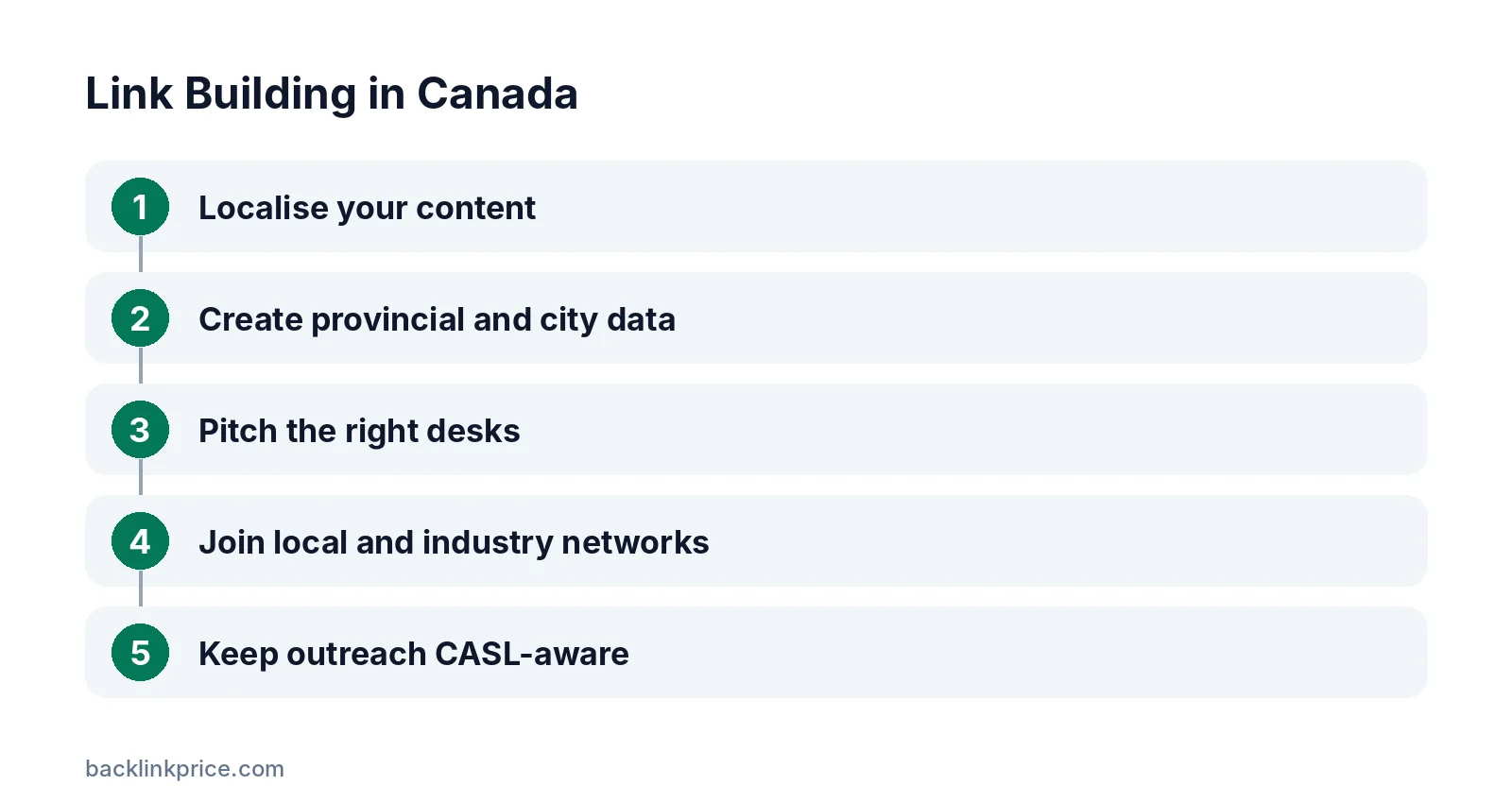
Step 1: Localise your content
Use Canadian spelling, Canadian dollars, Canadian laws, and Canadian sources. For Quebec audiences, publish quality French content rather than machine translation.
Step 2: Create provincial and city data
Survey Canadians or analyse public data, and break results down by province and city. Regional angles help you reach provincial and local media.
Our guide on how to get backlinks with original research explains survey design.
Step 3: Pitch the right desks
Pitch national, provincial, French-language, and trade journalists separately with angles that fit each. Keep pitches short and relevant.
Step 4: Join local and industry networks
Join boards of trade, chambers of commerce, and industry associations. Speaking at events or contributing to newsletters often leads to links.
Read how to get local backlinks for more ideas.
Step 5: Keep outreach CASL-aware
Target contacts whose role matches your request, identify yourself clearly, and include a simple way to opt out. Keep records of how you found each contact.
Why brand mentions matter for Canadian AI search
Coverage helps both rankings and AI answers.
An Ahrefs study of 75,000 brands found branded web mentions correlated at 0.664 with AI Overview visibility, compared with 0.218 for backlinks. Being named by Canadian publications builds both.
Learn more in what is a brand mention in AI search.
Seasonal and regional angles
Use Canada's own calendar and regions.
Tax season, winter weather, provincial holidays, and back-to-school dates create timely hooks. Regional differences in costs, housing, or habits give each province its own story.
Common mistakes in Canadian link building
These mistakes waste effort or create risk.
- Treating every public email address as consent to contact.
- Using American spelling and examples for Canadian audiences.
- Ignoring French-language media and audiences.
- Building only US links to rank in Canada.
- Not disclosing paid placements.
Google's spam policies treat buying links that pass ranking credit as link spam.
Working with agencies on Canadian campaigns
Agree on outreach rules before work starts.
Ask any agency or freelancer how they source contacts and whether their outreach is CASL-aware. Request live examples of Canadian links and check those sites' real traffic and relevance.
Agree in writing that paid placements will be disclosed and links qualified.
How to measure results
Track Canadian results separately from other markets.
- Referring domains from Canadian sites and .ca domains.
- Rankings in Google Canada and Bing for target terms.
- Organic traffic from Canada by province.
- Coverage in national, provincial, and trade media.
Use how to track backlinks to set up reports.
Frequently Asked Questions
Do I need .ca links to rank in Canada?
Not exclusively, but relevant Canadian links help. A mix of links from Canadian publications, organisations, and relevant international sites is normal. Relevance matters more than the domain ending.
Does CASL apply to link building outreach emails?
It can, depending on whether the message is commercial. CASL requires consent, identification, and an unsubscribe mechanism for commercial electronic messages. Get legal advice if you email Canadian contacts at scale.
Is a published email address enough for implied consent under CASL?
Not always. The address generally must be conspicuously published by the person, without a statement refusing messages, and your message must relate to their role or business.
Does Bing matter in Canada?
Yes, especially on desktop. Statcounter measured Bing at 9.36% of Canadian search in July 2026 and 15.89% on desktop in August 2026.
Should I create French content for Canada?
If you target Quebec or francophone audiences, yes. Quality French content opens links from French-language media and sites that English content cannot reach.
Sources
- Statcounter: Search engine market share in Canada
- Statcounter: Desktop search engine market share in Canada
- Government of Canada: Understanding consent under CASL
- Government of Canada: CASL enforcement advisory (2015)
- CRTC: CASL guidance on implied consent
- Bennett Jones: CRTC assesses conspicuous publication in CASL decision
- Ahrefs: AI Overview brand correlation study
- Competition Bureau: Deceptive Marketing Practices Digest, Volume 4
- Google Search Central: Spam policies

The BacklinkPrice Team researches backlink prices, publisher sites and link building tools. We check prices and plans against each provider's own pages and date them, so you know how current the numbers are.
More from BacklinkPrice TeamRelated guides