Link Building in the UK: A Practical Guide for 2026
Localise content, win UK media with data stories, use local networks, and label paid content the way the ASA and CAP Code require.
Link building in the UK works best with British English content, links from relevant UK publications and organisations, and digital PR built on UK data, while following the ASA's rule that paid content must be obviously identifiable as advertising. UK newsrooms, trade titles, and regional media are strong link sources for brands with real stories and data.
Key takeaways
- Google dominates UK search: Statcounter measured a 91.19% share in June 2026, with Bing at 6.22%.
- UK digital PR is a mature market, and links from national and regional news are a common goal for UK campaigns.
- The CAP Code requires marketing communications to be obviously identifiable; "Advertisement Feature" is named as an appropriate label for advertorials.
- The ASA has ruled that labels such as "sponsored" and "in association with" were not sufficient for advertorials.
- Local sources such as councils, universities, chambers of commerce, and regional newspapers help UK businesses build relevant links.
How the UK differs for link building
The principles are universal, but language, media, and regulation shape the details.
- Language: Use British spelling and UK examples, prices in pounds, and UK sources.
- Media: The UK has dense national, regional, and trade media, which suits digital PR.
- Regulation: The Advertising Standards Authority (ASA) enforces clear labelling of paid content.
- Local structure: Councils, chambers, and regional business groups are active online.
For international principles, see do links from foreign-language sites help.
How people search in the UK
Google is the main target, with Bing more relevant on desktop.
Statcounter's UK data put Google at 91.19% and Bing at 6.22% of search engine market share in June 2026. Bing's share is noticeably higher on desktop, which matters for B2B audiences.
Bing also feeds several AI assistants. Read how to get your site indexed in Bing.
Labelling rules for paid content in the UK
Paid content must be obviously identifiable as advertising under the CAP Code.
The ASA's guidance on advertisement features explains that Section 2 of the CAP Code requires marketing communications to be obviously identifiable. It names "Advertisement Feature" as an appropriate label for advertorial content.
In past rulings, the ASA found that labels such as "sponsored", "in association with", "Recommended by", and "Brand Publisher" were not sufficient for advertorials.
Paid links should also be qualified for Google with rel="sponsored" or nofollow, as described in Google's guide to qualifying outbound links. This is not legal advice.
Where to get links in the UK
Use this table to plan sources.
| Source | Examples | Notes |
|---|---|---|
| National news | National newspapers and broadcasters' sites | Data-led digital PR |
| Regional and local news | Regional dailies and city news sites | Local data and community stories |
| Trade media | Sector magazines and portals | High relevance |
| Chambers and business groups | Local chambers of commerce, industry bodies | Member directories, events |
| Universities | UK universities and research centres | Partnerships, studies, guest lectures |
| Councils and community | Local authority partner pages, charities | Sponsorships and community projects |
Step-by-step: building links in the UK
Plan for UK readers from the start.
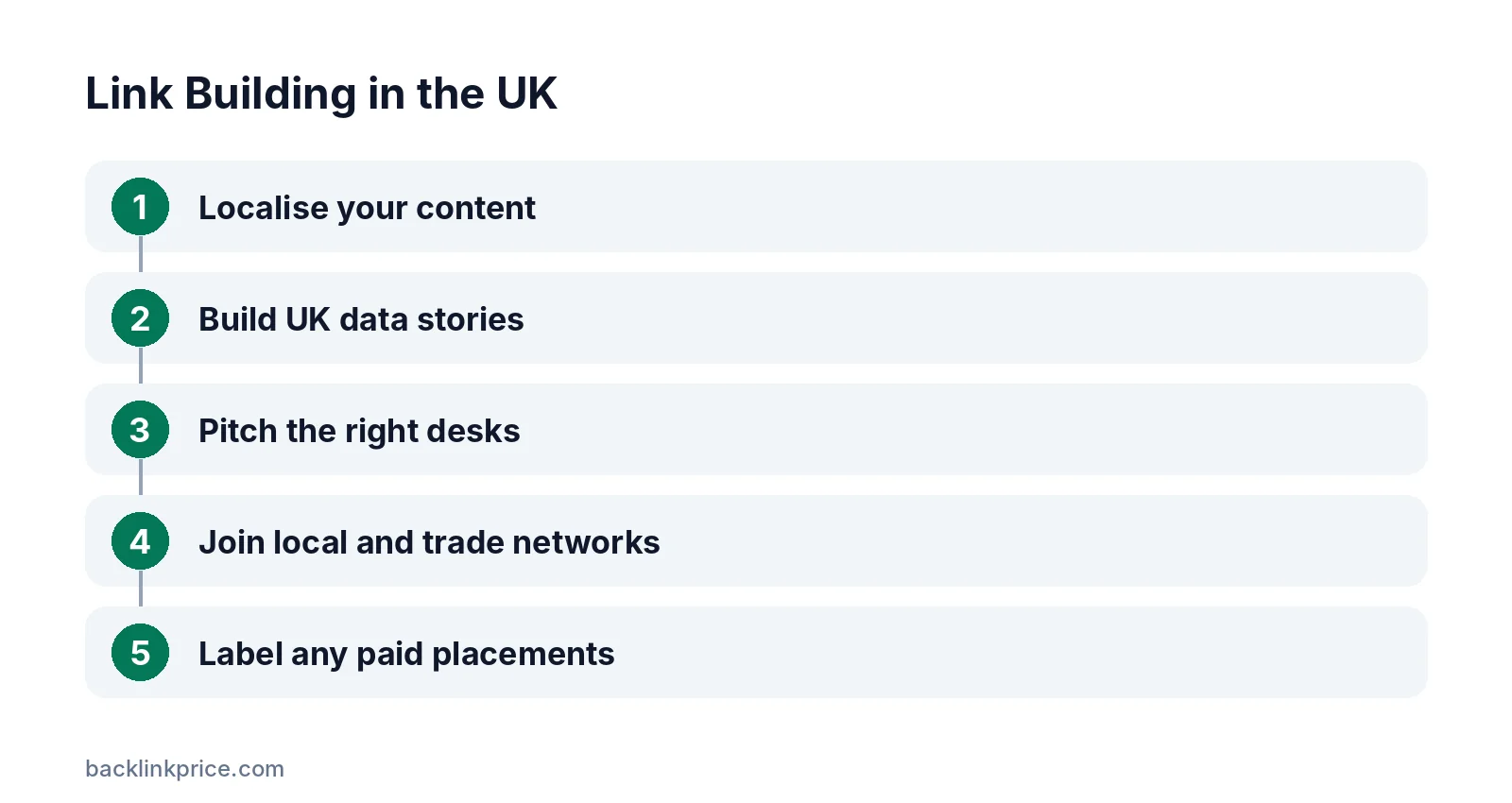
Step 1: Localise your content
Use British English, pounds sterling, UK laws, and UK sources. Content that reads as American is less likely to be cited by UK writers.
Step 2: Build UK data stories
Survey UK consumers or businesses, or use public UK data, then break results down by region. Regional angles open doors to many local outlets.
Our guide on how to get backlinks with original research covers survey design.
Step 3: Pitch the right desks
Pitch national, regional, and trade journalists separately, with the angle that fits each. Keep pitches short and timely.
Journalists are busy everywhere. Cision's 2025 survey found half receive more than 50 pitches per week, and 86% reject pitches mainly for lack of relevance.
Step 4: Join local and trade networks
Join your chamber of commerce and relevant trade bodies, attend events, and contribute expertise. These often lead to directory listings and articles.
See how to get local backlinks for more local sources.
Step 5: Label any paid placements
If you pay for content, make sure it is clearly labelled as advertising and that links are qualified. Do not ask publishers to disguise paid content as editorial.
Why brand mentions matter for UK AI search
Being named by UK publications helps both rankings and AI answers.
An Ahrefs study of 75,000 brands found branded web mentions correlated at 0.664 with visibility in Google's AI Overviews, compared with 0.218 for backlinks. Coverage in UK media can deliver both mentions and links.
That makes earned UK press doubly valuable. A regional data story that names your brand can be cited by journalists, by AI assistants, and by other sites that pick up the story.
Content that earns links is rare. The Backlinko and BuzzSumo content study of 912 million posts found 94% had zero external links, so original UK data stands out.
Common mistakes
These mistakes slow UK link building.
- Using American spelling and examples for UK audiences.
- Pitching national media with stories that only suit local outlets.
- Accepting "sponsored" labels that the ASA has found insufficient.
- Ignoring regional media and trade titles.
- Building only US links to rank in the UK.
How to measure results
Track UK results separately.
- Referring domains from .co.uk and UK-based sites.
- Rankings in Google UK for target terms.
- Organic traffic from the UK.
- Coverage in national, regional, and trade media.
Use how to track backlinks to keep UK links in a separate view.
Frequently Asked Questions
Do I need .co.uk links to rank in the UK?
Not exclusively, but relevant UK links help. A mix of links from UK publications, UK organisations, and relevant international sites is normal. Relevance and audience matter more than the domain ending alone.
Is paying for guest posts legal in the UK?
Paid content is allowed, but it must be obviously identifiable as advertising under the CAP Code. Google also expects paid links to be marked sponsored or nofollow. Undisclosed paid content carries both regulatory and SEO risk.
What label should paid articles use in the UK?
The CAP Code names "Advertisement Feature" as an appropriate label for advertorials, and the ASA has accepted labels such as "Ad" and "Advertising". It has found labels like "sponsored" and "in association with" insufficient for advertorials.
Does digital PR work well in the UK?
Yes. The UK has a large, active media market with national, regional, and trade outlets. Data-led stories with regional breakdowns are a common approach for UK digital PR campaigns.
Does Bing matter in the UK?
Less than Google, but it is not negligible. Statcounter measured Bing at 6.22% of UK search share in June 2026, with higher shares on desktop. Bing data also feeds some AI assistants.
Sources

The BacklinkPrice Team researches backlink prices, publisher sites and link building tools. We check prices and plans against each provider's own pages and date them, so you know how current the numbers are.
More from BacklinkPrice TeamRelated guides