Link Building in Australia: A Practical Guide for 2026
Target Google and desktop Bing, localise for Australian readers, earn links from local and trade media, and label paid content under the AANA Code.
Link building in Australia works best when you create content for Australian readers, earn links from Australian news, trade, education, and community sites with local data and stories, and clearly label any paid content as advertising under the AANA Code of Ethics.
Google leads Australian search, but Bing holds a meaningful share on desktop, which matters for B2B brands.
Key takeaways
- Statcounter put Google at 88.22% and Bing at 8.74% of Australian search in July 2026.
- On desktop, Bing's share was much higher, at 16.56% in August 2026.
- Section 2.7 of the AANA Code of Ethics says advertising shall be clearly distinguishable as such.
- Ad Standards has found posts in breach where a gifted or paid relationship wasn't clear.
- State-by-state and city data stories help reach Australia's regional and metro media.
How Australians search
Google leads, but Bing matters more on desktop than in many countries.
Statcounter's Australia data showed Google at 88.22% and Bing at 8.74% in July 2026. On desktop, Bing reached 16.56% in August 2026.
That desktop share makes Bing worth real attention for B2B and office-hours searches. Read how to get your site indexed in Bing.
Labelling paid content in Australia
Advertising must be clearly distinguishable.
Australia's advertising self-regulation is administered by Ad Standards under codes including the AANA Code of Ethics. DLA Piper explains that the Code was updated in February 2021, and Section 2.7 states that advertising shall be clearly distinguishable as such.
Clayton Utz notes that a breach of an advertising code may also raise issues under the Australian Consumer Law. Label sponsored articles clearly, and mark paid links with rel="sponsored" or nofollow for Google. This is not legal advice.
In an Ad Standards case study, the Panel found an Instagram story breached Section 2.7 because a small "thank you @brand" note did not make clear the product was gifted. The same principle applies to sponsored articles: make the relationship obvious.
Where to get links in Australia
Plan a mix of national, local, and industry sources.
| Source | Examples | How to earn |
|---|---|---|
| National and metro news | National and capital-city news sites | Data stories, expert comment |
| Regional news | Regional papers and community news | Local data, community stories |
| Trade publications | Industry magazines and portals | Insights and sector data |
| Universities | Research centres, career pages | Research partnerships, guest lectures |
| Associations and chambers | Industry bodies, local chambers | Membership, events, sponsorships |
| Councils and community | Local events and programmes | Sponsorships, community projects |
Step-by-step: building links in Australia
Plan for Australian readers from the start.
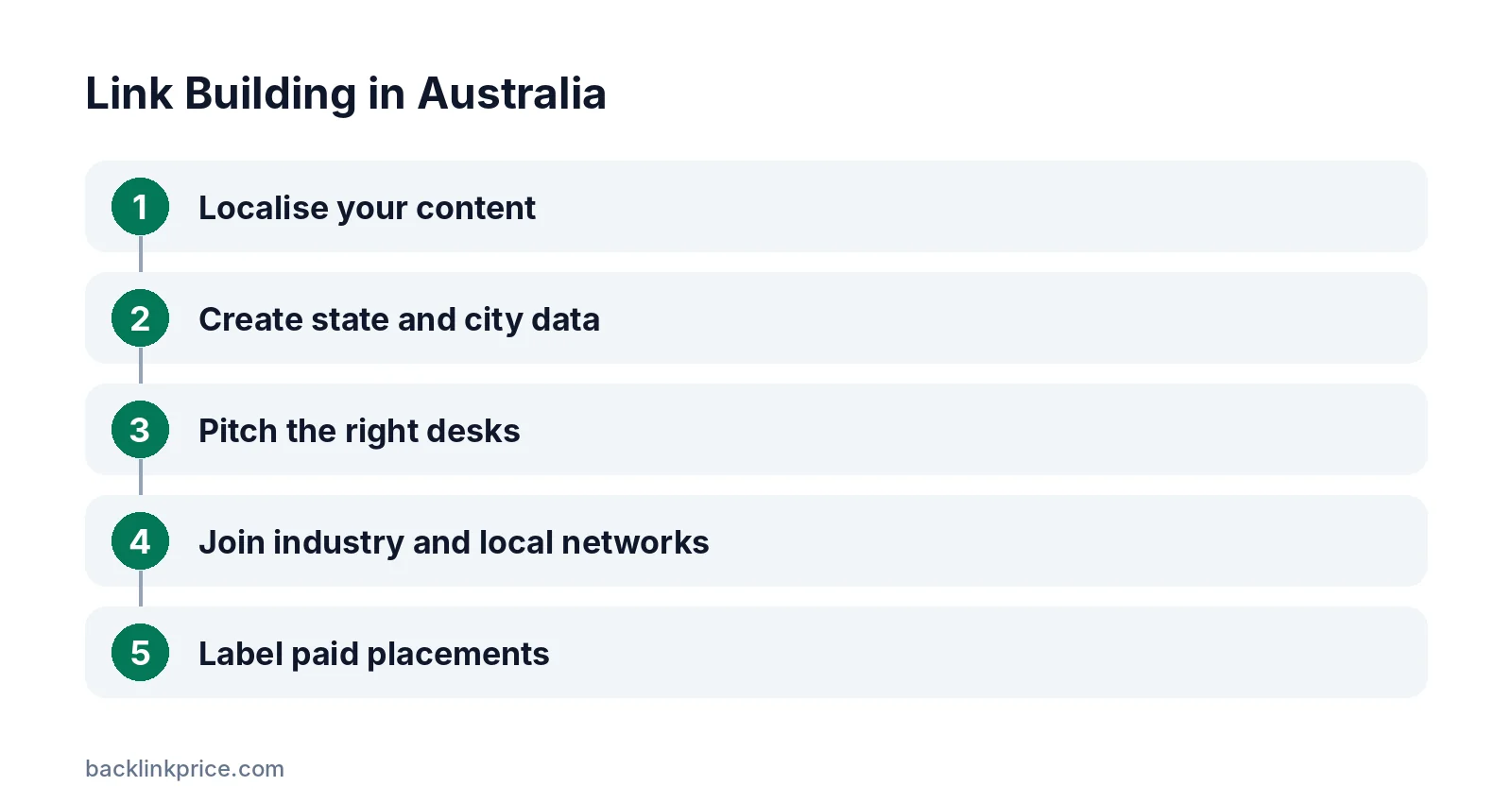
Step 1: Localise your content
Use Australian spelling, prices in Australian dollars, local laws, and Australian sources. Content that clearly targets Australians is more likely to be cited by local writers.
Step 2: Create state and city data
Survey Australians or analyse public data, then break results down by state and capital city. Each region gives local media a reason to cover it.
Our guide on how to get backlinks with original research explains survey design.
Step 3: Pitch the right desks
Pitch national, metro, regional, and trade journalists separately with angles that fit each. Cision's 2025 survey found 86% of journalists reject pitches mainly for lack of relevance.
Step 4: Join industry and local networks
Join chambers of commerce and industry associations, and contribute to their events, panels, or member newsletters. These often lead to directory listings and articles.
Read how to get local backlinks for more local ideas.
Step 5: Label paid placements
If you pay for a sponsored article, make sure it is clearly labelled as advertising and that the links are qualified with sponsored or nofollow. Don't ask publishers to disguise paid content as editorial.
Why brand mentions matter for Australian AI search
Coverage helps both rankings and AI answers.
An Ahrefs study of 75,000 brands found branded web mentions correlated at 0.664 with AI Overview visibility, compared with 0.218 for backlinks. Being named by Australian publications builds both.
Learn more in what is a brand mention in AI search.
Working with Australian agencies and freelancers
Ask for proof and agree on rules.
Ask for live examples of links built, and check those sites' real Australian traffic and relevance yourself. Agree in writing which tactics are allowed and that paid placements will be labelled.
Be cautious of fixed price lists for high-authority links on unrelated sites. They often rely on link networks with little genuine audience.
Common mistakes in Australian link building
These mistakes waste effort.
- Using American spelling and examples for Australian audiences.
- Building only overseas links to rank in Australia.
- Ignoring regional media and trade titles.
- Accepting vague labels on sponsored content.
- Buying links on sites with no real Australian audience.
Google's spam policies treat buying links that pass ranking credit as link spam.
Seasonal angles for Australian campaigns
Australia's calendar differs from the northern hemisphere.
Summer falls over Christmas and the new year, and the financial year ends on 30 June. Campaigns about holidays, tax time, or seasonal spending should follow the Australian calendar, not American or European timing.
Local events, school holidays, and state-specific public holidays also create timely hooks for regional media.
How to measure results
Track Australian results separately from other markets.
- Referring domains from Australian sites and .au domains.
- Rankings in Google Australia and Bing for target terms.
- Organic traffic from Australia by state.
- Coverage in national, regional, and trade media.
Use how to track backlinks to set up reports.
Frequently Asked Questions
Do I need .com.au links to rank in Australia?
Not exclusively, but relevant Australian links help. A mix of links from Australian publications, organisations, and relevant international sites is normal. Relevance and audience matter more than the domain ending.
Does Bing matter in Australia?
Yes, more than in many countries. Statcounter measured Bing at 8.74% of Australian search overall in July 2026 and 16.56% on desktop in August 2026.
Do sponsored articles need labels in Australia?
Yes. Section 2.7 of the AANA Code of Ethics says advertising shall be clearly distinguishable as such. Google also expects paid links to be marked sponsored or nofollow.
Does digital PR work in Australia?
Yes. Australia has national, metro, regional, and trade media that cover data-led stories. State and city breakdowns are a common way to earn coverage across many outlets.
What labels are clear enough for paid content?
Ad Standards has found posts in breach when a commercial relationship wasn't obvious, such as a small "thank you" tag on gifted products. Clear labels like "Advertisement" or "#ad" are safer.
Sources
- Statcounter: Search engine market share in Australia
- Statcounter: Desktop search engine market share in Australia
- DLA Piper: Influencer marketing according to AANA
- Clayton Utz: Cracking down on influencer ads (2021)
- Ad Standards: Case study on distinguishable advertising
- Ahrefs: AI Overview brand correlation study
- Cision: 2025 State of the Media takeaways
- Google Search Central: Spam policies

The BacklinkPrice Team researches backlink prices, publisher sites and link building tools. We check prices and plans against each provider's own pages and date them, so you know how current the numbers are.
More from BacklinkPrice TeamRelated guides