Link Building for Dentists: A Practical Guide for Dental Practices
How dental practices earn local links from schools, sponsorships, associations and local news, while keeping citations accurate and advertising ethical.
Link building for dentists means earning links from local, relevant sources such as schools, community sponsorships, dental associations, local news, and accurate business listings. These links help a practice rank in local search, while reviews and correct listings help patients choose it. All promotion should stay truthful under ADA advertising standards.
Key takeaways
- Patients compare dentists online: an IronMonk survey of 1,500 Americans found 43.3% would pick the dentist with the best online reviews.
- AI tools are a new discovery channel: MouthWatch cites research that 47% of patients have used AI chatbots to find a healthcare provider.
- Local links from schools, sponsorships, and community groups matter more than generic links for most practices.
- Incorrect listings cost trust: BrightLocal found 62% of consumers would avoid a business with incorrect online information.
- The ADA Code says no dentist shall advertise in a way that is false or misleading.
Why links matter for dental practices
Links help your site rank, especially for competitive local terms.
Most dental searches are local, such as "dentist near me" or "emergency dentist in [city]". Links from local and relevant sites help Google see your practice as a trusted local business.
Reviews and links work together. Becker's Dental reported IronMonk's finding that 43.3% of respondents would choose a dentist based on online reviews, while 14.4% would choose the cheapest.
For the basics, read what is local link building.
Ethics and advertising rules for dentists
Keep every claim truthful and every endorsement real.
Section 5.F of the ADA Code of Professional Conduct says that, although any dentist may advertise, no dentist shall advertise or solicit patients in a manner that is false or misleading in any material respect.
The ADA's advertising guidance adds that endorsements and testimonials must reflect the endorser's actual opinion and experience, which covers online reviews and blogs.
State dental boards may have extra rules, so check yours. This is not legal advice.
Best link sources for dentists
Focus on sources tied to your community and profession.
| Source | How to earn the link | Effort |
|---|---|---|
| Local schools | Oral health talks, sponsorships of school events | Medium |
| Sports teams and clubs | Sponsor a youth team or event | Low to medium |
| Dental associations | Membership directories, speaking, committee work | Low |
| Dental schools | Alumni pages, mentoring, guest lectures | Medium |
| Local news | Expert comment, community stories, free care days | Medium |
| Business listings | Accurate profiles on major directories | Low |
| Suppliers and labs | Case studies or customer pages | Low |
Step-by-step: link building for a dental practice
Start with the easy local wins, then add content and PR.
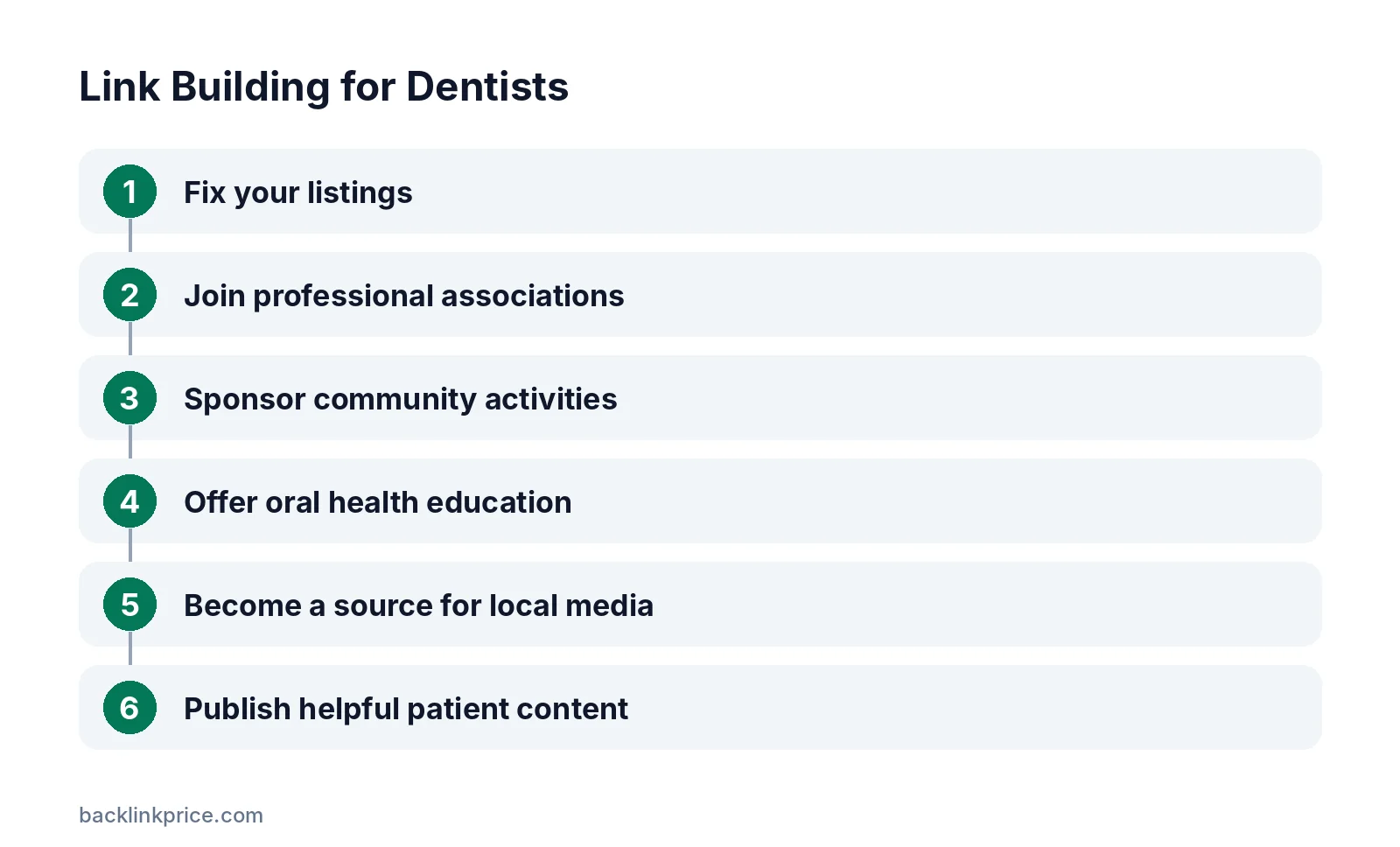
Step 1: Fix your listings
Make sure your name, address, and phone number match across major directories and your Google Business Profile. BrightLocal cites its 2023 finding that 62% of consumers would avoid a business with incorrect information online.
See local citations vs local backlinks for the difference between the two.
Step 2: Join professional associations
Local and state dental associations often list members. Speaking at meetings or writing for their newsletters can earn further mentions.
Step 3: Sponsor community activities
Youth sports, school fairs, and charity runs often thank sponsors on their websites. Choose causes your team actually supports.
Our guide on how to get backlinks from sponsorships explains how to ask for a link politely.
Step 4: Offer oral health education
Visit schools, senior centres, or community groups to give oral health talks. Organisers often post about the visit and link to the practice.
Step 5: Become a source for local media
Offer quick, accurate expert comment on topics like children's dental health, sugar, or sports mouthguards. Local reporters need reliable sources.
Read how to get backlinks from journalists for pitching tips.
Step 6: Publish helpful patient content
Write clear answers to common questions, such as what to do with a knocked-out tooth. Useful guides earn links from parenting blogs, schools, and local sites.
Link building and AI search for dentists
Patients are starting to ask AI tools for provider recommendations.
The MouthWatch 2026 dental marketing survey cites TechTarget research that 47% of patients have used AI chatbots like ChatGPT or Gemini to find a healthcare provider.
AI tools draw on reviews, listings, and mentions across the web. An Ahrefs study of 75,000 brands found brand mentions correlated with AI Overview visibility more strongly than backlinks did.
Content ideas that earn links for dentists
Useful, local, and specific content attracts the most links.
- A guide to dental emergencies, with what to do before reaching a dentist.
- A school-year checklist for parents covering check-ups and mouthguards.
- A plain-English explainer on insurance terms and common treatment costs in your area.
- A local oral health resource page listing community clinics and programmes.
Each of these gives schools, parents, and local sites a reason to link. Keep medical claims accurate and review content with a licensed dentist.
Most content earns no links, so quality matters. The Backlinko and BuzzSumo content study found 94% of posts had zero external links.
Mistakes dentists should avoid
These shortcuts can hurt rankings or reputation.
- Buying links from unrelated sites or link networks.
- Posting fake reviews or offering incentives that break platform rules.
- Using inconsistent practice names or old addresses across listings.
- Making claims about results you cannot support.
- Ignoring local sources in favour of national directories only.
Read how to get local backlinks for more ideas.
How to measure results
Track local outcomes, not just link counts.
- Referring domains from local and dental-related sites.
- Rankings for "dentist in [city]" and service terms.
- Calls, bookings, and direction requests from your Google Business Profile.
- New patients who say they found you online.
Frequently Asked Questions
How many backlinks does a dental website need?
There is no fixed number. It depends on how competitive your area is. A practice in a small town may rank with a handful of good local links, while one in a large city may need many more.
Are directory links useful for dentists?
Accurate listings on major directories help patients find correct details and support local trust. They are less valuable as links on their own, so combine them with community and media links.
Can dentists buy backlinks?
Buying links that pass ranking value breaks Google's spam policies and can lead to lost rankings. Paid placements should be marked sponsored or nofollow. Earned local links are safer and more useful.
Do online reviews help dental SEO?
Reviews strongly influence which dentist patients choose and are part of local search visibility. Ask real patients for honest reviews, and never write or buy fake ones.
Should a dental practice blog?
Yes, if the content answers real patient questions clearly and accurately. Helpful guides can earn links from schools, parenting sites, and local organisations over time.
Sources
- ADA: Principles of Ethics and Code of Professional Conduct, Section 5 (Veracity)
- ADA: Legal and ethical advertising
- Becker's Dental: 43% of patients choose dentist based on online reviews
- MouthWatch: Dental practice marketing in 2026
- BrightLocal: How to manage business listings properly
- Backlinko: Content study
- Ahrefs: AI Overview brand correlation study

The BacklinkPrice Team researches backlink prices, publisher sites and link building tools. We check prices and plans against each provider's own pages and date them, so you know how current the numbers are.
More from BacklinkPrice TeamRelated guides