Link Building for Doctors: A Practical Guide for Medical Practices
How physicians and clinics earn trusted links from hospitals, medical societies, local media and patient education content, while staying ethical.
Link building for doctors means earning links from trusted, relevant sources such as hospital and health system profiles, medical societies, universities, local media, community health partners, and accurate directory profiles, supported by clear patient education content.
These links help a practice show authority in a field where Google and patients both demand trust. Every claim must be accurate and non-deceptive.
Key takeaways
- Patients research doctors online: rater8 found 84% of patients check online reviews before choosing a provider.
- AI is now a discovery channel: rater8's 2026 report found 36% of recent doctor-seekers named AI tools as a top influence.
- 75% of patients in that report said they wouldn't book with a doctor rated below 4.0 stars.
- The AMA Code of Medical Ethics allows physician advertising that is not false or deceptive.
- Medical links work best when they come from real professional and community relationships.
Why links matter for medical practices
Health topics need strong trust signals.
Medical searches affect people's health, so search engines look for signs of expertise and authority. Links from hospitals, societies, and respected media are strong signals.
Most physician searches are also local, such as "cardiologist near me". Read what is local link building for the basics.
How patients choose doctors online
Reviews, search, and now AI all play a role.
Medical Economics reported on a rater8 survey of more than 1,000 US patients. It found 84% check online reviews before selecting a new provider, and 61% prioritise reviews over referrals from friends and family.
The 2026 rater8 Patient Choice Report found 36% of recent doctor-seekers cited AI tools as a top influence, ahead of Google search results (34%) and doctor referrals (32%).
rater8's own 2025 report says more than half of patients read at least six reviews before booking. It describes online reviews as still foundational, with AI tools now added to how patients research providers.
Ethics and advertising rules for physicians
Truthful, non-deceptive promotion is the standard.
The AMA Code of Medical Ethics Opinion 9.6.1 says there are no restrictions on physician advertising except those that can be justified to protect the public from deceptive practices. Statements about patient satisfaction should be representative of the physician's patients.
Never use fake reviews, invented testimonials, or before-and-after claims you cannot support. State medical boards and privacy laws such as HIPAA also apply. This is not legal advice.
Best link sources for doctors
Focus on professional and community relationships.
| Source | How to earn the link | Effort |
|---|---|---|
| Hospital and health system profiles | Keep affiliated physician profiles current with a practice link | Low |
| Medical societies | Membership directories, committees, speaking | Low to medium |
| Universities and medical schools | Teaching, research, alumni profiles | Medium |
| Local media | Expert comment on health stories | Medium |
| Community partners | Health fairs, school talks, charity events | Medium |
| Physician directories | Accurate profiles on major platforms | Low |
| Conferences and podcasts | Speaker pages and episode notes | Medium |
Step-by-step: link building for a medical practice
Start with the links you already deserve.
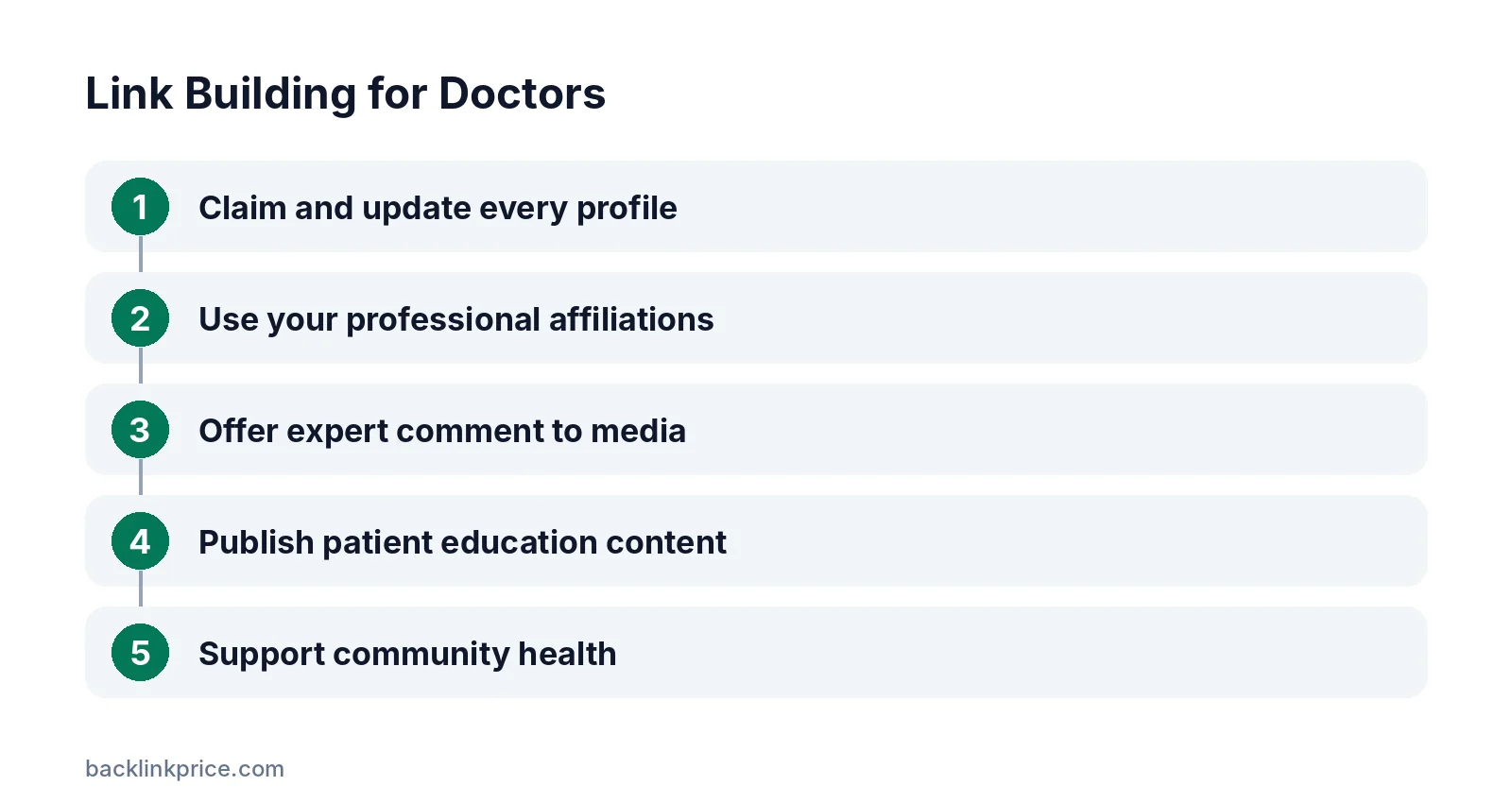
Step 1: Claim and update every profile
Check hospital, insurer, society, and directory profiles. Make sure your name, address, phone, and website link are correct everywhere.
See local citations vs local backlinks to understand the difference.
Step 2: Use your professional affiliations
Ask the hospitals, groups, and societies you belong to whether they can link to your practice from your profile. These are among the most trusted links available.
Step 3: Offer expert comment to media
Local and health reporters need qualified sources. Offer short, accurate comment on seasonal and trending health topics.
Read how to get backlinks from journalists for pitching tips.
Step 4: Publish patient education content
Write clear guides that answer common patient questions, reviewed by a physician. Useful guides earn links from schools, community groups, and health bloggers.
Step 5: Support community health
Health fairs, school talks, and charity runs often credit partners online. Choose causes your practice genuinely supports.
Our guide on how to get backlinks from sponsorships explains the approach.
Reviews and links work together
Reputation affects both rankings and bookings.
The 2026 rater8 report, covered by MediaPost, found 75% of respondents would not book with a doctor rated below 4.0 stars. It also found 55% had walked away from at least one doctor because of online reviews.
Ask real patients for honest reviews, and respond professionally and briefly without disclosing any health information.
Content ideas that earn links for doctors
Answer the questions patients and local groups actually ask.
- What to expect before, during, and after a common procedure.
- Seasonal health guides, such as allergy or flu season tips.
- A guide for schools or coaches on recognising a health issue.
- Plain-language explainers of common test results.
Have a physician review each piece and show the reviewer's name and credentials. Clear authorship helps readers and other sites trust the content.
Mistakes doctors should avoid
These shortcuts damage trust.
- Buying links from unrelated or spammy sites.
- Posting fake reviews or paying for positive ones.
- Making claims about outcomes that are not representative.
- Leaving outdated addresses or phone numbers on directories.
- Publishing health content without physician review.
Google's spam policies treat buying links that pass ranking credit as link spam.
How to measure results
Track patient-facing outcomes.
- Referring domains from medical and local sites.
- Rankings for specialty and location searches.
- Calls, bookings, and direction requests from your Google Business Profile.
- New patients who found you online.
For local link ideas, read how to get local backlinks.
Frequently Asked Questions
What are the best backlinks for a doctor's website?
Links from hospitals, health systems, medical societies, universities, and respected local media are among the most valuable. They are relevant, trusted, and hard to fake.
Can doctors advertise online?
Yes. The AMA Code of Medical Ethics allows physician advertising that is not false or deceptive. State medical boards and privacy laws also apply, so check your local rules.
Do online reviews affect a doctor's SEO?
Reviews strongly affect which doctor patients choose and are part of local search visibility. Encourage honest reviews from real patients and never post fake ones.
Should a medical practice publish blog content?
Yes, if the content is accurate, reviewed by a physician, and answers real patient questions. Helpful guides can earn links from schools and community organisations over time.
How long does link building take for doctors?
Profile and affiliation links can appear within weeks. Media coverage and content-driven links usually take several months to build up.
Sources
- AMA Code of Medical Ethics: Opinion 9.6.1 Advertising and Publicity
- Medical Economics: Patients trust online reviews, but they don't leave them (February 2025)
- Medical Economics: Patients now shop for doctors like consumers (2026 rater8 report)
- MediaPost: Patients' use of AI to find doctors doubles
- rater8: The Next Evolution of Patient Choice (2025)
- Google Search Central: Spam policies

The BacklinkPrice Team researches backlink prices, publisher sites and link building tools. We check prices and plans against each provider's own pages and date them, so you know how current the numbers are.
More from BacklinkPrice TeamRelated guides