Link Building in Germany: A Practical Guide for 2026
Use native German content and outreach, earn links from relevant German sites, and label any paid content as Anzeige or Werbung under German law.
Link building in Germany works best with German-language content, links from relevant .de sites, and outreach written by native speakers, while following strict German rules on labeling paid content as "Anzeige" or "Werbung". German publishers expect a clear Impressum, accurate data, and formal, respectful communication, and they react badly to generic English outreach.
Key takeaways
- Google dominates search in Germany: Statcounter measured an 88.49% share in August 2026, with Bing at 5.84%.
- Links from German-language, topically relevant sites matter more for German rankings than English links.
- German law requires paid content to be clearly identifiable as advertising; courts and lawyers recommend the labels "Anzeige" or "Werbung" at the start.
- Outreach should be in native German, usually with the formal "Sie", and should reference the recipient's specific content.
- Digital PR with German data, local business associations, and industry portals are strong link sources.
How link building in Germany differs
The fundamentals are the same as anywhere, but language, law, and culture change the details.
- Language: Links from German-language pages send clearer relevance signals for German keywords.
- Law: Paid content must be labeled as advertising under the Unfair Competition Act (UWG).
- Trust: German sites are expected to have an Impressum (legal notice), and publishers check yours.
- Tone: Formal, precise outreach works better than casual, salesy messages.
For general international principles, see do links from foreign-language sites help.
How people search in Germany
Google is the main target, but Bing still matters for some audiences.
Statcounter's data for Germany put Google at 88.49% of search engine market share in August 2026, with Bing at 5.84%. Bing's share is higher on desktop, so B2B audiences may see more Bing traffic.
Bing also feeds some AI assistants, so a site that ranks in Bing may get more AI visibility. See how to get your site indexed in Bing.
Labeling rules for paid links in Germany
Paid placements must be clearly marked as advertising. German law, mainly the Unfair Competition Act (UWG), requires that commercial intent be recognizable.
Hogan Lovells notes that German case law has found "sponsored by" may not be adequate, and recommends the German words "Anzeige" or "Werbung" at the beginning of the content. A Mondaq summary of German case law describes a court holding that "Sponsored by" was insufficient and that "Anzeige" had to be used.
This applies to sponsored articles, advertorials, and paid guest posts. It also aligns with Google's rule that paid links should use rel="sponsored" or nofollow, as explained in Google's guide to qualifying outbound links. This is not legal advice; check with a German lawyer for your case.
Where to get links in Germany
Use this table to plan sources.
| Source | Examples | Notes |
|---|---|---|
| Industry portals and trade media | Sector magazines and portals | Strong relevance, often editorial |
| Business associations | IHK (chambers of commerce), industry associations | Member directories and events |
| Local media | Regional newspapers and city portals | Local data and community stories |
| Universities and research | Hochschulen, research institutes | Partnerships, studies, guest lectures |
| Blogs and communities | Niche German blogs | Native outreach required |
| Data journalism outlets | National and regional news | Digital PR with German data |
Step-by-step: building links in Germany
Plan the campaign for German audiences from the start.
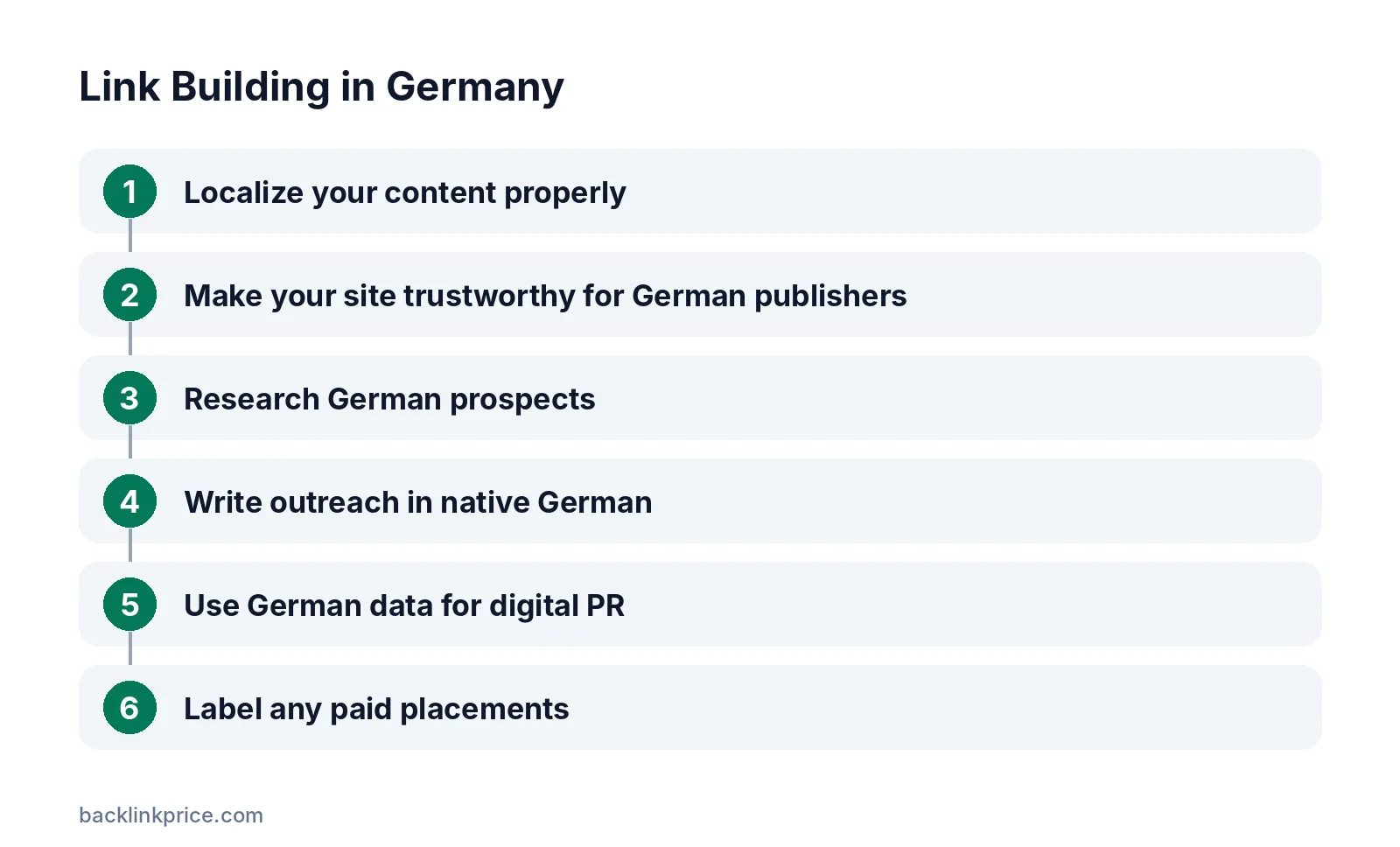
Step 1: Localize your content properly
Translate and adapt content with native writers. Use German examples, prices in euros, and local sources.
Machine translation without editing is easy to spot. If you run several language versions, follow Google's guidance on managing multi-regional and multilingual sites.
Step 2: Make your site trustworthy for German publishers
Add a clear Impressum, privacy policy, and German contact details. Publishers often check these before linking.
Step 3: Research German prospects
Find German sites that link to competitors, German resource pages, and trade portals. Use backlink tools filtered to German-language or .de sites.
See how to analyze competitor backlinks for the method.
Step 4: Write outreach in native German
Use the formal "Sie" unless the site is clearly informal. Be precise about what you offer and why it helps their readers.
Expect low reply rates and plan follow-ups. Backlinko's study of 12 million outreach emails found an 8.5% response rate overall, and personalized emails did better than generic ones.
Step 5: Use German data for digital PR
Run surveys of German consumers or businesses, or analyze public German data. National and regional media cover data stories with a local angle.
Regional angles work especially well because Germany has strong regional media in each federal state. Our guide on how to get backlinks with original research explains how to structure a study.
Step 6: Label any paid placements
If you pay for content, make sure it is labeled "Anzeige" or "Werbung" and that links are qualified. Do not ask publishers to hide advertising.
Common mistakes
These mistakes slow link building in Germany.
- Sending English outreach to German publishers.
- Using machine translation without editing.
- Ignoring Impressum and data protection expectations.
- Asking for unlabeled paid articles.
- Building links only from .com or English sites to rank in Germany.
- Using casual tone with formal publishers.
How to measure results
Track German results separately from other markets.
- Referring domains from German-language and .de sites.
- Rankings in Google.de for target keywords.
- Organic traffic from Germany in your analytics.
- Coverage in German media.
To fit Germany into a wider plan, read how to create a link building strategy.
Frequently Asked Questions
Do I need .de backlinks to rank in Germany?
Not exclusively, but relevant German-language links help a lot. A mix of links from .de sites, German-language pages on other domains, and relevant international sites is normal. Relevance and language matter more than the domain ending alone.
Is buying links legal in Germany?
Paying for placements is not illegal in itself, but the content must be clearly labeled as advertising under German law. Google also expects paid links to be marked sponsored or nofollow. Unlabeled paid links carry both legal and SEO risk.
Should outreach emails use "Sie" or "du"?
Use "Sie" by default, especially for businesses, media, and B2B sites. Some startups, gaming, or lifestyle blogs use "du", so mirror the tone on their site if it is clearly informal.
What content earns links in Germany?
German-language data studies, practical guides adapted to German rules and prices, local rankings, and expert commentary on German news. Content that cites German sources and shows local knowledge performs better than translated international content.
Does Bing matter in Germany?
It matters less than Google, but it is not zero. Statcounter measured Bing at 5.84% of search market share in Germany in August 2026, with higher shares on desktop. Bing also feeds some AI assistants.
Sources

The BacklinkPrice Team researches backlink prices, publisher sites and link building tools. We check prices and plans against each provider's own pages and date them, so you know how current the numbers are.
More from BacklinkPrice TeamRelated guides