How to Get Backlinks from Conference Speaking: Step-by-Step (2026)
Land talks at relevant events, then make sure the speaker page, agenda, recap posts, and your slides page all link back to you.
You get backlinks from conference speaking by landing talks at relevant events, then making sure every page about your talk links to you: the speaker page, the agenda, the recap post, the slides, and any press coverage. One talk can produce several links if you plan for them before, during, and after the event.
Key takeaways
- A single talk can create 3 to 6 link opportunities: speaker profile, session page, sponsor or partner page, recap articles, slide hosts, and media coverage.
- Smaller industry events and meetups accept new speakers more easily and still publish speaker pages.
- Call-for-speakers platforms such as Sessionize list open calls, so you can find events months ahead.
- Brand mentions from events add to how AI tools see your company; Ahrefs found branded web mentions correlated at 0.664 with AI Overview visibility in a 2025 study.
- The link is a by-product: organizers link to speakers who give strong, useful talks and help promote the event.
What conference speaking links are
Conference speaking links are links to you from pages connected to a talk you give at an event. They are editorial links, because the organizer chose you to speak.
Common link sources include:
- Your speaker profile on the event website.
- The session or agenda page for your talk.
- Event recap and "key takeaways" articles by organizers and attendees.
- Slide and video hosting pages, such as the event's YouTube channel.
- News coverage or trade press about the event.
Virtual events, webinars, and local meetups produce the same types of pages on a smaller scale.
Why speaking is worth it for link building
Speaking earns links that most competitors cannot buy, from sites that are relevant to your industry. Event sites often have good authority because sponsors, speakers, and media link to them.
Talks also create brand mentions in context. In an Ahrefs study of 75,000 brands published in 2025, branded web mentions had the strongest correlation with AI Overview visibility (0.664), well above backlinks (0.218).
For the trust side, see how to build E-E-A-T with backlinks.
When this tactic fits
Speaking fits businesses with real expertise and someone willing to present. It works well for SaaS, agencies, consultants, B2B services, and professional firms.
It fits poorly if no one on your team can speak confidently or if your industry has very few events. Webinars and podcasts are good alternatives in that case; see how to get backlinks with webinars.
Step-by-step: how to get backlinks from conference speaking
Plan the links from the start, not after the talk.
Step 1: Find events that fit your audience
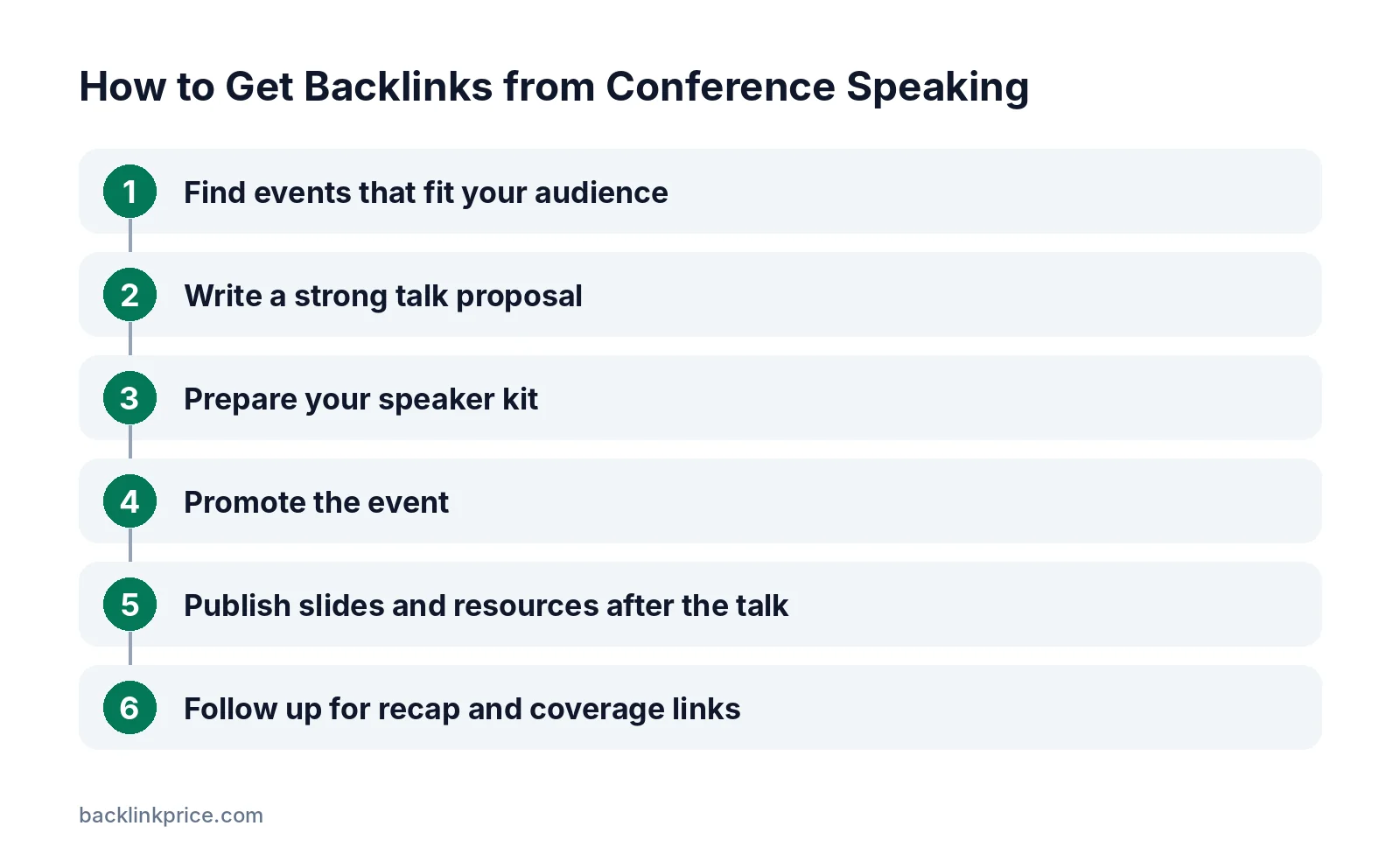
List industry conferences, trade shows, local meetups, and virtual summits your customers attend. Search "[industry] conference call for speakers" and "[industry] call for papers".
Platforms such as Sessionize and PaperCall list open calls for speakers, especially for tech events.
Step 2: Write a strong talk proposal
Organizers want useful, specific talks, not sales pitches. A good proposal has:
- A clear title that promises one outcome.
- A short abstract of 100 to 200 words.
- 3 takeaways attendees will leave with.
- Your bio with relevant experience.
Data you own makes a proposal stand out. See how to get backlinks with original research for ideas.
Step 3: Prepare your speaker kit
Once accepted, send organizers a speaker kit: headshot, short bio, company name, and the exact URL you want linked. Use your brand name or your personal author page as the link.
Many organizers copy what you send, so a clean kit means a clean link.
Step 4: Promote the event
Share the session on your site, newsletter, and social channels. Organizers notice speakers who help sell tickets, and they are more likely to invite them back and feature them in recaps.
Add the event to an "Events" or "Speaking" page on your own site, linking to the event page.
Step 5: Publish slides and resources after the talk
Host your slides and resources on a page on your site. Give the organizer and attendees one URL to share, such as yourdomain.com/talks/event-name.
This page often earns links from recap posts, because writers want a source for the slides.
Step 6: Follow up for recap and coverage links
Thank the organizers and ask whether they will publish recaps or videos. Send your resources page for inclusion.
Warm contacts reply far more often than cold ones. For comparison, Backlinko's study of 12 million cold outreach emails found an 8.5% response rate.
Search for recap posts by attendees a week later, then contact authors who mention your talk but do not link. Our guide on how to turn unlinked mentions into links explains the outreach.
Where speaking links come from
Use this table as a checklist after every event.
| Link source | When it appears | Who to contact | Likely value |
|---|---|---|---|
| Speaker profile | Weeks before the event | Event organizer | Steady, relevant |
| Session or agenda page | Before the event | Event organizer | Relevant |
| Event recap post | 1 to 2 weeks after | Organizer, attendees | High if it links to your slides |
| Video page | Weeks after | Event media team | Medium |
| Trade press coverage | Around the event | Journalists covering it | High |
| Your own speaking page | Any time | You | Internal and referral value |
Common mistakes
These mistakes cost speakers their links.
- Sending a sales pitch as a talk proposal.
- Forgetting to send a bio with your URL.
- Linking your bio to a keyword-stuffed sales page.
- Not publishing slides on your own site.
- Ignoring recap posts that mention you without a link.
- Paying for a speaking slot and expecting it to be treated as editorial.
Paid speaking slots are sponsorships. Google expects paid links to be marked, as explained in its guide to qualifying outbound links.
How to measure results
Track each talk as a small campaign.
- Links from the speaker page, agenda, recaps, and coverage.
- Referral visits to your talk resources page.
- Leads or sign-ups from attendees.
- New invitations to speak or appear on podcasts.
Review results after each event. Over a year, you will see which events bring links and business, and which only bring applause. To keep track of links over time, see how to track backlinks.
Frequently Asked Questions
Do conference speaker pages give dofollow links?
Many do, but each event decides. Check the live speaker page with your browser's Inspect tool. Even when a link is nofollow, a speaker profile still adds a relevant brand mention and can lead to recap posts and interviews that do link.
How do I get my first speaking opportunity?
Start small. Local meetups, online webinars, and niche virtual summits accept new speakers more easily than major conferences. Each talk builds a speaking history and a recording you can use when you apply to bigger events.
Should I pay to speak at a conference?
Paid speaking slots are sponsorships, not editorial selection. They can still be worth it for leads and visibility, but any links that come from the deal should be treated as paid and marked accordingly by the organizer.
What should my speaker bio link to?
Link to your homepage or your personal author page on your company site. An author page works well because it shows your expertise and other content. Avoid keyword-rich anchors and links to sales pages, which look unnatural in a bio.
How long after the talk should I follow up?
Send a thank-you within a day or two, with a link to your slides and resources. Then search for recap posts about a week after the event, and contact authors who mention your talk without linking to your resources page.
Sources

The BacklinkPrice Team researches backlink prices, publisher sites and link building tools. We check prices and plans against each provider's own pages and date them, so you know how current the numbers are.
More from BacklinkPrice TeamRelated guides