How to Get Backlinks from Integration Partners: A Practical Guide
Build a real integration, then ask partners to list it in their marketplace, help docs, and launch content. Avoid link-swap partner pages.
You get backlinks from integration partners by building a real integration, then asking each partner to list it in their app marketplace, integration docs, and launch content. These links are natural because they help shared customers find a working connection. They only cross the line when the "partnership" exists mainly to swap links.
Key takeaways
- An integration partner is a company whose product connects with yours, such as a CRM that syncs with your email tool.
- Partner links usually come from 4 places: marketplace listings, help docs, co-marketing content, and partner directories.
- Big platforms run open directories; Zapier's developer page says integrations connect to 9,000+ apps.
- Google's spam policies name "partner pages exclusively for the sake of cross-linking" as a link scheme, so keep links tied to a real integration.
- Measure partner links by installs and sign-ups as well as by referring domains.
What integration partner links are
Integration partner links are links from companies whose products connect to yours, placed where their users look for that connection. They are a type of partnership link building.
Typical examples include:
- A listing in a partner's app marketplace or integrations page.
- A help-center article explaining how to connect both tools.
- A launch blog post, newsletter mention, or changelog entry.
- A case study featuring a customer who uses both products.
These links are relevant by nature. The partner links to you because their users need your product to complete a workflow.
Why integration links are worth pursuing
Integration links are relevant, stable, and often come from strong domains. They also bring users who are ready to install.
Large platforms treat integrations as a growth channel. Zapier's developer platform promotes access to its Partner Program and connections to 9,000+ apps. Zapier's own history of reaching 5,000 apps in 2022 describes how partners go through a beta and launch process.
Marketplaces like the Shopify App Store and Slack Marketplace also list apps with their own pages. Each listing is a page that buyers search and that AI assistants can read.
When this approach works
It works best for software, plugins, and services that genuinely connect to another product. It also works for agencies certified by a platform, which often get a listing in the platform's partner directory.
It does not work if you have no real integration. Building a fake "partner page" to trade links is exactly what Google warns about.
Step-by-step: how to earn links from integration partners
Follow the order below: build value first, then ask for visibility.
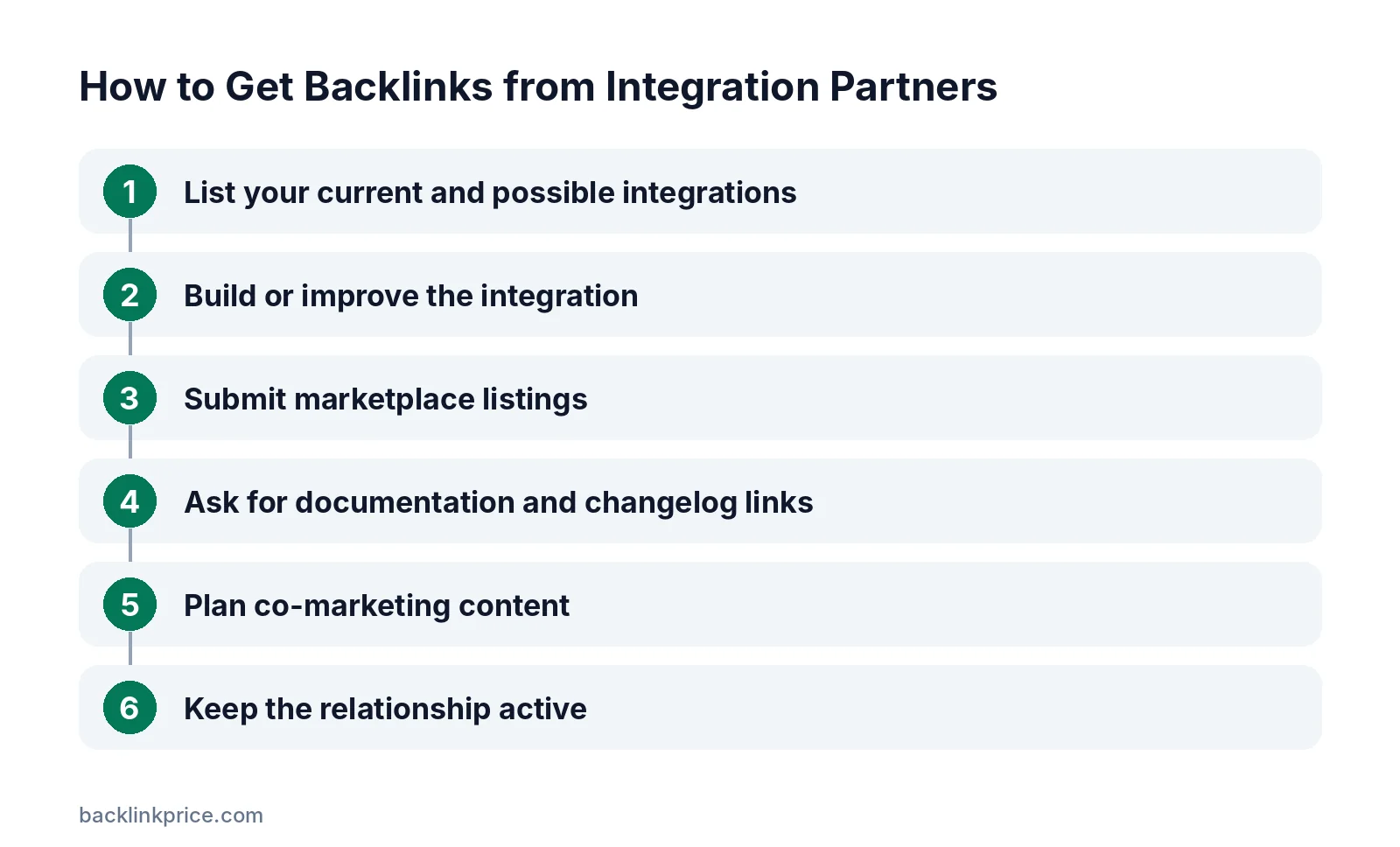
Step 1: List your current and possible integrations
Write down every tool your product connects with, natively or through a connector such as Zapier or Make. Add tools your customers ask for most.
Sort the list by customer demand and partner size.
Step 2: Build or improve the integration
A useful, documented integration is the foundation. Publish setup docs on your site and keep them current.
For marketplaces, read the listing requirements before you build. Most require a working app, support contact, privacy policy, and screenshots.
Step 3: Submit marketplace listings
Submit to each partner's marketplace or integrations directory. Write a clear description of what the integration does and who it is for.
Some listings link to your site with a followed link, some with nofollow, and some only to an install flow. That is fine. See dofollow vs nofollow links for what each means.
Step 4: Ask for documentation and changelog links
Partner support teams often write help articles that mention connected tools. Offer a ready-made setup guide they can adapt.
Ask to be included in their changelog or "new integrations" post when you launch.
Step 5: Plan co-marketing content
Propose a joint webinar, a shared template, or a customer case study. Each piece gives both sides a reason to link.
If you want a model for outreach emails, read how to write a link building outreach email.
Step 6: Keep the relationship active
Share usage numbers, customer feedback, and product updates with your partner contact every quarter. Active partners are more likely to feature you in future content.
Where partner links come from
This table shows the most common sources, what you need, and the usual link type.
| Link source | What you need | Typical effort | Usual link |
|---|---|---|---|
| App marketplace listing | Approved app, docs, screenshots | Medium | Varies by platform |
| Integrations page on partner site | Working integration | Low | Often followed |
| Partner help docs | Setup guide, support contact | Low | Often followed |
| Launch post or changelog | New integration or major update | Low | Varies |
| Co-marketing content | Webinar, case study, template | High | Often followed |
| Partner or agency directory | Certification or partner tier | Medium | Varies |
Google's rules on partner links
Partner links are fine when they reflect a real relationship and help users. They become risky when the main purpose is to pass ranking value.
Google's spam policies list "excessive link exchanges" and "partner pages exclusively for the sake of cross-linking" as examples of link spam.
Keep partner links in context, on pages that explain the integration. If a partner asks for a reciprocal sitewide footer link, decline. Our guide on are reciprocal links bad explains where the line sits.
Common mistakes
These are the errors that waste partner goodwill.
- Asking for links before the integration is live.
- Creating a "partners" page full of logos with no real integrations.
- Requesting exact-match keyword anchors.
- Letting docs go out of date, so partners remove the link.
- Ignoring the partner's own launch process and brand rules.
- Treating partners as link sources instead of as relationships.
How to measure results
Measure partner links by business impact first, links second.
- Installs or activations from each marketplace listing.
- Referral visits and sign-ups from partner pages.
- New referring domains from partner content.
- Links lost when partners redesign their sites. See how to monitor lost links.
Review the numbers every quarter and put more effort into the partners whose users convert.
Frequently Asked Questions
Are links from integration partners safe?
Yes, when they come from a real integration and sit on pages that explain it. Google warns against partner pages created only for cross-linking and excessive link exchanges. Keep links contextual, avoid sitewide reciprocal footers, and let the integration itself be the reason for the link.
Do app marketplace listings give dofollow links?
It depends on the platform, and policies change. Some marketplaces link to your website with a followed link, some use nofollow, and some only link to an install page. Check each listing with your browser's Inspect tool, and value it for installs as well as links.
What if a partner wants a link back?
Linking back to a real partner from your integrations page or setup docs is normal and helpful for users. Avoid trading links in footers, sidebars, or unrelated blog posts. If the only reason for the link is the swap itself, skip it.
How long does it take to get listed in a marketplace?
It varies by platform. Some approve listings in days, while larger marketplaces run review and beta stages that can take several weeks. Read the partner's developer documentation early, because their requirements can affect how you build the integration.
Can small companies get partner links from big platforms?
Yes, many large platforms run open marketplaces that any approved app can join. Start with the platforms your customers already use, build a reliable integration, and follow their listing process. Bigger co-marketing opportunities usually come later, once your app has active users.
Sources

The BacklinkPrice Team researches backlink prices, publisher sites and link building tools. We check prices and plans against each provider's own pages and date them, so you know how current the numbers are.
More from BacklinkPrice TeamRelated guides