How to Get Backlinks from Your Employees' Profiles: A Practical Guide
Help staff build real public profiles, then earn links through author bios, speaker pages, and podcast appearances that mention your company.
You get backlinks from your employees' profiles by helping staff build real public profiles, such as author bios, speaker pages, podcast guest pages, and community profiles, that mention where they work and link to your site. Most social profile links are nofollow, so the real value comes from the editorial pages those profiles lead to.
Key takeaways
- Employee profile links come from 2 layers: owned profiles (LinkedIn, GitHub, X) and earned profiles (author bios, speaker pages, interviews, podcast pages).
- Owned profile links are usually nofollow, but they confirm who your people are and where they work.
- Earned profiles on other sites often include a followed link and a brand mention in context.
- Google's helpful content guidance asks "who created the content", so clear author identities support trust.
- Never pressure staff to post links; make it optional, easy, and good for their own careers.
What employee profile backlinks are
Employee profile backlinks are links to your website that appear on pages about the people who work for you. They connect a real person's public identity with your company.
They fall into 2 groups:
- Owned profiles: LinkedIn, GitHub, X, Medium, community forums, and personal websites.
- Earned profiles: author bios on guest articles, speaker pages at events, podcast guest pages, expert quotes, and award or association member pages.
Owned profiles are quick wins with low SEO weight. Earned profiles take more effort but carry more value.
Why employee profiles matter for links and trust
Employee profiles show search engines and readers that real experts stand behind your company.
Google's guidance on creating helpful, reliable content asks site owners to consider "who" created content and to make authorship clear. Pages about your staff help answer that question across the web.
Brand mentions also matter for AI search. In an Ahrefs study of 75,000 brands from 2025, branded web mentions showed the strongest correlation (0.664) with brand visibility in AI Overviews.
For more on trust signals, see how to build E-E-A-T with backlinks.
Owned vs earned employee profiles
This table shows where the links come from and what to expect.
| Profile type | Examples | Usual link type | Main value |
|---|---|---|---|
| Professional network | LinkedIn profile, company page | Usually nofollow | Identity, referral visits |
| Developer platforms | GitHub profile, README | Varies | Credibility for technical brands |
| Publishing platforms | Medium, Substack profile | Varies | Content reach |
| Guest author bios | Bio on an industry blog | Often followed | Relevant editorial link |
| Speaker pages | Conference or webinar page | Often followed | Authority, event audience |
| Podcast guest pages | Show notes, guest profile | Varies | Brand mention, audience |
| Associations and awards | Member or winner pages | Often followed | Trust, local or industry relevance |
Step-by-step: how to earn links through employee profiles
Run this as a light "visible experts" program, not as a link quota.
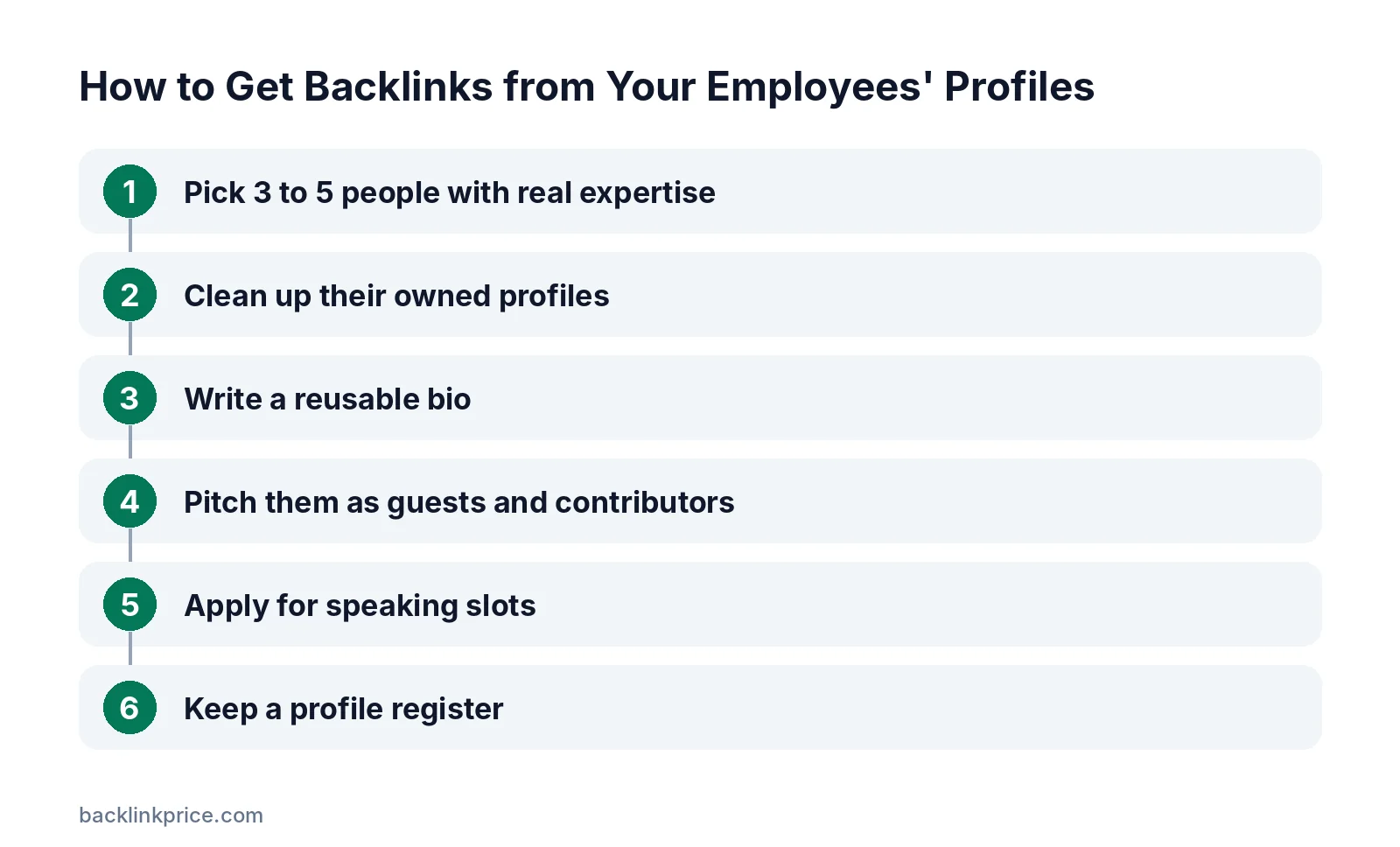
Step 1: Pick 3 to 5 people with real expertise
Choose staff who know a topic well and are willing to be public. Founders, product leads, engineers, and senior consultants are common choices.
Step 2: Clean up their owned profiles
Help them add your company name and website to LinkedIn and other profiles. Make sure job titles are accurate and consistent.
For technical staff, GitHub lets users add a website and company to their public profile.
Create author pages on your own site for each person, with a short bio and links to their profiles. Google's article structured data guidelines explain how to mark up author information.
Step 3: Write a reusable bio
Prepare a 2-sentence bio and a headshot for each expert. Include their role and your company name with a link to your homepage or their author page.
This bio becomes the text they use for guest posts, events, and podcasts. For guest articles, see how to write a guest post that gets accepted.
Step 4: Pitch them as guests and contributors
Pitch your experts for guest articles, podcasts, webinars, and expert quotes. Each appearance usually comes with a bio link.
Our guide on how to get backlinks from podcasts covers the podcast side in detail.
Expect most pitches to go unanswered at first. In Backlinko's study of 12 million outreach emails, only 8.5% received a reply.
Step 5: Apply for speaking slots
Industry events, meetups, and webinars often publish speaker pages with links. Start with smaller events and build a speaking history. More ideas are in how to get backlinks from events.
Step 6: Keep a profile register
Track every public profile and appearance in one sheet. Update bios when people change roles, and ask hosts to update links if your URL changes.
How to treat employees fairly in this program
Employee advocacy works only when it is voluntary and benefits the employee.
- Make participation optional.
- Let employees approve every bio and appearance.
- Give credit: share their articles and talks internally and publicly.
- Do not ask staff to post links in forums or comments to promote the company.
- Remove company links from bios when someone leaves, if they ask.
If staff post about your products on social media, the FTC's Endorsement Guides FAQ explains that employees should disclose their connection to the company.
Common mistakes
These mistakes waste effort or create risk.
- Creating fake employee profiles or fake authors.
- Stuffing keyword anchors into staff bios.
- Spamming forums with employee accounts.
- Using one generic bio for everyone.
- Forgetting to update bios when titles or URLs change.
- Treating nofollow social links as the main goal.
How to measure results
Measure the program by earned appearances and the links they bring.
- Number of guest articles, podcasts, talks, and quotes per quarter.
- Referring domains from those appearances.
- Referral traffic to author pages and the homepage.
- New brand mentions. See how to track brand mentions in ChatGPT for the AI side.
Review the numbers every quarter and give the most active experts more support.
Frequently Asked Questions
Do LinkedIn profile links help SEO?
They help very little with rankings, because profile links on large social platforms are usually nofollow. They are still useful: they confirm identity, send some referral traffic, and connect your brand with real people. Treat them as a foundation, not as a link building tactic.
Should employees link to the homepage or a specific page?
Usually the homepage or the employee's author page on your site. An author page works well because it shows their expertise and links to their content. Avoid linking bios to sales pages with keyword anchors, which can look manipulative.
Is it safe to ask employees to add links to their profiles?
Yes, if it is optional and accurate. Adding a real employer and website to a public profile is normal. Problems start when staff are pushed to post links in forums, comments, or unrelated profiles, or when bios are stuffed with keywords.
Do speaker pages give dofollow links?
Often, but not always, since each event or host decides how it links. Check the live page with your browser's Inspect tool. Even a nofollow speaker link helps with brand mentions and can lead to further invitations and coverage.
How many employees should be part of the program?
Start with 3 to 5 people who have real expertise and want visibility. A small group that appears regularly brings better results than a large group that never publishes. Add more people once you have a working process.
Sources
- Google Search Central: Creating helpful, reliable, people-first content
- Google Search Central: Article structured data
- Ahrefs: AI Overview brand visibility factors, 75K brands (2025)
- FTC: Endorsement Guides, what people are asking
- Backlinko: Email outreach study of 12 million emails
- GitHub Docs: Personalizing your profile

The BacklinkPrice Team researches backlink prices, publisher sites and link building tools. We check prices and plans against each provider's own pages and date them, so you know how current the numbers are.
More from BacklinkPrice TeamRelated guides