How to Get Included in Roundup Posts: A Step-by-Step Guide
Find active weekly link roundups and expert roundups in your niche, then pitch fresh, useful content or fast, specific answers at the right time.
To get included in roundup posts, find blogs that publish weekly link roundups or expert roundups in your niche, then send them something worth featuring at the right time. For link roundups, that is a strong new piece of content. For expert roundups, it is a quick, specific answer to the question they are asking.
Key takeaways
- A roundup post is an article that collects links, tips, or quotes from several sources on one topic, usually on a fixed schedule.
- There are 2 main types: link roundups (weekly or monthly lists of the best content) and expert roundups (quotes from several people on one question).
- In an Ahrefs poll from 2022, 43.9% of people who ran expert roundups said backlinks were their main goal, so contributors are often linked.
- Timing matters more than polish: pitch link roundups a few days before they publish, and answer expert requests within 24 to 48 hours.
- Most content earns no links at all, which is why a steady roundup habit can be a useful source of links.
What a roundup post is
A roundup post is a regular article that gathers the best links, tips, or opinions on one topic in one place. Bloggers use them to give readers a digest and to build relationships with other creators.
Link roundups are lists of recommended articles, often titled "Weekly roundup", "Friday links", or "Best of the month". The curator adds a short note and a link for each item.
Expert roundups ask several people the same question and publish their answers side by side. Ahrefs describes expert roundups as posts that feature quotes from industry experts about a specific topic.
Both formats link out by design, which is why they are popular with link builders. For a wider view of link types, see what makes a good backlink.
Why roundups are worth your time
Roundups are one of the few places where linking to others is the whole point of the page. That makes them easier to get into than standard articles.
Most content earns very few links. In a Backlinko and BuzzSumo analysis of 912 million blog posts, 94% of posts had zero external links.
Roundup curators, by contrast, need fresh content every week. In the Ahrefs poll on expert roundups, 43.9% of respondents said links were their main reason for running one, and 36.8% said relationships.
Roundup links are usually smaller wins than a feature in a major publication. Their value comes from consistency, relevance, and the relationships they start.
When roundups fit and when they don't
Roundups fit best in niches with active blogs and newsletters, such as marketing, tech, personal finance, parenting, and hobbies. They fit poorly in niches where few people publish regularly.
They also need a steady supply of content. If you publish one article per quarter, you will run out of things to pitch.
Use roundups as one part of a wider plan. Our guide on how to create a link building strategy shows where they fit next to other tactics.
Step-by-step: how to get into roundup posts
The process is find, qualify, time, pitch, and follow up. Each step takes less time than standard outreach because curators actively want submissions.
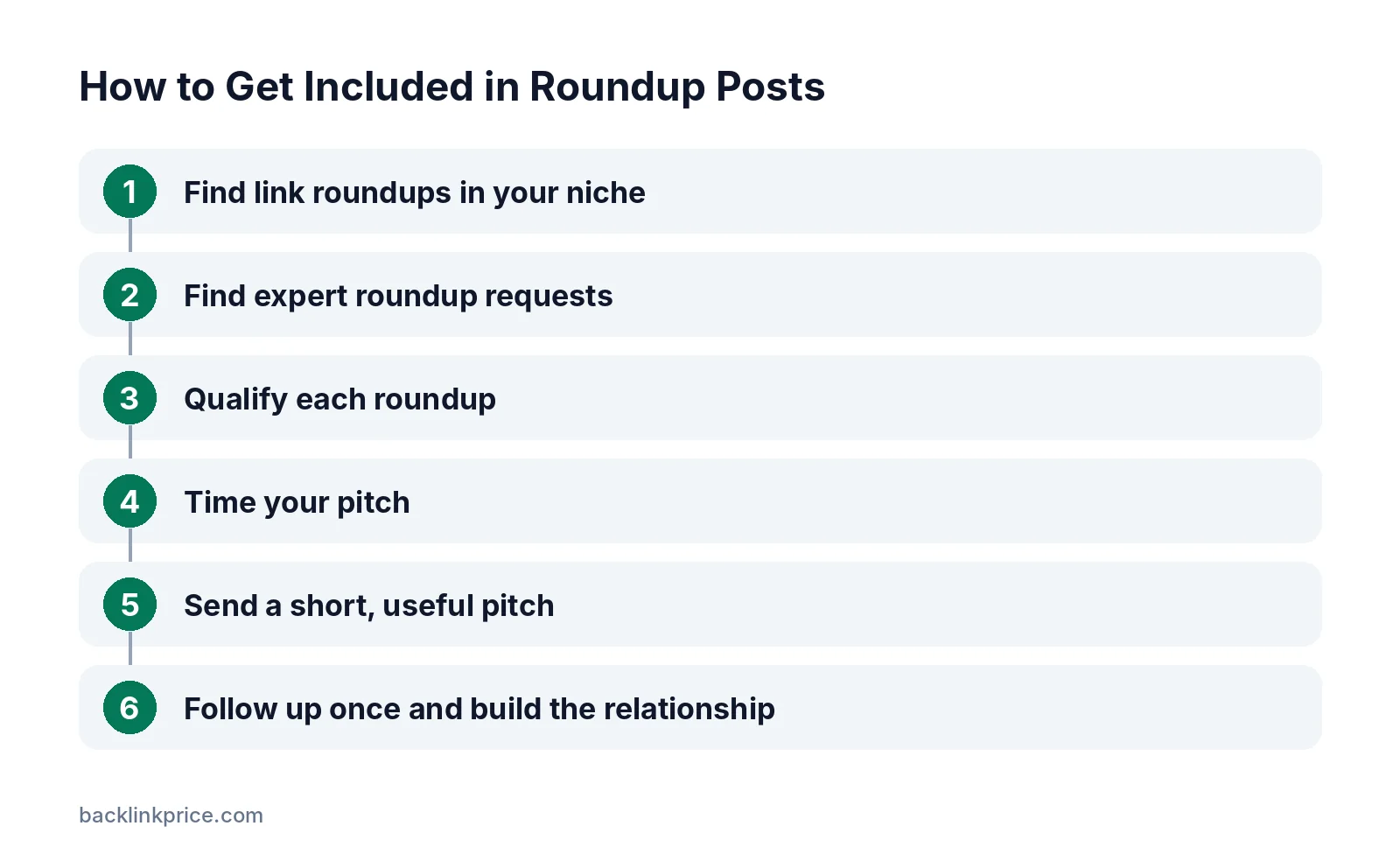
Step 1: Find link roundups in your niche
Use Google search operators to find them. Try queries like these, replacing "keyword" with your topic:
- keyword "weekly roundup"
- keyword "link roundup"
- keyword intitle:roundup
- keyword "best of the week"
Google's own guide to refining searches explains how quotes and operators narrow results.
Step 2: Find expert roundup requests
Expert roundups are usually built from requests, not searches. Watch these sources:
- Journalist and expert request platforms such as Qwoted, Featured, and Help a B2B Writer.
- Relevant LinkedIn and X posts asking for "quick quotes" or "tips for a roundup".
- Newsletters in your niche that collect expert answers.
Set alerts so you see requests within hours, not days.
Step 3: Qualify each roundup
Check that the roundup is still active, published in the last 1 to 2 months, and relevant to your topic. Look at what it links to.
If it links to obvious paid placements or unrelated casino or loan sites, skip it. Our checklist on how to vet a guest post site works for roundups too.
Step 4: Time your pitch
Note the publishing day. If a roundup goes live every Friday, pitch on Tuesday or Wednesday with content published that week.
For expert roundups, speed wins. Many curators close a request after they have enough answers.
Step 5: Send a short, useful pitch
For a link roundup, include the curator's name, the roundup name, one link, and one sentence on why it suits their readers. Our guide to writing a link building outreach email covers subject lines.
For an expert roundup, answer the exact question in 50 to 150 words, add a one-line bio, and include a headshot link if asked. Do not attach a sales pitch.
Step 6: Follow up once and build the relationship
Send one short follow-up if you have not heard back after a week. When you get featured, thank the curator and share the roundup.
Repeat curators are the real win. After 2 or 3 good submissions, many will start contacting you first.
Tools, time, and cost
You can run a roundup program with free tools and about 2 to 4 hours per week. Paid tools mainly speed up discovery and tracking.
| Task | Free option | Paid option | Weekly time |
|---|---|---|---|
| Find link roundups | Google search operators | Ahrefs Content Explorer | 30 to 60 minutes |
| Find expert requests | LinkedIn, X searches | Qwoted, Featured | 30 to 60 minutes |
| Track curators and dates | Google Sheets | Outreach CRM | 15 minutes |
| Write pitches | Outreach tool templates | 1 to 2 hours | |
| Monitor new links | Google Search Console | Ahrefs or Semrush alerts | 15 minutes |
Common mistakes
Most roundup pitches fail for the same few reasons.
- Pitching old content that the curator could have found months ago.
- Sending one generic email to every curator without naming their roundup.
- Answering expert questions with vague or promotional text.
- Missing the deadline because alerts were not set up.
- Pitching roundups that have stopped publishing.
- Asking for a dofollow link instead of offering useful content.
How to measure results
Track each roundup as a small campaign so you can see which curators send real value.
Record these per pitch:
- Date pitched, roundup name, and URL.
- Featured or not, and the live URL.
- Link status and attribute (dofollow, nofollow, or sponsored).
- Referral traffic from the roundup in Google Analytics.
Review the sheet monthly. Keep pitching curators who feature you and send traffic, and drop the rest. To check new links, see how to track backlinks.
Frequently Asked Questions
Are roundup links good for SEO?
They can be, because a relevant, editorially chosen link from an active blog is a normal, natural link. The value depends on the site's quality and relevance. Links from roundups on low-quality sites that link to anything have little value and are not worth chasing.
How often should I pitch roundups?
Pitch whenever you publish something genuinely useful, which for most sites is once or twice a month. For expert roundups, respond to every relevant request you can answer well. Consistency matters more than volume, because curators remember reliable contributors.
Do I need to pay to get into a roundup?
No, most roundups are free and editorial. If a curator asks for payment, the placement is advertising, and Google expects paid links to be marked as sponsored or nofollow. Decide whether the audience is worth it as an ad rather than as an SEO link.
What is the difference between a roundup and a listicle?
A roundup collects other people's content or opinions, often on a schedule. A listicle is any article structured as a list, such as a list of tools or tips. A "best of" listicle is closer to a review page, while a roundup is closer to a digest.
How long should an expert roundup answer be?
Aim for 50 to 150 words unless the curator gives a limit. Answer the exact question, include one specific tip or example, and skip the self-promotion. Short, quotable answers are easier for the curator to use and more likely to be placed near the top.
Sources

The BacklinkPrice Team researches backlink prices, publisher sites and link building tools. We check prices and plans against each provider's own pages and date them, so you know how current the numbers are.
More from BacklinkPrice TeamRelated guides