How to Get Featured on Comparison Pages: What Actually Works
Target the X vs Y and alternatives pages that rank for your competitors, then give each author accurate facts, pricing, and free access to test.
To get featured on comparison pages, target the "X vs Y" and "X alternatives" pages that already rank or get cited for your competitors, then give each author accurate, checkable facts about your product. Offer a clean feature and pricing summary, free access to test, and a clear reason readers would choose you.
Key takeaways
- A comparison page puts 2 or more products side by side, usually as "X vs Y" or "best alternatives to X".
- These pages catch buyers late in their research, so a mention can send both a link and qualified traffic.
- Authors need facts they can verify: public pricing, a feature list, review profiles, and test access.
- Google's review guidance asks comparison content to cover comparable products and explain what sets each apart.
- Track inclusion, link attributes, referral visits, and whether AI answers start naming you for "alternatives" questions.
What counts as a comparison page
A comparison page is any article or landing page that evaluates products against each other for the same job. The 3 most common formats are:
- "X vs Y" pages, which compare 2 named products.
- "X alternatives" pages, which list options for people leaving a product.
- Comparison tables inside guides, such as "Feature comparison of the top 5 tools".
Software review sites also generate comparison pages automatically. G2's compare tool, for example, lets buyers put products side by side.
Comparison pages differ from "best of" lists in intent. A "best of" list helps someone discover options. A comparison page helps someone who has a shortlist choose.
Why comparison pages are worth targeting
Comparison pages sit close to the buying decision, so they influence real choices. People who read "X vs Y" usually already know the category and are close to buying.
Software buyers research heavily before talking to vendors. A 2026 Gartner Digital Markets survey of 1,588 U.S. software buyers found that most read reviews and compare options before they contact a vendor.
AI assistants lean on comparison content too. In Ahrefs' study of 26,283 ChatGPT source URLs from December 2025, "best X" list pages were the most common page type cited, and vendor landing pages were often cited for software questions.
For the AI side of this, read how to get mentioned in AI answers.
Step-by-step: how to get onto comparison pages
Follow these steps in order, and keep a sheet so nothing is pitched twice.
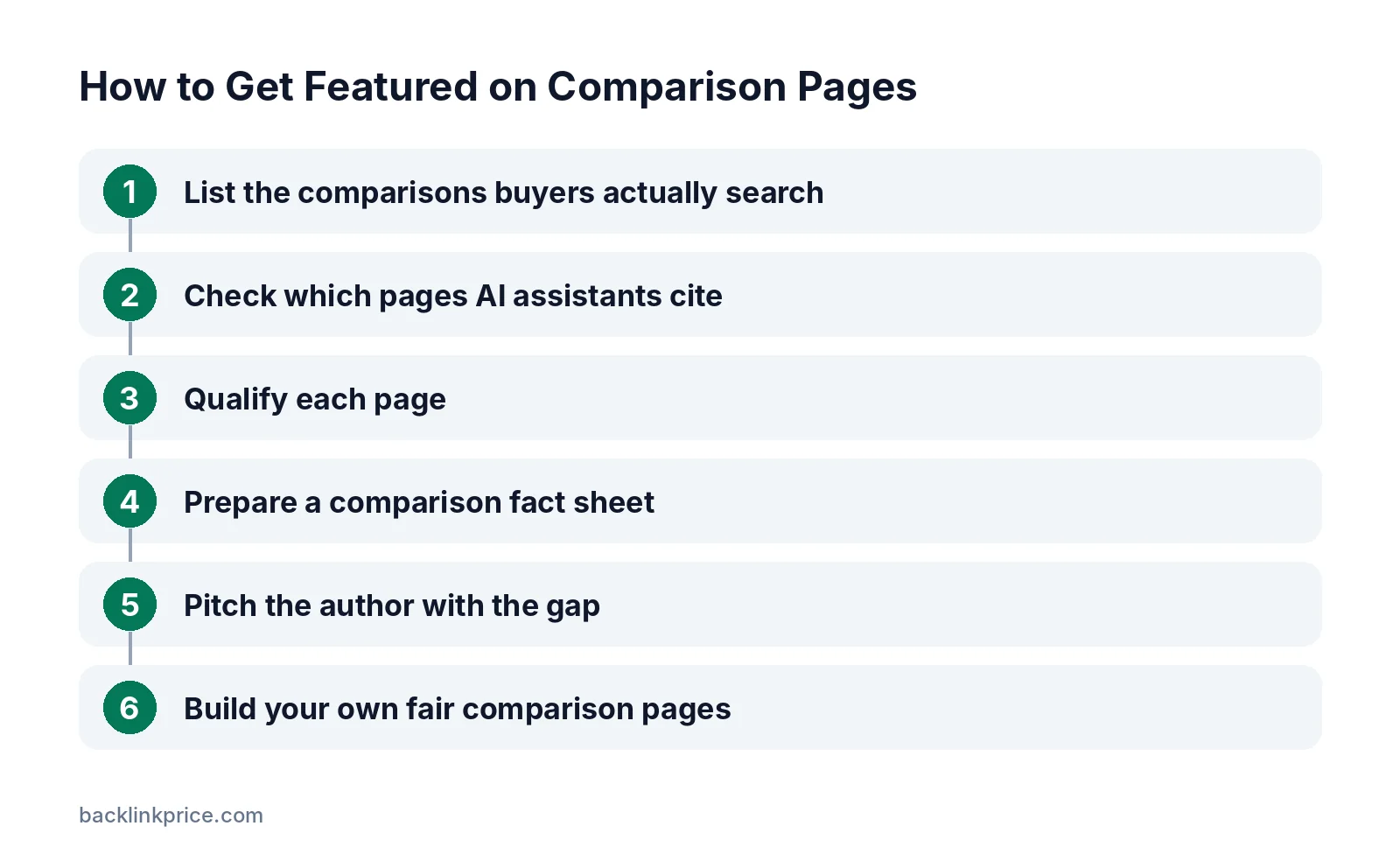
Step 1: List the comparisons buyers actually search
Start with your top 3 to 5 competitors. For each, search:
- "[competitor] vs"
- "[competitor] alternatives"
- "[competitor] competitors"
Google's autocomplete and "People also ask" boxes show which comparisons people look for. Record pages on page one.
You can also see who links to your rivals with competitor backlink analysis.
Step 2: Check which pages AI assistants cite
Ask ChatGPT, Perplexity, and Google's AI Overviews the same questions, such as "What are the best alternatives to [competitor]?" Note the sources they show.
Pages that appear in both Google and AI answers go to the top of your list.
Step 3: Qualify each page
Keep pages that are maintained, show a real author, and compare products fairly. Drop pages that exist only to sell placements.
Check traffic and links with an SEO tool. Our guide on how to check a website's traffic before buying a link explains which numbers to trust.
Step 4: Prepare a comparison fact sheet
Authors save time when you give them accurate data. Create a one-page sheet with:
- Pricing plans and the link to your public pricing page.
- Top 5 features, with links to documentation.
- Integrations and limits (users, storage, contacts).
- Review ratings, with links to your profiles.
- The type of customer you fit best and worst.
Being honest about where you are weaker builds trust. Authors notice when a vendor admits a limit.
Step 5: Pitch the author with the gap
Name the page, point out the missing option, and attach the fact sheet. Offer full test access.
Expect a low reply rate and plan for follow-ups. In Backlinko's study of 12 million outreach emails, only 8.5% got a response.
For email structure, see how to write a link building outreach email.
Step 6: Build your own fair comparison pages
Publish your own "you vs competitor" pages with accurate tables and links to sources. Authors often use these as research, and some link to them directly.
Google's guidance on high-quality reviews recommends covering comparable products and explaining what makes each one different.
Correcting wrong information on comparison pages
Many comparison pages contain outdated pricing or features, and a polite correction is a strong reason to contact the author.
Send the exact sentence that is wrong, the correct fact, and a link that proves it. Keep it neutral. Authors are more likely to update when you make it easy and do not demand anything else.
Fixing errors also protects you in AI answers, which can repeat outdated facts from popular pages.
What a good comparison entry contains
This table shows what authors usually need from you and why.
| What to provide | Example | Why authors want it |
|---|---|---|
| Public pricing link | Pricing page with plan names | Prices change often and must be current |
| Feature list | Top 5 features with doc links | Lets them build accurate tables |
| Test account | Full access for 30 days | Supports first-hand evaluation |
| Review profiles | G2 or Capterra page | Independent proof of user satisfaction |
| Best-fit statement | "Best for teams under 10 users" | Helps them place you correctly |
| Known limits | "No on-premise version" | Makes the comparison fair and credible |
Common mistakes
These errors waste pitches and can damage your reputation with authors.
- Sending only marketing copy without facts or links.
- Exaggerating features or hiding pricing.
- Asking authors to remove a competitor.
- Pitching pages where your product does not fit the comparison.
- Offering payment for a "neutral" comparison without disclosure.
- Forgetting to update authors when pricing changes.
How to measure results
Measure comparison pages by influence, not only by links.
- Number of pages that include you, and your position.
- Links gained and their attributes. See dofollow vs nofollow links for what each means.
- Referral traffic and sign-ups from those pages.
- Whether AI answers name you for "[competitor] alternatives".
Check the pages every quarter. Many authors refresh comparisons once or twice a year.
Frequently Asked Questions
Can I get added to a competitor's own comparison page?
Rarely, and usually only if they already list several alternatives. Some companies publish honest "alternatives" pages to build trust, but most will not promote a rival. Focus on independent publishers, review sites, and agencies that write neutral comparisons instead.
Should I create my own "vs" pages?
Yes, if you keep them fair and factual. Your own comparison pages can rank for competitor terms, help sales teams, and give independent authors a source to cite. Include a dated comparison table and link to each product's official pricing and documentation.
What if a comparison page has wrong information about my product?
Email the author with the exact wrong sentence, the correct fact, and a link that proves it. Keep the message short and neutral. Most authors want accurate content and will update it, especially when the correction is quick to make.
Do comparison pages help with AI search visibility?
They can. AI assistants often cite list and comparison pages when users ask for alternatives or recommendations. Being described accurately on several independent comparison pages gives AI systems more sources that mention your product in the right context.
How often should I check comparison pages?
Check your most important pages every quarter and after any pricing or product change. Keep a list of pages that mention you, with the date you last checked them. This makes it easy to send corrections quickly.
Sources
- Gartner Digital Markets: 2026 Software Review Trends
- Ahrefs: Do Self-Promotional "Best" Lists Boost ChatGPT Visibility? (December 2025)
- Google Search Central: Write high quality reviews
- Google Search Central blog: Product review ranking, one year on (2022)
- G2: Compare software products
- Backlinko: Email outreach study of 12 million emails

The BacklinkPrice Team researches backlink prices, publisher sites and link building tools. We check prices and plans against each provider's own pages and date them, so you know how current the numbers are.
More from BacklinkPrice TeamRelated guides