How to Get Backlinks from Your Customers: A Step-by-Step Guide
Give customers a real reason to link, such as a case study, spotlight, or badge, ask after a win, and never trade discounts for links.
You get backlinks from your customers by giving them something worth linking to: a case study about their results, a badge or certificate they are proud to show, a tool page they already reference, or a feature in your content. Ask at the moment they are happiest, make linking easy, and never require a link in exchange for a discount.
Key takeaways
- Customer links work best when they come from a real reason to mention you, such as a case study, an award, or a "built with" credit.
- The best moment to ask is right after a success, such as a launch, a renewal, or a strong result.
- Google's spam policies warn against keyword-rich links embedded in widgets and "powered by" footers, so keep anchors branded and use nofollow where Google asks for it.
- Paying or discounting in exchange for links or reviews creates risk with Google and, for reviews, with the FTC.
- Most content never earns a link on its own; a Backlinko and BuzzSumo study of 912 million posts found 94% had zero external links, so warm sources matter.
What customer backlinks are
Customer backlinks are links from websites run by the people and businesses that use your product or service. They point to you because you are part of their story, their stack, or their results.
Common examples include:
- A customer's case study or press page that names your company.
- A "tools we use" or "our partners" page.
- A blog post where a customer explains how they solved a problem with your product.
- A credit such as "website by" or "built with".
- An award badge or certification they display.
Because these sites already know you, the outreach is warm. That makes customer links one of the easiest link earning sources for most businesses.
Why customer links are valuable
Customer links are relevant, trusted, and hard for competitors to copy. A competitor cannot easily get a link from a site that buys from you.
They also beat waiting for links to arrive. In a Backlinko and BuzzSumo analysis of 912 million blog posts, 94% of posts had zero external links.
They also strengthen how AI assistants understand your brand. When many independent sites describe what your product does, AI tools have more sources to draw from. In an Ahrefs study of 75,000 brands from 2025, branded web mentions had the strongest correlation (0.664) with brand visibility in AI Overviews.
See do brand mentions without links help AI search for more of the evidence.
When to ask (and when not to)
Ask when a customer has just had a clear win. Good moments include:
- They hit a measurable result with your product.
- They renew, expand, or upgrade.
- They launch something you helped with.
- They leave a positive review or reply to a survey with a high score.
Do not ask during a support issue, right after a price increase, or when they are new and have no results yet.
Step-by-step: how to earn links from customers
Turn this into a light, repeatable process run by marketing and customer success together.
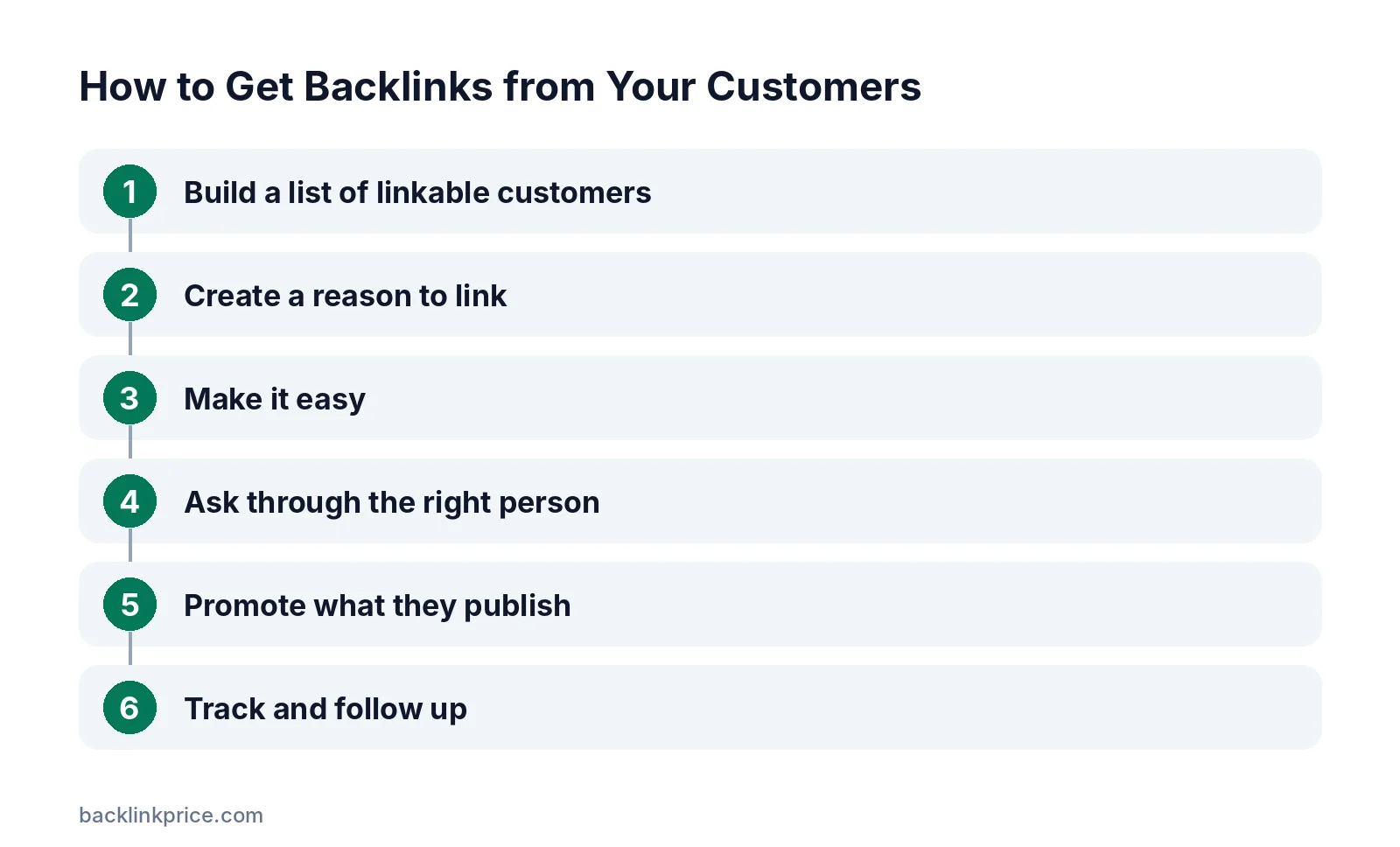
Step 1: Build a list of linkable customers
Export your customer list and keep accounts that have a website with a blog, news page, or resources section. Add notes on their results and who your main contact is.
Step 2: Create a reason to link
Pick the format that fits each customer:
- A co-written case study published on both sites. See how to get backlinks with case studies.
- A short customer spotlight in your blog or newsletter.
- A badge for a real milestone, such as "Certified partner" or "Customer of the year".
- A template or resource they can embed or reference.
Step 3: Make it easy
Send ready-to-use text, an image, and the exact URL you would like them to link to. Offer to draft their blog post for review.
Keep the anchor branded or descriptive, such as your company name. Exact-match keyword anchors look manipulative. Read how to choose anchor text for safe options.
Step 4: Ask through the right person
The account manager or founder who knows the customer should send the request. A warm email from a known contact gets far more replies than a cold one from marketing.
Step 5: Promote what they publish
Share their post, link to it from your case study, and mention it in your newsletter. Customers who get visibility from you are happy to repeat it.
Step 6: Track and follow up
Log the request, the result, and the live link. Follow up once after a week. Check links every quarter, because customer sites get redesigned often.
Rules to follow with badges, widgets, and incentives
Badges and "powered by" credits can earn links, but Google treats manipulative versions as link spam.
Google's spam policies list "keyword-rich, hidden, or low-quality links embedded in widgets that are distributed across various sites" and "widely distributed links in the footers or templates of various sites" as link spam.
Practical rules:
- Use your brand name as the anchor, not keywords.
- Do not hide links inside widgets or embeds.
- Do not make a link a condition for using your product.
- Do not offer discounts or payment in exchange for links.
For reviews, the FTC's rule on consumer reviews and testimonials took effect on October 21, 2024. It bans buying positive reviews and requires care with incentives.
Customer link ideas by business type
Use this table to choose the right angle for your business.
| Business type | Best customer link angle | Example page on the customer's site |
|---|---|---|
| SaaS | Case study or "tools we use" | /customers, /resources, blog post |
| Agency | "Website by" credit, case study | Footer credit, about page |
| Ecommerce supplier | Stockist or retailer listing | "Where to buy" page |
| Local service | Testimonial exchange, project feature | Blog post about a renovation |
| B2B manufacturer | Supplier or certified partner badge | Partners or certifications page |
Common mistakes
These mistakes turn a good tactic into wasted effort or risk.
- Sending a generic mass email to all customers.
- Asking for a link before the customer has seen results.
- Requesting keyword-rich anchors.
- Offering discounts for links.
- Forgetting to link back to the customer's story from your own site.
- Not checking whether links are still live after a few months.
How to measure results
Track customer links as a program, not as one-off wins.
- Requests sent, replies, and live links per quarter.
- Referring domains gained from customer sites.
- Referral traffic and leads from those pages.
- Lost links over time. See how to monitor lost links for a simple routine.
Compare results across angles. If case studies earn links 3 times as often as badges, shift your effort to case studies.
Frequently Asked Questions
Is it okay to ask customers for backlinks?
Yes, as long as the link is earned and optional. Asking a happy customer to mention you in a case study, partner page, or blog post is normal. Problems start when you require a link, pay for it, or push keyword-rich anchors.
Should "powered by" footer links be nofollow?
Google's spam policies treat widely distributed footer and template links as possible link spam. If your product places a credit link on every customer site, use a branded anchor and consider nofollow. Editorial mentions on a customer's own pages do not need this.
Can I offer a discount for a link?
It is better not to. A discount in exchange for a link is a form of payment, and Google expects paid links to be marked sponsored or nofollow. Offer visibility instead, such as featuring the customer in your content.
How many customer links can I expect?
It depends on your customer base and how many have active websites. A steady program that asks after clear wins often turns a small share of active customers into links each year. Track your own rate after the first quarter and adjust from there.
What anchor text should customers use?
Your brand name or a natural phrase such as "our email platform, [Brand]" works best. Avoid exact-match keywords like "best email marketing software". Branded anchors look natural and match how real customers talk about tools they use.
Sources

The BacklinkPrice Team researches backlink prices, publisher sites and link building tools. We check prices and plans against each provider's own pages and date them, so you know how current the numbers are.
More from BacklinkPrice TeamRelated guides