How to Pitch for Listicle Inclusion: What Actually Works
A good listicle pitch names the exact list, explains which reader it misses, and offers proof and free access in under 150 words.
A good listicle inclusion pitch is a short, personal email that names the exact list, explains which reader it misses, and offers proof the author can check in minutes. Keep it under 150 words, give free access for testing, and never ask for a ranking position or a hidden paid spot.
Key takeaways
- The pitch should answer 3 questions fast: which list, what gap, and why your product fills it.
- Authors favor products they can verify, and Google's review guidance asks reviewers to show first-hand evidence when they call something "the best".
- Under 150 words, one clear ask, and free test access is the format that gets read.
- Follow up once or twice, 4 to 7 days apart; most replies in large outreach studies come from emails that are short and specific.
- A placement you pay for is an ad, so it needs disclosure and a qualified link.
What a listicle inclusion pitch is
A listicle inclusion pitch is an outreach email asking the author of a list article to consider adding your product, service, or resource. The target is usually a "best X" or "top X tools" page.
The pitch is different from a guest post request. You are not asking to write anything. You are giving the author a reason to update their own content.
These pages matter for AI search as well as Google. In an Ahrefs study of 750 ChatGPT prompts and 26,283 source URLs, "best X" lists made up 43.8% of the page types cited. For the full research process, see how ChatGPT chooses which sources to cite.
Why most listicle pitches fail
Most pitches fail because they are generic, unverifiable, or ask for too much. Authors of popular lists receive many requests and ignore the ones that look templated.
Response rates for cold outreach are low in general. Backlinko's study of 12 million outreach emails found that only 8.5% received a response.
Common reasons a pitch is ignored:
- It does not name the list or show the sender read it.
- It claims "we are the best" without proof.
- It asks for the number 1 spot.
- It mentions payment or "link exchange" in the first email.
What to include in your pitch
Include only what helps the author decide quickly. Each element below should take one line.
- The exact list URL and title, so they know you read it.
- The gap, such as a missing budget option, a team size, an integration, or a use case.
- One proof point they can verify, like a public pricing page, a G2 or Capterra profile, or a named customer you have permission to mention.
- Free access to test the product, with no conditions.
- A one-sentence description they can adapt.
Software buyers lean heavily on reviews, so a review profile is strong proof. Gartner Digital Markets' 2024 Software Buying Behavior Survey found that most buyers read up to 10 reviews before buying.
Step-by-step: how to write and send the pitch
Work through these steps for every list, even when you use a template as a starting point.
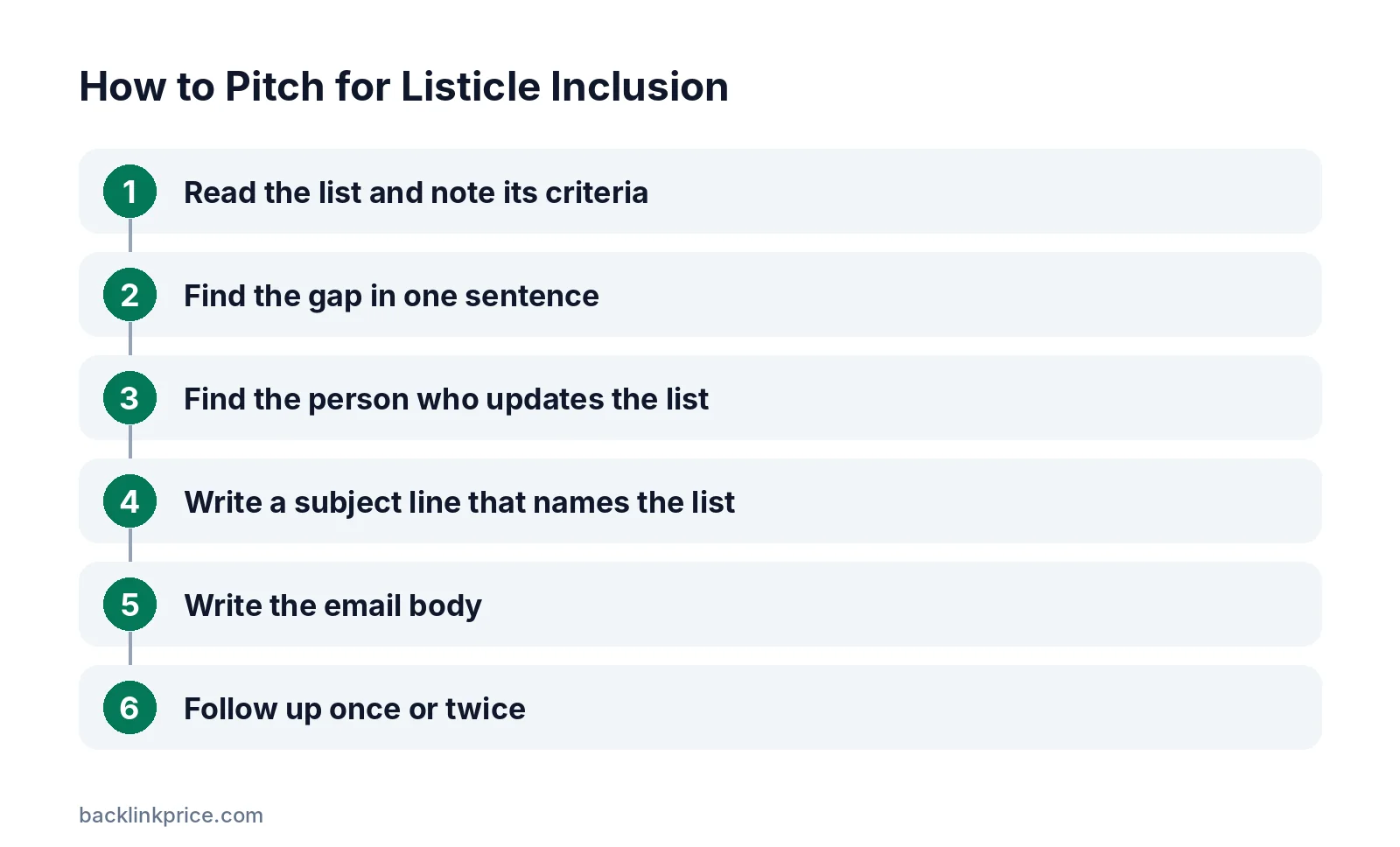
Step 1: Read the list and note its criteria
Look for how the author chose products. Many lists explain their method, such as pricing, ease of use, or integrations. Your pitch should match those criteria.
Google's guidance on writing high-quality reviews asks reviewers to explain why something is best, with first-hand evidence. Authors who follow it will want to test your product.
Step 2: Find the gap in one sentence
Write the gap as a reader problem. For example: "Your list has no option for teams under 5 people that need a free plan."
If you cannot find a real gap, do not pitch that list yet.
Step 3: Find the person who updates the list
Check the byline, author page, and LinkedIn. Editors and content leads often own updates on company blogs.
For tools and methods, see how to find email addresses for outreach.
Step 4: Write a subject line that names the list
Keep it plain and specific, such as "A small-team option for your CRM list". Avoid "Partnership opportunity" or "Quick question". More examples are in how to write a link building outreach email.
Step 5: Write the email body
Use this structure, then rewrite it in your own words for each list:
- Line 1: Their list and one specific thing you liked.
- Line 2: The gap you noticed.
- Line 3: How your product fills it, with one proof link.
- Line 4: An offer of free access and help with screenshots.
- Line 5: A simple "Would it be useful if I sent access?"
Step 6: Follow up once or twice
Send one follow-up after 4 to 7 days, adding something new such as a short demo video. Stop after the second follow-up.
Our guide on how to follow up on outreach emails covers timing and wording.
An example pitch
Here is a short example you can adapt. The product and details are placeholders.
| Part | Example text |
|---|---|
| Subject | A free-plan option for your "best invoicing tools" list |
| Opening | Hi Sam, your invoicing list saved me time comparing late-fee features. |
| Gap | It doesn't include a tool with a free plan for freelancers who send under 5 invoices a month. |
| Fit + proof | Our app has a permanent free tier (pricing page link) and 300+ reviews on Capterra (profile link). |
| Offer | Happy to set up a full account for you to test, plus screenshots if helpful. |
| Ask | Would that be useful for your next update? |
Paid inclusion, disclosure, and Google's rules
If an author asks for money, treat the placement as advertising. That changes what both of you must do.
Google's spam policies treat buying links for ranking as link spam. Paid links should use rel="sponsored" or rel="nofollow".
The FTC's rule on consumer reviews and testimonials took effect on October 21, 2024. It bans fake reviews and buying positive reviews. For more on paid placements, read is buying backlinks safe.
Common mistakes
Avoid these and your reply rate will rise.
- Copy-pasting the same email to 100 authors.
- Pitching a list your product clearly does not fit.
- Sending a sales deck instead of access.
- Asking to replace a competitor.
- Making unverifiable claims, such as "trusted by thousands".
- Following up more than twice.
How to measure your pitch performance
Track pitches like a small sales pipeline. Log every email and outcome in a sheet.
Measure:
- Open rate and reply rate per template version.
- Inclusions per 10 pitches.
- Links gained, with their attributes.
- Whether the list later appears in AI answers for your category.
Test one change at a time, such as a new subject line or proof point, so you know what improved results.
Frequently Asked Questions
How long should a listicle pitch be?
Keep it under 150 words. Authors skim requests on mobile, and a short email with one clear ask is easier to answer. Put the list name, the gap, and the proof in the first 3 lines, and leave details for a reply.
Should I ask to be ranked first?
No, asking for a ranking position looks pushy and is often refused outright. Ask to be considered for the gap you identified. If your product is genuinely better for that reader, a fair author will position it accordingly after testing.
What if the author asks for payment?
Decide whether the audience is worth it as advertising. If you agree, the page should disclose the payment, and the link should be marked sponsored or nofollow. Do not agree to undisclosed paid placements, because they carry risk for both sides.
Can I pitch the same list again later?
Yes, if something meaningful changes, such as a new free plan, a major feature, or new reviews. Wait at least 3 months and lead with what is new. Repeating the same pitch without new information usually gets ignored again.
Do I need a free trial to pitch a list?
It helps a lot, because authors who test a product write better entries. If you cannot offer a trial, offer a sandbox account, a recorded demo, or a live walkthrough. Without some way to verify your claims, many authors will not add you.
Sources
- Ahrefs: Do Self-Promotional "Best" Lists Boost ChatGPT Visibility? (December 2025)
- Backlinko: Email outreach study of 12 million emails
- Google Search Central: Write high quality reviews
- Gartner Digital Markets: What software buyers look for in user reviews (2024)
- Google Search Central: Spam policies
- Federal Register: FTC Rule on Consumer Reviews and Testimonials (August 2024)

The BacklinkPrice Team researches backlink prices, publisher sites and link building tools. We check prices and plans against each provider's own pages and date them, so you know how current the numbers are.
More from BacklinkPrice TeamRelated guides