How to Get Backlinks from Alumni Networks: A Practical Guide
Share outcome stories with your alumni offices, join alumni startup directories, and give back through mentoring and talks to earn alumni links.
You get backlinks from alumni networks by giving your school, university, or former employer a story worth sharing about what you have built, then asking their alumni office, careers team, or newsletter to feature it with a link. Alumni teams actively look for success stories, so a well-packaged update is often welcome.
Key takeaways
- Alumni links come from news posts, alumni magazines, "alumni-founded companies" directories, careers pages, and mentoring programs.
- Alumni offices want stories that show outcomes: launches, funding, awards, hiring graduates, or giving back.
- University links get no special ranking boost; Google's John Mueller has said links from .edu domains are treated like other links.
- Corporate alumni networks, such as former-employee groups at large companies, work the same way.
- Offer value back, such as mentoring, internships, or guest talks, so the relationship lasts beyond one link.
What alumni network backlinks are
Alumni network backlinks are links from the websites and publications of institutions you or your team once belonged to. That includes universities, colleges, schools, bootcamps, accelerators, and former employers.
Common places these links appear:
- Alumni news and "where are they now" stories.
- Alumni magazines with online editions.
- Directories of alumni-founded startups.
- Careers pages listing employers who hire graduates.
- Mentor and guest speaker pages.
They are a close cousin of backlinks from universities, but they start from a personal connection.
Why alumni links are worth pursuing
Alumni links are warm, relevant, and come from institutions with a reason to celebrate you. Many universities have dedicated teams whose job is to find and publish alumni stories. Alumni relations is a profession of its own, supported by groups such as CASE, the association for education advancement staff.
Be realistic about ranking value. Google's John Mueller said in 2008, as reported by Search Engine Roundtable, that .edu backlinks do not get additional credibility from Google. In 2021 he clarified that Google does not ignore all .edu links either; it depends on how they are earned.
The value is a trusted, relevant mention plus an audience of graduates. See are edu backlinks worth it for the details. Brand mentions matter for AI search as well: an Ahrefs study of 75,000 brands in 2025 found branded web mentions correlated at 0.664 with AI Overview visibility.
Which alumni networks to target
Start with the networks where your team has the strongest ties. List every founder's and employee's:
- Universities and colleges.
- Schools with active alumni programs.
- Bootcamps and professional courses.
- Accelerators and incubators.
- Former employers with alumni groups.
A team of 10 can easily have 20 or more institutions between them. Prioritize those with active alumni news pages.
Step-by-step: how to earn alumni links
Package your story so the alumni team can publish it with little work.
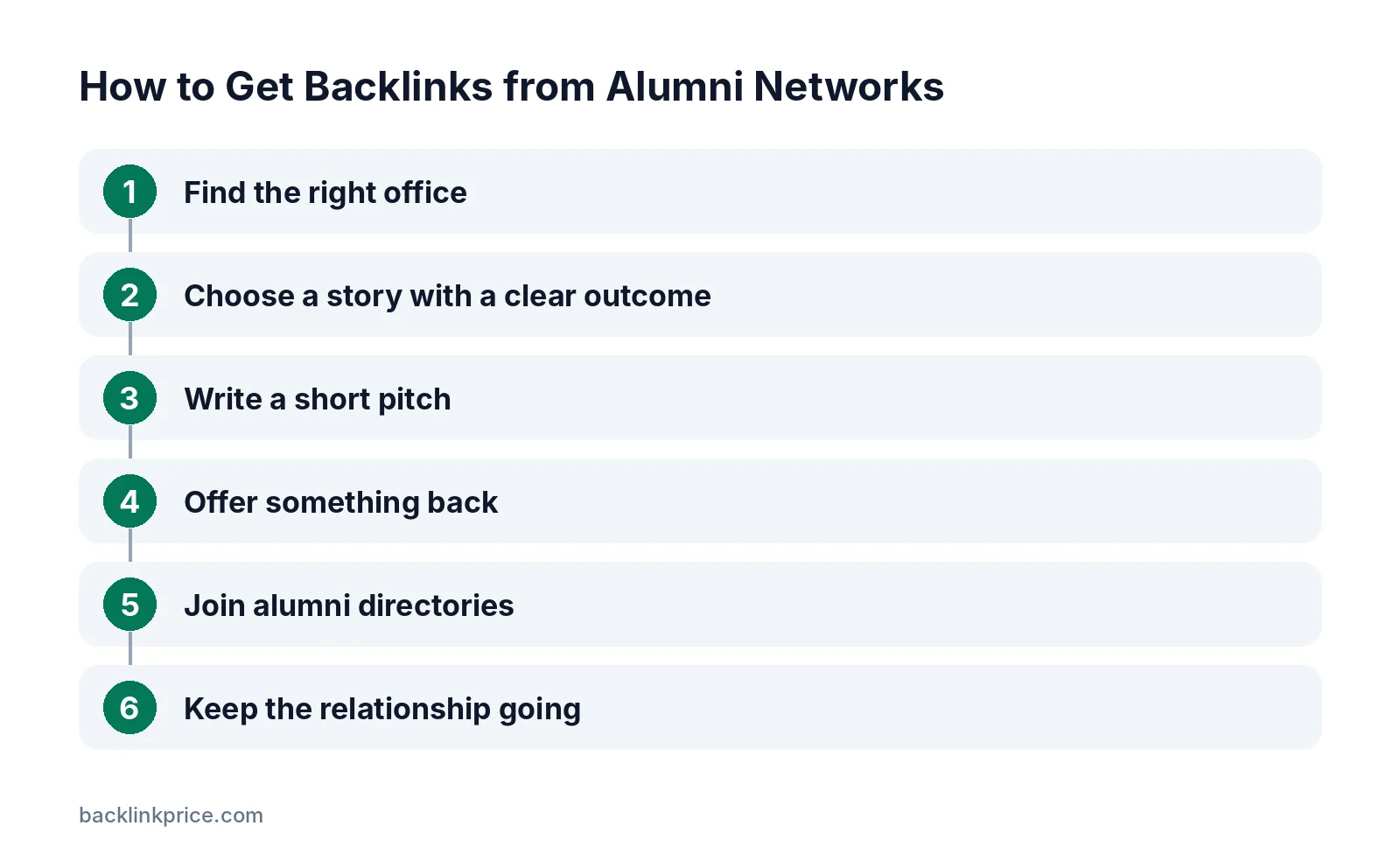
Step 1: Find the right office
Look for "alumni relations", "alumni news", "development office", or "careers service" pages. Accelerators and bootcamps often have a "portfolio" or "graduates" page.
Step 2: Choose a story with a clear outcome
Alumni teams publish outcomes. Good angles include:
- Launching a company or product.
- Hitting a milestone, such as 100 employees or a funding round.
- Winning an award.
- Hiring graduates from the institution.
- Giving back through mentoring or scholarships.
Step 3: Write a short pitch
Introduce yourself with your graduation year and program, share the story in 3 sentences, and offer photos and a quote. Mention your website URL naturally.
Our guide on how to get backlinks with awards has more on packaging achievements.
Step 4: Offer something back
Offer to mentor students, speak to a class, host interns, or join an alumni panel. Each of these often comes with its own page and link.
See how to get backlinks from events for how to get the most from speaking slots.
Step 5: Join alumni directories
Many institutions run directories of alumni businesses or startups. Submit your company with accurate details.
Step 6: Keep the relationship going
Send updates once or twice a year, share their posts about you, and attend alumni events. Alumni teams return to people who respond and help.
Where alumni links usually appear
This table shows common alumni link sources and what they need from you.
| Source | What they need | Typical effort | Repeatable? |
|---|---|---|---|
| Alumni news story | Outcome story, photos, quote | Medium | Yes, with new milestones |
| Alumni magazine (online) | Longer interview | Medium | Occasionally |
| Alumni startup directory | Company details | Low | Update yearly |
| Careers employer page | Hiring graduates | Low | Yes |
| Mentor or speaker page | Volunteering time | Medium | Yes |
| Accelerator portfolio | Program participation | Low | Permanent |
Rules to follow
Keep alumni links natural.
- Do not offer donations in exchange for links. A donation is fine; a link-for-donation deal is a paid link.
- Use your brand name in the link, not keyword anchors.
- Do not ask alumni staff to place links on unrelated pages.
Google's spam policies apply to every domain, including universities.
Common mistakes
These mistakes waste a warm connection.
- Pitching a sales message instead of a story.
- Forgetting to mention your program and graduation year.
- Expecting .edu links to boost rankings on their own.
- Sending no photos or quotes, which slows publication.
- Ignoring corporate alumni networks.
- Disappearing after the first feature.
How to measure results
Track alumni outreach across every institution.
- Institutions contacted and stories published.
- Links and mentions, with dates and attributes.
- Referral traffic and job applications from alumni pages.
- Ongoing roles, such as mentoring or speaking.
Add each new link to your tracking routine; see how to track backlinks.
Frequently Asked Questions
Are alumni .edu links good for SEO?
They can help when they are relevant and earned, but the .edu extension itself gives no special boost. Google has said it treats .edu links like other links. Their main value is trust, relevance, and an audience of graduates who may become customers or employees.
What if I did not graduate recently?
That is fine. Alumni teams feature graduates from every decade, and long careers often make better stories. Mention your program and year, and focus on what you have achieved and how it connects to your time at the institution.
Can employees' alumni networks help my company?
Yes. Each employee's school or former employer is a possible source of a story, especially when they lead a project or win an award. Ask employees first, and let them decide whether they want to be featured.
Do corporate alumni networks give links?
Some do. Large companies with former-employee networks sometimes publish alumni news or startup directories. Policies vary, so check whether the network has a public website and how it features members before you pitch.
How often should I contact alumni offices?
Once or twice a year is enough, ideally when you have real news. Alumni teams plan content around their calendar, so sending updates before major alumni events or magazine deadlines improves your chances.
Sources
- Search Engine Roundtable: Google says EDU links are not better links (2008)
- Search Engine Roundtable: Google does not ignore all edu links (2021)
- Ahrefs: AI Overview brand visibility factors, 75K brands (2025)
- Google Search Central: Spam policies
- Search Engine Journal: Are .edu links a Google ranking factor?

The BacklinkPrice Team researches backlink prices, publisher sites and link building tools. We check prices and plans against each provider's own pages and date them, so you know how current the numbers are.
More from BacklinkPrice TeamRelated guides