How to Get Backlinks from Community Involvement: A Practical Guide
Support clubs, nonprofits, schools, and associations in ways they document online, and the thank-you pages, member lists, and news stories link to you.
You get backlinks from community involvement by taking part in local and industry communities in ways that get documented online: sponsoring a youth team, volunteering, supporting a nonprofit, joining an association, or helping at community events. The organizations you help usually thank supporters on their websites, and local media and blogs often cover the activity.
Key takeaways
- Community links come from organizations you genuinely support: clubs, schools, nonprofits, associations, and local events.
- These links are usually local and relevant, which makes them useful for local search and trust.
- Money-for-link sponsorships should be marked rel="sponsored" under Google's guidelines, so focus on involvement that would happen anyway.
- Brand mentions add up: Ahrefs found branded web mentions correlated at 0.664 with AI Overview brand visibility in a 2025 study of 75,000 brands.
- Track each activity separately, because a single volunteer day can bring several mentions.
What community involvement links are
Community involvement links are links to your business from organizations and media that document your participation in community life. They are a type of local backlink, but they can also be industry-wide.
Common examples include:
- A sponsor or supporter page on a sports club or school website.
- A "thank you to our volunteers" post from a nonprofit.
- A member directory from a business association or chamber of commerce.
- A local news story about a clean-up day or fundraiser.
- An event page listing community partners.
Why community links are valuable
Community links are hard to fake, locally relevant, and often come from trusted sites. Schools, councils, and established nonprofits rarely link out at random.
They are also earned through activity rather than content alone. In a Backlinko and BuzzSumo analysis of 912 million blog posts, 94% of posts had zero external links.
They also strengthen your brand's footprint across the web. In an Ahrefs study of 75,000 brands published in 2025, branded web mentions showed the strongest correlation with AI Overview visibility (0.664), far above backlinks (0.218).
For local businesses, being part of the community also supports reputation. Google's guide to improving local ranking says prominence is based on information Google has about a business from across the web, including links and articles.
When this approach fits
It fits any business with a real presence in a place or an industry. It is especially strong for local service businesses, retailers, clinics, law firms, and B2B firms with an active trade community.
For a wider view of local ranking signals, Moz's local SEO guide is a useful primer.
It is slow. Community links arrive over months, as relationships form. It works best as a long-term habit, not a one-month campaign.
Step-by-step: how to earn links through community involvement
Choose causes that fit your business and your team, then make your involvement visible.
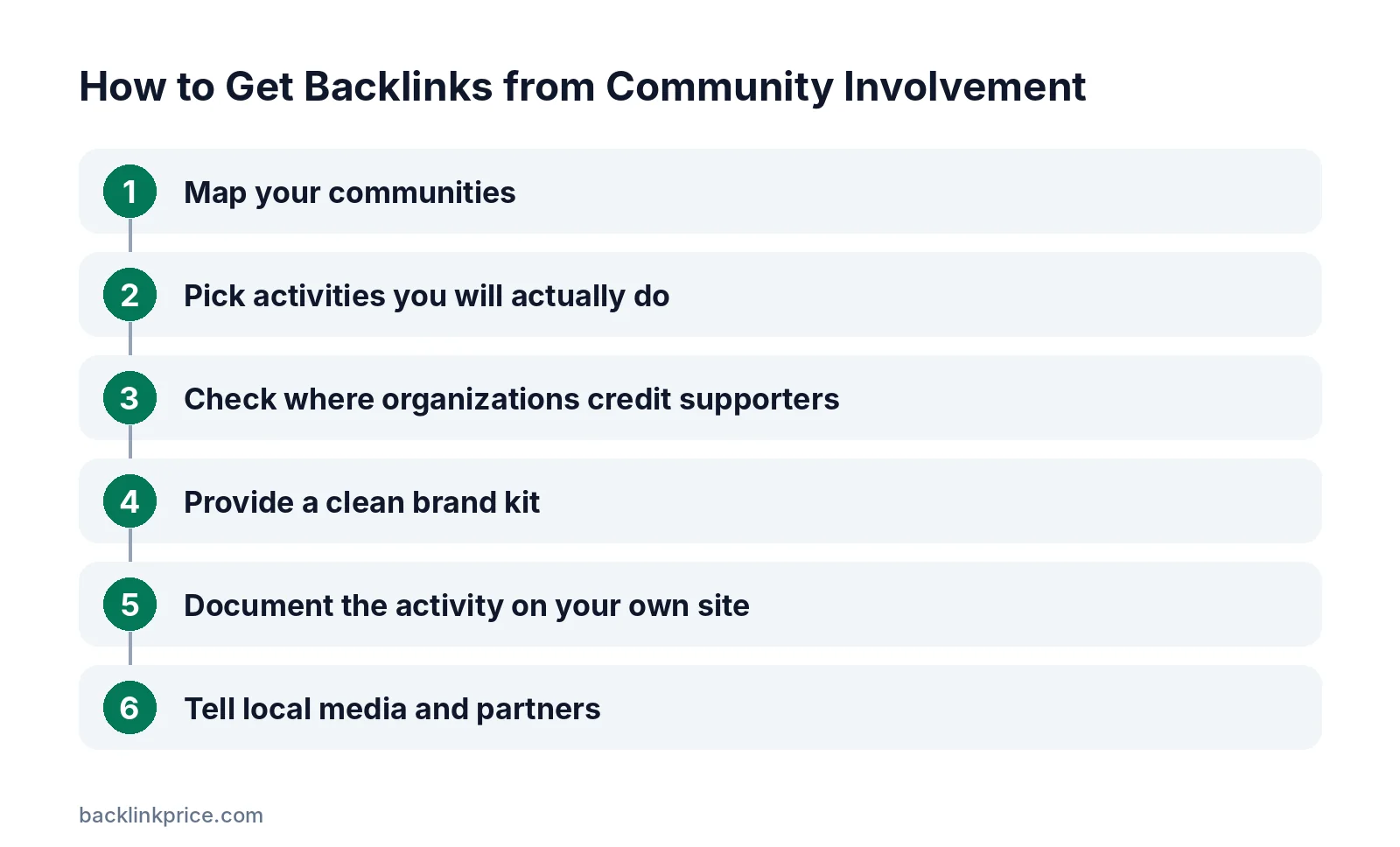
Step 1: Map your communities
List the communities around you:
- Local: neighborhood groups, schools, sports clubs, charities, chambers of commerce.
- Industry: associations, professional groups, open-source or user communities.
- Customer communities: groups your customers belong to.
Step 2: Pick activities you will actually do
Choose 2 or 3 activities your team cares about, such as mentoring students, volunteering at a food bank, or helping organize a local festival.
Real involvement leads to real mentions. Token gestures rarely do.
Step 3: Check where organizations credit supporters
Before you commit, look at each organization's website for supporter, sponsor, partner, or volunteer pages. This tells you whether a mention is likely.
A search such as site:example.org "thank you" or site:example.org sponsors can reveal these pages quickly.
Step 4: Provide a clean brand kit
Send your logo, a one-line description, and your website URL. Ask that the link use your business name.
If you are paying for a sponsorship, the organization should mark the link as sponsored. See are paid links against Google guidelines.
For how to choose and negotiate sponsorships, read how to get backlinks from sponsorships.
Step 5: Document the activity on your own site
Publish a short post or a "Community" page with photos and links to the organizations you support. Linking out to them is natural and shows the relationship is real.
Step 6: Tell local media and partners
Send a brief note to local news outlets, community newsletters, and partner organizations. Include photos and a short quote.
Our guide on how to get featured in news articles covers how to pitch local reporters.
Community link opportunities compared
Use this table to pick activities with the best mix of impact and effort.
| Activity | Typical link source | Effort | Likely link type |
|---|---|---|---|
| Youth sports sponsorship | Club sponsor page | Low to medium | Sponsored or followed |
| Volunteer day | Nonprofit news or thank-you post | Medium | Often followed |
| Chamber or association membership | Member directory | Low | Varies |
| Mentoring at a school or college | School news page | Medium | Often followed |
| Hosting a fundraiser | Local news, partner pages | High | Often followed |
| Donating expertise (free workshop) | Organizer's event page | Medium | Often followed |
Common mistakes
These mistakes make community links look like link buying, or waste goodwill.
- Choosing causes only because they have high-authority websites.
- Paying for "sponsor links" and asking for them to be followed.
- Sending a logo and disappearing until the next renewal.
- Using keyword anchors like "best plumber Leeds" instead of your name.
- Failing to show the involvement on your own site.
- Dropping commitments after the link appears.
How to measure results
Measure both the links and the community value.
- Links and mentions per activity, with their attributes.
- Referral traffic from community sites.
- Local search visibility for your business name and main services.
- Leads that mention the activity, such as "I saw you sponsor the under-12s".
Review each activity yearly and keep the ones that matter to your team and your community. To track links, see how to track backlinks.
Frequently Asked Questions
Are sponsorship links bad for SEO?
Not when handled correctly, because if you pay for a sponsorship and get a link, Google expects the link to be marked sponsored or nofollow. That is fine. The sponsorship still brings brand exposure, local trust, and traffic, even if the link passes little ranking value.
Do community links help local SEO?
They can. Links and mentions from local organizations help show that your business is active and known in an area. Google says local prominence draws on information about a business from across the web, including links and articles.
How do I find community organizations to support?
Start with groups your team already cares about, then check local sports clubs, schools, charities, and your chamber of commerce. Search your city name with words like "sponsors", "supporters", or "volunteers" to find organizations that credit partners online.
Should I ask for a link when I volunteer?
You can ask politely whether they list volunteers or partners, but do not make it a condition. Many organizations are happy to thank supporters with a mention. If they do not, the volunteering still has value for your team and community.
How long does it take to see results?
Expect months rather than weeks. Some organizations update supporter pages once a year, and local news coverage depends on timing. Treat community involvement as an ongoing program and track mentions every quarter.
Sources

The BacklinkPrice Team researches backlink prices, publisher sites and link building tools. We check prices and plans against each provider's own pages and date them, so you know how current the numbers are.
More from BacklinkPrice TeamRelated guides