How to Get Backlinks from Hosting a Meetup: A Practical Guide
Host a recurring meetup, keep each session page on your own site, and earn links from calendars, venues, speakers, partners, and recaps.
You get backlinks from hosting a meetup by creating a recurring local or online event, publishing a page for each session on your own site, and getting that event listed and covered by community calendars, partner organizations, speakers, venues, and local media.
The links come from the people and organizations involved, because they want to promote something they are part of.
Key takeaways
- A hosted meetup creates link sources that a one-off event cannot: event calendars, venue pages, speaker bios, sponsor pages, and recap posts each time you meet.
- Meetup platforms are large; Meetup reported more than 44 million members and 330,000 groups in 2020.
- Speakers and co-organizers usually link to the events they appear in, which makes them your best link partners.
- Publishing a recap page for every session gives others one URL to link to.
- Keep sponsor links honest: when money changes hands, Google expects those links to be marked sponsored or nofollow.
What meetup backlinks are
Meetup backlinks are links to your site that come from pages about events you organize. They differ from backlinks from events you only attend or sponsor, because you control the event page and the story.
Typical sources include:
- Local and industry event calendars.
- Venue and co-working space event pages.
- Speaker websites and LinkedIn posts.
- Partner and sponsor pages.
- Recap posts by attendees, local blogs, and news sites.
Why hosting a meetup earns links
Hosting puts you at the center of a small network that keeps producing pages. Every session has a new speaker, a new topic, and new attendees who may write about it.
Meetup-style communities are common. A 2020 snapshot of Meetup's media page listed more than 44 million members, 330,000 groups, and 84,000 events per week.
Events also create brand mentions in context. In an Ahrefs study of 75,000 brands published in 2025, branded web mentions correlated with AI Overview visibility at 0.664, the strongest factor measured.
When a meetup makes sense
A meetup fits when your audience gathers around a shared skill, tool, or local interest. Examples include a city's WordPress users, a regional SEO community, or a monthly founders' breakfast.
It is a long game. Most groups need several sessions before attendance, speakers, and coverage build up. If you can commit to at least 6 sessions, the effort usually pays off.
Step-by-step: how to earn links from hosting a meetup
Set up the link sources once, then repeat them every session.
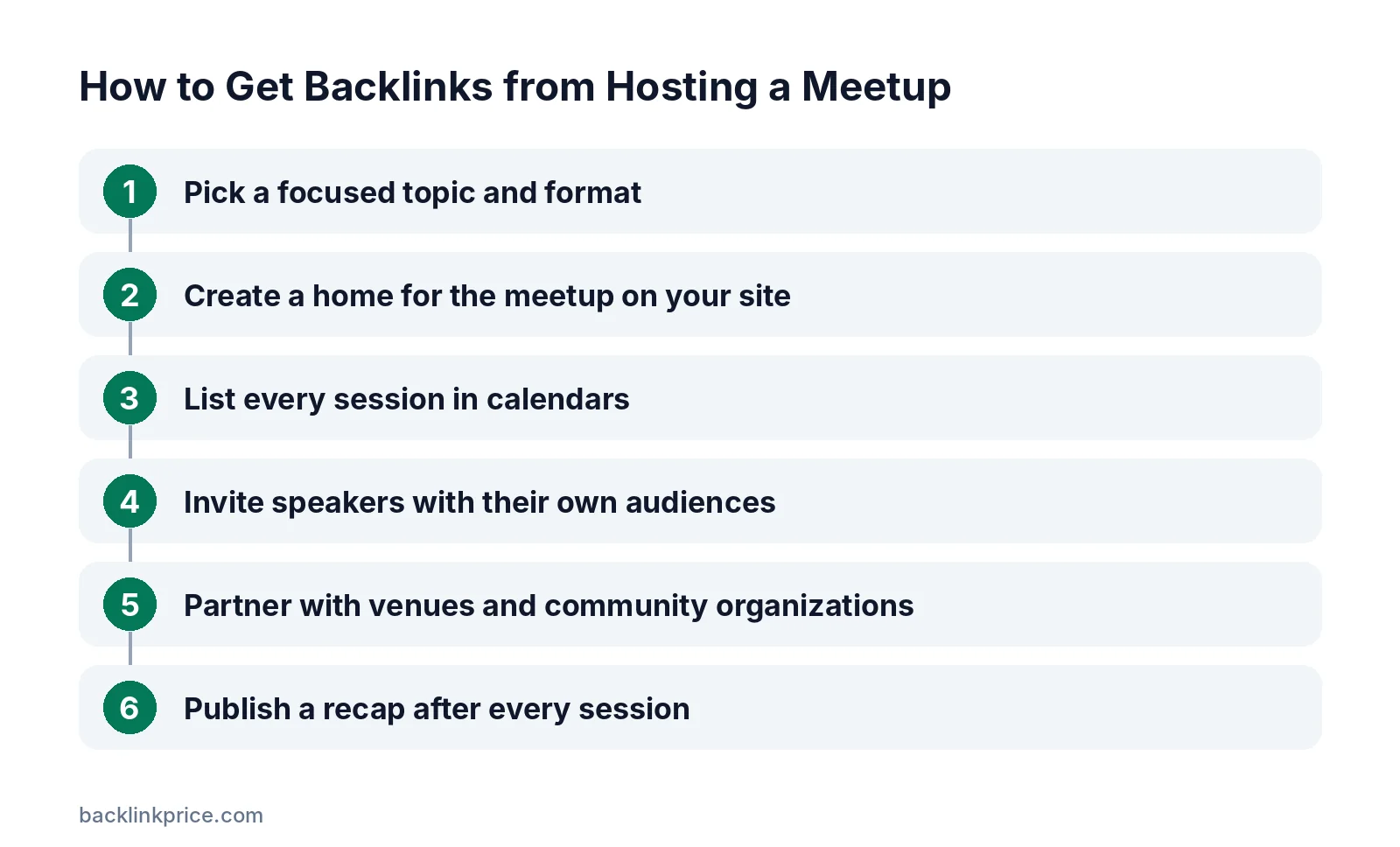
Step 1: Pick a focused topic and format
Choose a topic narrow enough to attract the right people, such as "Ecommerce SEO in Manchester". Decide on a format: talks, panels, workshops, or networking.
Check whether a similar group already exists. Joining forces with an inactive group can be faster than starting a new one.
Topic communities can be very active. The WordPress community team reported 3,890 WordPress meetup events in 2023, of which 2,223 were in person and 1,667 online.
Step 2: Create a home for the meetup on your site
Build a meetup page on your website with the next date, the agenda, past sessions, and a way to sign up. This is the page you want others to link to.
Add Event structured data to each session page, so search engines understand the date, location, and organizer.
Step 3: List every session in calendars
Publish each session on your platform, such as Meetup, and on local calendars: city tourism sites, chamber of commerce calendars, university event boards, and industry newsletters.
Many calendar listings include a link to the event page. Some are nofollow, which is fine for discovery.
Step 4: Invite speakers with their own audiences
Speakers often promote events on their sites and social profiles. Choose speakers who write or publish regularly.
Send each speaker a short kit with the event URL, a graphic, and suggested text. Interview-style sessions work well too; see how to get backlinks with interviews.
Step 5: Partner with venues and community organizations
Venues, co-working spaces, and universities often list hosted events on their own websites. Ask them to include your event page link.
Local business groups and associations may feature the meetup in newsletters. Our guide on how to get local backlinks lists more local sources.
Step 6: Publish a recap after every session
Write a recap with key takeaways, photos, slides, and speaker links. Share it with speakers, attendees, and partners.
Recaps give journalists and bloggers a source to cite, and they keep your meetup page fresh.
Link sources from a hosted meetup
Use this table as your checklist for each session.
| Source | What to ask for | When | Effort |
|---|---|---|---|
| Meetup platform listing | Link to your meetup page | When announcing | Low |
| Local event calendars | Event listing with link | 2 to 4 weeks before | Low |
| Venue website | Listing on their events page | When booked | Low |
| Speaker websites | Mention in their "talks" page | After confirmation | Low |
| Partner organizations | Newsletter or partner page mention | Before the event | Medium |
| Local media and blogs | Coverage or recap mention | Around the event | Medium |
| Recap posts by attendees | Link to your recap page | After the event | Medium |
Sponsors and Google's rules
Sponsorship is common for meetups, but paid links must be labeled.
If a company pays for pizza in exchange for a link, that link is paid. Google's guide to qualifying outbound links asks sites to mark paid links with rel="sponsored".
The same applies in reverse: if you sponsor someone else's meetup, expect a sponsored link. Our guide on what Google says about nofollow explains the attributes.
Common mistakes
These mistakes stop meetups from earning links.
- Pointing all promotion to a platform page instead of your own site.
- Running sessions with no recap or slides.
- Picking a topic so broad that no one feels it is for them.
- Turning sessions into sales pitches, which drives speakers away.
- Stopping after 2 or 3 sessions.
- Selling "dofollow sponsor links" without disclosure.
How to measure results
Track the meetup as a long-term community program.
- Attendance and sign-ups per session.
- Referring domains to your meetup and recap pages.
- Referral traffic from calendars, partners, and speakers.
- Leads or customers who first met you at the meetup.
Review results every 3 months. To check links regularly, see how to track backlinks.
Frequently Asked Questions
Do I need Meetup.com to host a meetup?
No. Meetup.com helps with discovery, but you can host using your own site, Eventbrite, Luma, LinkedIn Events, or a simple registration form. Whatever platform you use, keep an event page on your own website so that links point to you.
How many sessions does it take to earn links?
It varies, but most groups need several sessions before speakers, partners, and local media take notice. Plan for at least 6 sessions over 6 to 12 months, and publish a recap after each one to build a library of linkable pages.
Are event calendar links worth getting?
Yes, for discovery and local relevance. Some calendar links are nofollow, but they still bring attendees and help search engines find your event pages. Calendars run by universities, chambers of commerce, and city sites are especially useful.
Can an online meetup earn links too?
Yes. Online meetups get listed on virtual event calendars, speaker pages, and newsletters. They lack venue links, but they can attract speakers from anywhere, which widens your network and the number of sites that may mention you.
Should I charge for tickets?
Free events are easier to grow and list. A small ticket price can reduce no-shows, but it may limit listings on some community calendars. Many organizers keep events free and cover costs with clearly disclosed sponsors.
Sources

The BacklinkPrice Team researches backlink prices, publisher sites and link building tools. We check prices and plans against each provider's own pages and date them, so you know how current the numbers are.
More from BacklinkPrice TeamRelated guides