How to Get Backlinks from Open Source Projects: A Practical Guide
Release useful code, host the docs on your own domain, and contribute real fixes. Developers then cite your project in tutorials and answers.
You get backlinks from open source projects by releasing useful code under your company's name, contributing real fixes to projects your team relies on, and sponsoring or documenting projects in ways maintainers credit publicly. Developers then link to your repo, docs, and site from READMEs, tutorials, package pages, blog posts, and Q&A answers.
Key takeaways
- Open source earns links because developers cite the tools they use in docs, tutorials, and answers.
- The audience is huge: GitHub's Octoverse 2025 reported more than 180 million developers and 630 million repositories.
- Links point to 3 places: your repository, your documentation site, and your company site; plan where each should go.
- Many code hosting and package pages use nofollow on user content, so the real SEO value comes from blogs, docs, and articles that cite your project.
- Contribute honestly: maintainers reject drive-by "link PRs" that add your URL without adding value.
What open source backlinks are
Open source backlinks are links to your website, docs, or repository that come from the open source community. They appear because people use, discuss, or depend on your code.
Common sources include:
- READMEs and "awesome lists" that recommend tools.
- Tutorials and blog posts that use your library.
- Package registry pages that show your homepage.
- Stack Overflow answers and community forums.
- Sponsor and contributor credits in other projects.
- Conference talks and newsletters for developers.
Why open source works for link building
Developers write a lot of public content, and they link to what they use. A popular library can earn links for years without new outreach.
The scale is large. GitHub's Octoverse 2025 report counted more than 180 million developers, 630 million repositories, and more than 1.12 billion contributions to public and open source projects in its 2025 data year.
Open source also builds trust with technical buyers. A company that maintains a respected library looks credible to engineers who influence software purchases. For SaaS context, see how to get backlinks for a SaaS company.
Which open source approach fits you
There are 3 main ways to take part, each with different effort and link potential.
| Approach | Example | Effort | Link potential |
|---|---|---|---|
| Release your own project | A library, CLI, plugin, or template | High | High if it solves a common problem |
| Contribute to existing projects | Bug fixes, docs, features | Medium | Medium, through contributor credits and posts |
| Sponsor projects | GitHub Sponsors, Open Collective | Low to medium | Low to medium; treat links as sponsored |
Step-by-step: how to earn links from open source
Start with a real developer problem, then make your project easy to find, use, and cite.
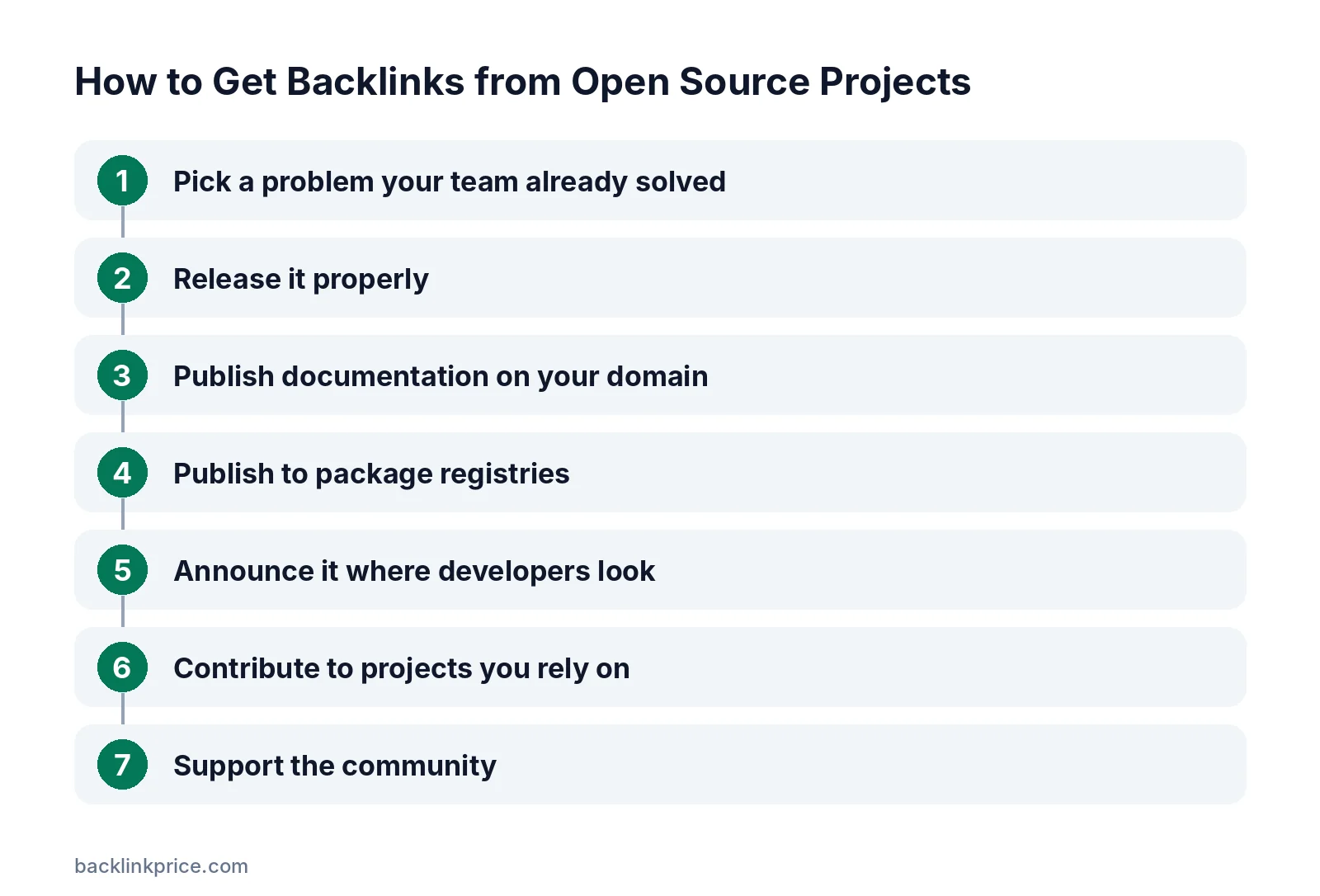
Step 1: Pick a problem your team already solved
Look at internal tools, scripts, or integrations your engineers built. If several customers or developers have the same problem, a cleaned-up version could be useful to many.
Step 2: Release it properly
Choose a clear license, write a strong README, and add installation steps, examples, and a changelog. Link the README to a documentation page on your own site.
For what links on GitHub itself are worth, see do links from GitHub help SEO.
GitHub's guide to licensing a repository explains how licenses work on the platform.
Step 3: Publish documentation on your domain
Host full docs on your site, such as yourdomain.com/docs/project. Tutorials and answers usually link to docs, so this is where most editorial links land.
Step 4: Publish to package registries
Release the package on npm, PyPI, or the registry your language uses, with your homepage URL set. Registry pages are where developers find and verify packages.
Step 5: Announce it where developers look
Share a launch post on your blog, then submit it to relevant newsletters, forums, and community sites. Explain the problem, the solution, and how to start.
Free, useful tools spread the same way. Our guide on how to get backlinks with tools and calculators shows how to package them.
Step 6: Contribute to projects you rely on
Fix bugs, improve docs, and answer issues in projects your product depends on. Many projects credit contributors and companies in release notes and contributor pages.
Write up what you fixed on your engineering blog. A short post explaining a hard bug often earns links from developers who hit the same problem, and it shows your team's expertise. Read how to get backlinks with case studies for a similar format.
Never open pull requests that only add your link. Maintainers see these as spam.
Step 7: Support the community
Sponsor key dependencies through GitHub Sponsors or Open Collective. Sponsor credits are paid placements, so expect sponsored or nofollow links.
Google's rules for open source links
Most open source links are natural, but a few patterns cross the line.
- Adding your URL to unrelated projects through pull requests.
- Paying maintainers for followed links without labeling them.
- Stuffing keyword anchors into READMEs.
Google's guide to qualifying outbound links asks that paid links use rel="sponsored". Organic links from tutorials and docs that cite your project need no special handling.
Common mistakes
These mistakes stop open source projects from earning links.
- Releasing code with no README, docs, or examples.
- Hosting docs only on the repository, so links never reach your site.
- Abandoning the project after launch.
- Choosing a license that blocks common use without explaining why.
- Spamming "awesome lists" with low-quality submissions.
- Treating contributions as marketing instead of help.
How to measure results
Measure community adoption first, then links.
- Stars, forks, downloads, and dependents.
- Referring domains to your docs and site.
- Mentions in tutorials, newsletters, and Q&A sites.
- Sign-ups or leads from developer traffic.
Use how to track backlinks to keep a monthly log of new links and lost ones.
Frequently Asked Questions
Do GitHub links count as backlinks?
They are links, but many code hosting platforms add nofollow to links in user content, so they pass little ranking value. Their main value is discovery. The links that matter more for SEO usually come from blogs, tutorials, and documentation sites that cite your project.
Should documentation live on GitHub or on my site?
Keep a short README on GitHub and host full documentation on your own domain. Tutorials and answers tend to link to documentation, so hosting it on your site means those editorial links point to you.
Is sponsoring open source a good way to get links?
Sponsoring is good for the community and your brand, but sponsor links are paid. Google expects paid links to carry rel="sponsored" or nofollow. Sponsor projects you depend on because it helps them, and treat any link as a bonus.
How long does it take an open source project to earn links?
It depends on how useful the project is and how well you promote it. Some projects earn links in the first weeks after launch, while others grow slowly through search and word of mouth. Steady maintenance and good docs matter more than launch size.
Can non-technical companies use open source for links?
Yes, in a lighter form. Publishing open datasets, templates, design assets, or style guides under an open license works in a similar way. People cite and link to free resources they can reuse.
Sources

The BacklinkPrice Team researches backlink prices, publisher sites and link building tools. We check prices and plans against each provider's own pages and date them, so you know how current the numbers are.
More from BacklinkPrice TeamRelated guides