How to Get Backlinks from Courses: A Practical Guide
Publish a free, open course on your own site, then get it listed on resource pages, best free course roundups, and educator reading lists.
You get backlinks from courses by publishing a free, genuinely useful course on your own site, then getting it listed on resource pages, "best free courses" roundups, university and library guides, and community wikis. People link to courses that teach a skill well and are easy to start, so open access and clear lessons matter more than production polish.
Key takeaways
- Free courses earn links from resource pages, "best free courses" lists, educators, and forums where people ask how to learn a skill.
- Host the course on your domain, with each lesson on its own indexable page, so links and search traffic come to you.
- Software companies such as HubSpot and Ahrefs run free academies, showing how courses support both education and brand.
- Course and lesson pages can use Google's structured data for courses to describe what you offer.
- Keep certificates honest: a free certificate badge is fine, but do not require a link back to earn it.
What course backlinks are
Course backlinks are links to an educational course you publish, from sites that recommend it as a way to learn.
Typical sources include:
- "Best free courses for [skill]" roundups.
- Resource pages on blogs, nonprofits, and associations.
- University and public library research guides.
- Community wikis and forum threads answering "how do I learn X?"
- Newsletters that share learning resources.
- Learners' own blogs and portfolios that mention completing the course.
Why courses can earn links
A course solves the "where should I start?" problem, which is one of the most common questions in any field. Writers and communities need trustworthy resources to point to.
Courses also build trust in your brand. Several software companies run free education hubs, such as HubSpot Academy and Ahrefs Academy, alongside their products.
Most content does not earn links on its own. In a Backlinko and BuzzSumo study of 912 million blog posts, 94% had zero external links. A complete, free course stands out because it takes real effort to replicate.
Free vs paid courses for links
Free courses earn far more links than paid ones, but paid courses can still earn some.
| Course model | Link potential | Best link sources | Trade-off |
|---|---|---|---|
| Free, ungated | High | Resource pages, roundups, educators | No direct revenue |
| Free with optional sign-up | Medium to high | Same, if lesson pages stay open | Some friction |
| Freemium (free intro, paid full) | Medium | Reviews, "best courses" lists | Writers may note the paywall |
| Paid only | Low | Reviews, affiliates (usually nofollow) | Links mostly sponsored |
Affiliate and sponsored links should be qualified. Google's guide to qualifying outbound links covers rel="sponsored".
Step-by-step: how to earn links with a course
Build a course people want to recommend, then make it easy to find.
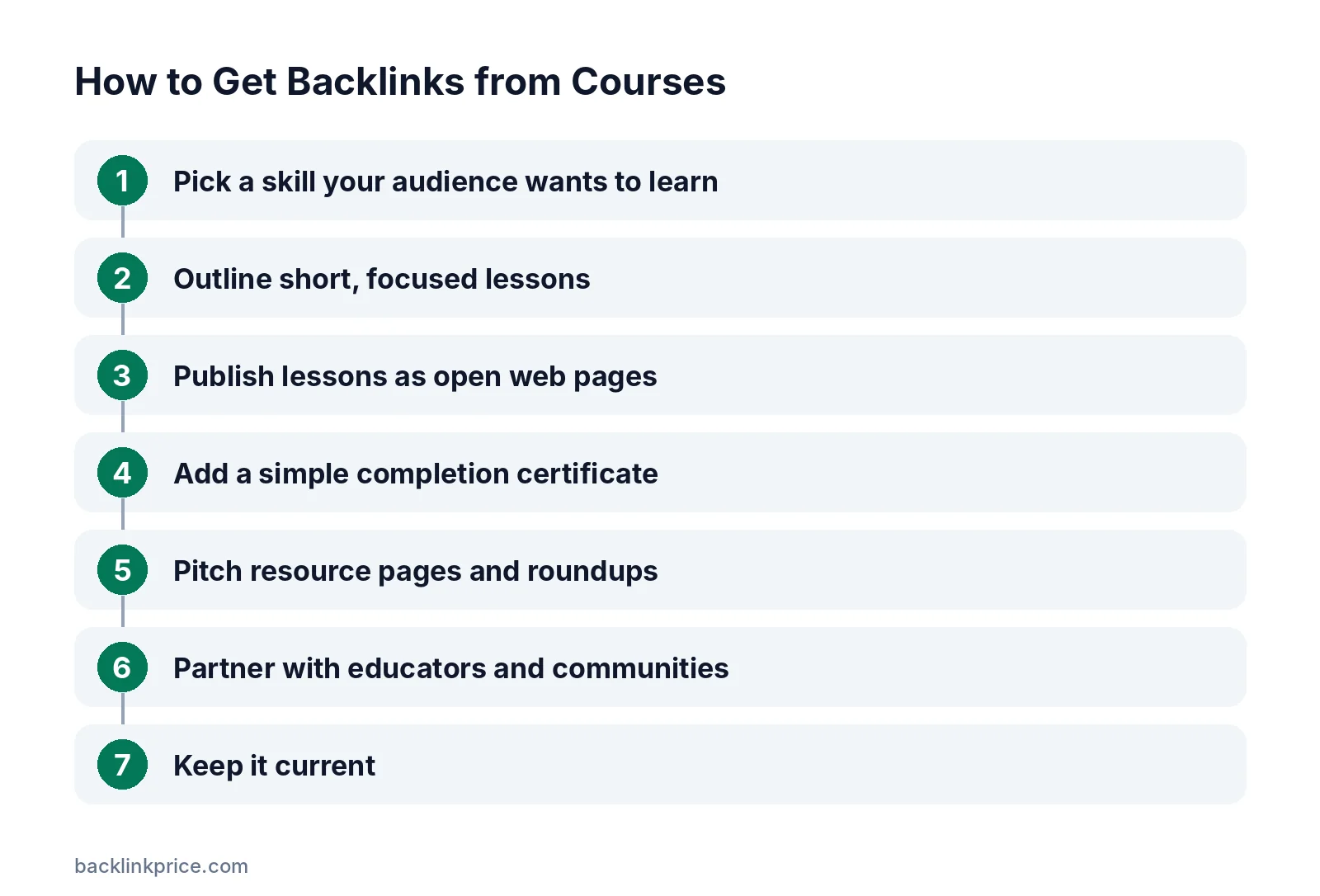
Step 1: Pick a skill your audience wants to learn
Choose a skill close to your product but useful without it. Check what types of content get the most backlinks to see how educational formats compare. For example, an email tool might teach "cold email basics" rather than "how to use our tool".
Step 2: Outline short, focused lessons
Split the course into 5 to 15 lessons, each with one goal. Include examples, exercises, and a short summary.
Step 3: Publish lessons as open web pages
Give each lesson its own URL with text, images, and optional video. Avoid hiding everything behind a login, because writers and search engines cannot see it.
Google's course structured data documentation explains how to describe courses for search features.
Step 4: Add a simple completion certificate
A free certificate gives learners something to share on profiles and portfolios. Do not require a backlink to earn it.
Step 5: Pitch resource pages and roundups
Find pages that list learning resources for your topic and email authors with a short note on what the course covers and who it is for.
Our guide to resource page link building explains how to find and pitch these pages.
Step 6: Partner with educators and communities
Offer the course to teachers, bootcamps, associations, and meetups as free material. Many will add it to their reading lists.
See how to get backlinks from universities for academic outreach.
Step 7: Keep it current
Update lessons when tools or rules change, and note the "last updated" date. Writers avoid recommending outdated courses.
Add companion resources
Courses earn more links when they come with downloadable extras. Add worksheets, checklists, templates, or sample files to key lessons.
These extras give writers a second reason to link, and they often get shared on their own. A course on outreach, for example, can include email templates and a tracking sheet. See how to get backlinks with templates for how to package them.
Keep each extra on an open page with a short explanation. Writers prefer to link to a page that explains the resource rather than to a direct file download.
Common mistakes
These mistakes stop courses from earning links.
- Turning the course into a product tutorial.
- Gating every lesson behind a sign-up form.
- Hosting the course only on a third-party platform.
- Requiring a backlink for a certificate.
- Never updating lessons.
- Long videos with no text version.
How to measure results
Measure learning and links together.
- Enrollments and completion rates.
- Referring domains to the course and lesson pages.
- Mentions in "best free courses" lists.
- Sign-ups or customers who started with the course.
Google Search Console's Links report shows which sites link to your course pages.
Track new links with how to track backlinks.
Frequently Asked Questions
Should my course be free to earn links?
Free courses earn the most links because writers can recommend them to anyone. Paid courses can earn reviews and some mentions, but many links will come through affiliate programs, which should be marked sponsored. A free introductory course is a good middle ground.
Should I host my course on my site or a course platform?
Host the core lessons on your own domain so links and search traffic come to you. Course platforms can help with discovery, but links there point to the platform, not your site. Many brands use both, with the main version on their own site.
Do course certificates help with backlinks?
They help with sharing, because learners post certificates on profiles and portfolios. Those links are often nofollow. Never require a backlink to earn a certificate, since that turns the link into a condition rather than a recommendation.
How long should a free course be?
Long enough to teach the skill properly, usually 5 to 15 short lessons. Shorter, focused courses are completed more often and are easier for writers to recommend to beginners.
Can a course help with AI search visibility?
It can. Structured, well-organized lessons are easy for AI tools to read and summarize, and courses recommended on many sites become associated with the skill. Keep lessons clear, factual, and updated.
Sources

The BacklinkPrice Team researches backlink prices, publisher sites and link building tools. We check prices and plans against each provider's own pages and date them, so you know how current the numbers are.
More from BacklinkPrice TeamRelated guides