How to Get Backlinks from Ebooks and Whitepapers: A Practical Guide
Put the key findings, charts, and method on an open page, keep the full PDF as an optional download, and pitch one finding per outlet.
Ebooks and whitepapers earn backlinks when they contain something other writers want to cite, such as original data, a clear framework, or expert analysis, and when that content is also published on an open, linkable web page. A PDF hidden behind a form rarely gets links. A landing page with key findings, charts, and an optional download often does.
Key takeaways
- Writers link to findings, data, and frameworks, not to download forms, so publish the core insights on an open page.
- A gated PDF can still collect leads; offer the full file by email while keeping a summary page public.
- Google can index PDFs, but a page with HTML text, headings, and charts is easier for readers, search engines, and AI tools to quote.
- Original research is the most linkable ingredient; a report with no new information rarely earns links.
- Promote each finding separately, because one report can supply many story angles.
What makes an ebook or whitepaper linkable
A linkable ebook or whitepaper gives readers information they cannot easily find elsewhere and makes it easy to cite.
The strongest ingredients are:
- Original data from a survey, your product, or analysis of public sources.
- A named framework or model that others can reference.
- Expert input from people with real authority in the field.
- Clear charts and quotable findings, each with a source and date.
An ebook that only summarizes common advice is useful for lead generation but rarely earns editorial links.
Why ebooks and whitepapers struggle to get links
Most long-form downloads are gated, and writers will not send readers to a form. They want a page they can quote and link to directly.
Links in general are scarce. A Backlinko and BuzzSumo analysis of 912 million blog posts found that 94% had zero external links. A gated PDF starts with an extra barrier on top of that.
Google can index PDFs, as its list of file types Google can index shows. But a page with headings, text, and charts is easier to scan and to quote in AI answers.
Gated vs open: how to get both leads and links
Use a hybrid model: an open summary page plus an optional download.
| Approach | Leads | Links | Best for |
|---|---|---|---|
| Fully gated PDF | High | Low | Sales enablement, late-stage buyers |
| Open HTML report | Low to medium | High | Research, thought leadership |
| Hybrid (open findings + gated PDF) | Medium | High | Most B2B reports |
| Open PDF only | Low | Medium | Technical papers, standards |
The hybrid keeps key findings, charts, and methodology on a public page. People who want the full report, templates, or raw data can download it. If the PDF itself attracts links, read how to get links to a PDF to handle them well.
Step-by-step: how to earn links with an ebook or whitepaper
Plan for citations before you write a single page.
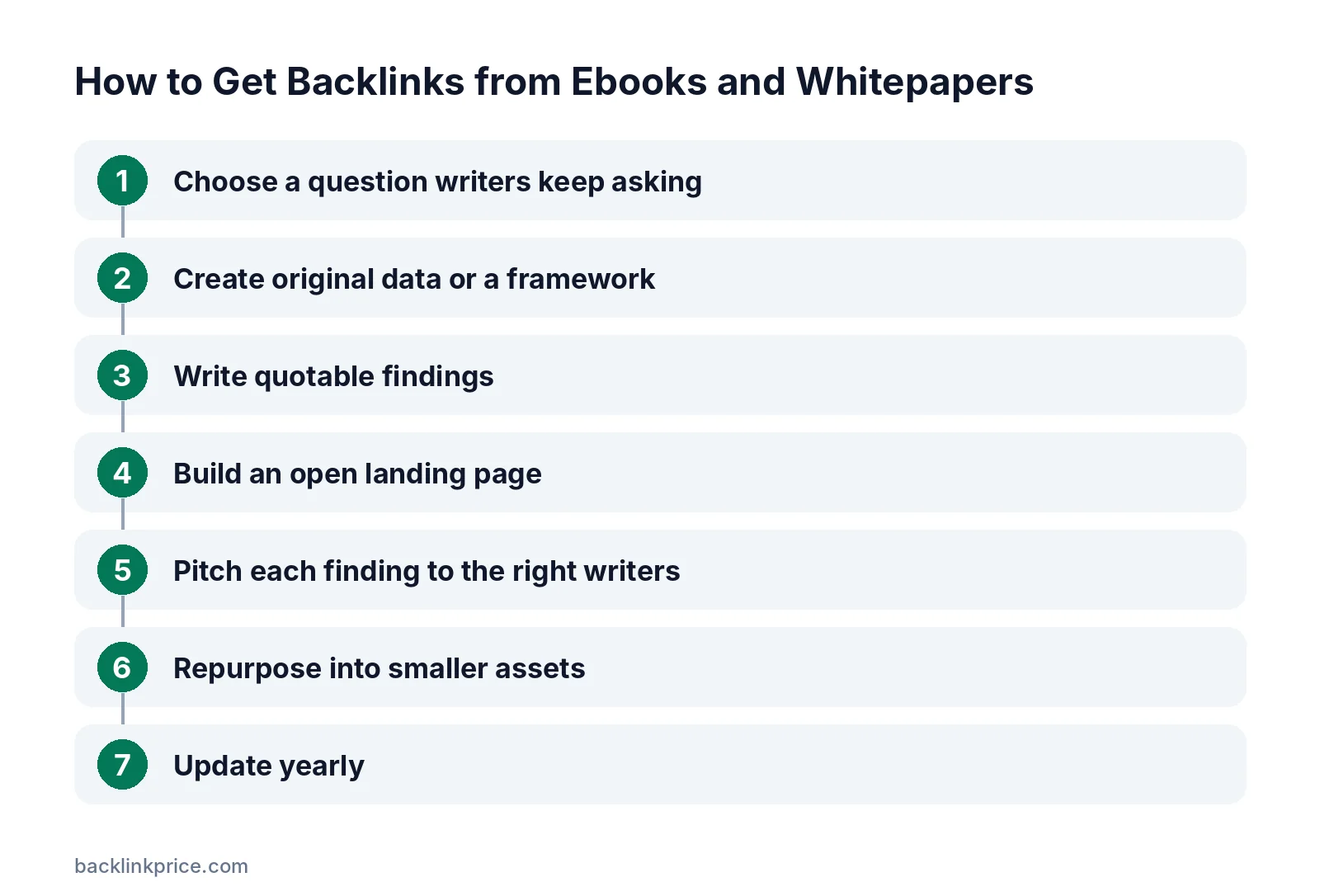
Step 1: Choose a question writers keep asking
Look for topics where journalists and bloggers quote data often, such as costs, adoption rates, benchmarks, or trends. Your report should answer one of those questions with new information.
Step 2: Create original data or a framework
Run a survey, analyze your product data, or combine public datasets from sources such as Data.gov. Document the method, sample size, and dates.
Our guide on how to get backlinks with original research covers survey design and packaging.
Step 3: Write quotable findings
Turn the main results into 5 to 10 short findings, each one sentence with a number. Writers often copy findings word for word, with a link.
Each citation also spreads your brand name. An Ahrefs study of 75,000 brands in 2025 found branded web mentions correlated at 0.664 with AI Overview visibility.
Step 4: Build an open landing page
Publish the findings, charts, methodology, and a short summary on an HTML page. Add a table of contents and an optional download button for the full PDF.
Step 5: Pitch each finding to the right writers
Different findings suit different outlets. Send trade media the industry angle, local media the regional angle, and newsletters the most surprising number.
Relevance is everything. In Cision's 2025 State of the Media survey, 86% of journalists named lack of relevance as the top reason they reject pitches.
For journalist outreach, see how to get backlinks from journalists.
Step 6: Repurpose into smaller assets
Create charts, a short statistics page, and blog posts from the report. Each smaller asset links back to the main report page.
Read how to get backlinks with statistics pages for one of the most effective formats.
Step 7: Update yearly
Repeat the research each year. Writers return to annual reports because they want the latest numbers, which gives the same page a fresh round of links.
Common mistakes
These mistakes keep reports from earning links.
- Gating every page, including the findings.
- Publishing only a PDF with no HTML version.
- No methodology, sample size, or dates.
- Long reports with no clear headline findings.
- Pitching the whole report instead of one finding per outlet.
- Letting the data go stale for years.
How to measure results
Track links and leads separately so you can judge both goals.
- Referring domains to the report page.
- Mentions of your findings, with or without links.
- Downloads and leads from the optional PDF.
- Links to repurposed assets.
When writers cite your numbers without linking, use how to turn unlinked mentions into links.
Frequently Asked Questions
Should I gate my whitepaper?
If links matter, do not gate the key findings. Keep a public page with the main results and methodology, and gate the full PDF, templates, or raw data if you need leads. This hybrid approach gives writers something to cite while still collecting contacts.
Can Google index PDF files?
Yes. Google lists PDF among the file types it can index. Still, an HTML page is easier to read on phones, easier to link to specific sections, and easier for AI tools to quote, so publish important content in HTML too.
What kind of whitepaper earns the most links?
Reports with original data on a topic writers cover often, such as costs, benchmarks, or trends. Frameworks and expert analysis can work too, but original numbers are the most reliable reason for others to cite you.
How long should an ebook be?
Long enough to cover the topic with evidence, but the length matters less than the findings. Many linkable reports are 10 to 30 pages with a short summary page. Focus on clear, quotable results rather than page count.
How do I promote a report after launch?
Pitch one finding at a time to the most relevant writers, share charts on social media, publish smaller posts based on each section, and update the data yearly. Each new angle is another chance for coverage and links.
Sources

The BacklinkPrice Team researches backlink prices, publisher sites and link building tools. We check prices and plans against each provider's own pages and date them, so you know how current the numbers are.
More from BacklinkPrice TeamRelated guides