How to Get Backlinks from Maps and Location Data: A Practical Guide
Publish maps and rankings that compare places on a question people care about, then pitch each local outlet the finding for its own area.
You get backlinks from maps and location data by publishing interactive or static maps that answer a "where" question people care about, such as costs, rankings, or trends by city or region, and pitching them to local and national outlets that cover each place.
Location data earns links because every city, state, or country in it is a separate story for a separate writer.
Key takeaways
- Location-based data multiplies outreach: a map of 50 cities gives you 50 local angles to pitch.
- The best maps answer one question clearly, such as "Where is rent rising fastest?"
- Public sources such as national statistics offices and open data portals often provide enough data.
- Host each map on a page with methodology, rankings, and per-location summaries so local writers can find their area quickly.
- Keep embeds honest; Google's spam policies warn against keyword-rich links hidden in widgets distributed across sites.
What location data assets are
A location data asset is a map, ranking, or dataset that compares places on something people care about. Examples include:
- Cost comparisons, such as average wedding costs by state.
- Rankings, such as the best cities for remote workers.
- Trends, such as where search interest in a product is growing.
- Local guides, such as the number of EV chargers per 10,000 residents.
They are a strong type of linkable asset, especially for local and regional media.
Why maps and location data earn links
Local journalists and bloggers always need stories about their own area. A national ranking hands each of them a ready-made local story.
Most content does not get linked. A Backlinko and BuzzSumo analysis of 912 million blog posts found 94% had zero external links. Location data stands out because it is specific and newsworthy for many outlets at once.
Brand mentions from coverage help in AI search too. An Ahrefs study of 75,000 brands found branded web mentions correlated at 0.664 with AI Overview visibility in 2025.
Where to get location data
Combine public data with your own if you can.
| Source | Examples | Notes |
|---|---|---|
| National statistics | U.S. Census Bureau, national statistics offices | Strong credibility, check update dates |
| Open data portals | City and state open data sites | Great for local maps |
| Search trends | Google Trends by region | Shows interest, not behavior |
| Your own data | Anonymized orders, sign-ups, prices | Unique, but check privacy |
| Surveys | Panel surveys with location filters | Needs enough responses per area |
The U.S. Census Bureau's data platform and Google Trends are common starting points. Always cite sources and dates.
Step-by-step: how to earn links with location data
Plan the outreach while you plan the data.
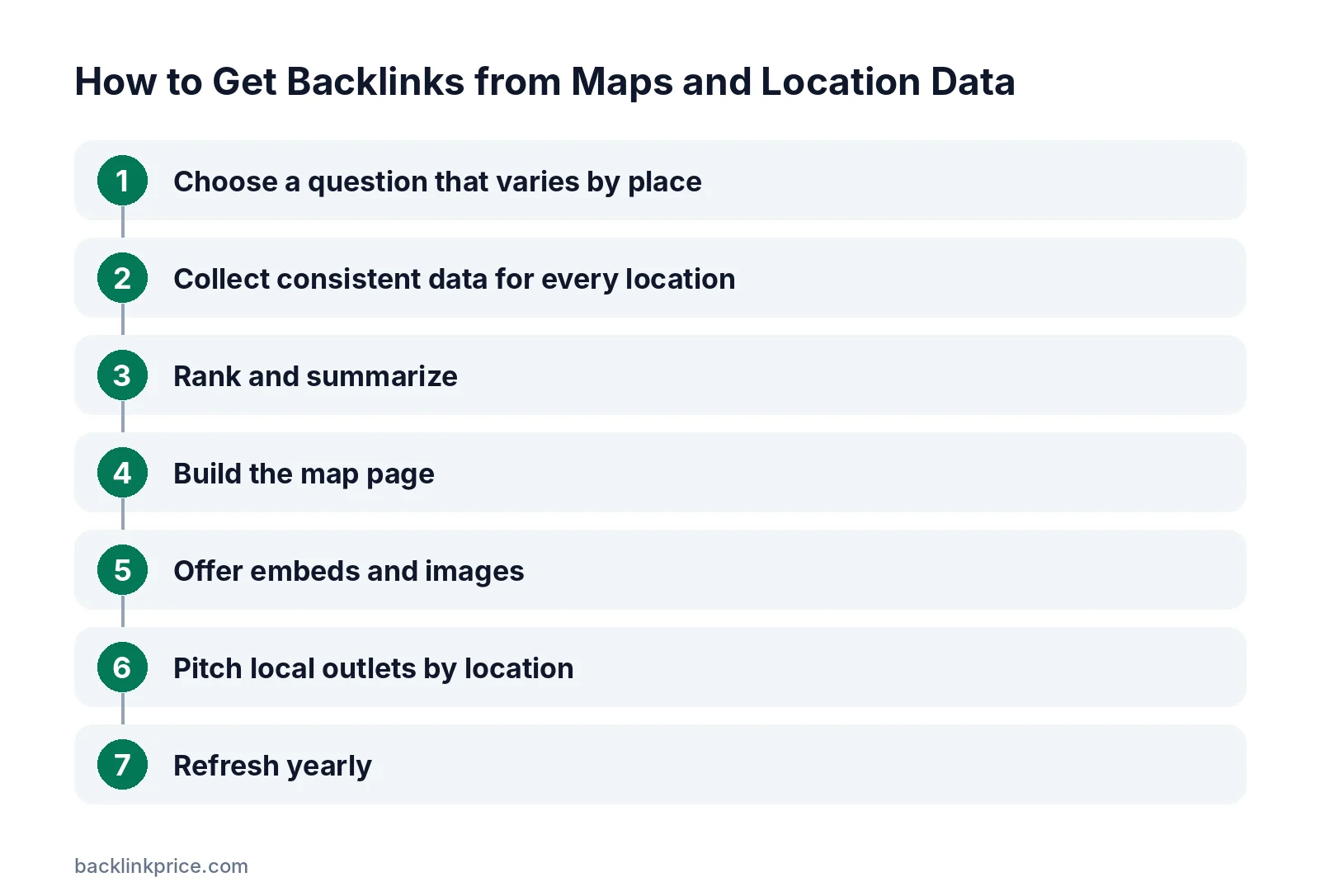
Step 1: Choose a question that varies by place
Pick a topic where differences between places are surprising or useful. Cost, safety, access, and growth questions work well.
Test the idea before you build. Search the topic plus a few city names and see whether local outlets have covered it before. If they have, your data gives them a fresh, updated angle. If nobody has, check that people actually search for it, so the page can also rank on its own.
Step 2: Collect consistent data for every location
Use the same source and time period for every place, so comparisons are fair. Note any gaps.
Step 3: Rank and summarize
Create a ranking table, then write a 1 to 2 sentence summary for each location. Local writers will look for their area first.
Step 4: Build the map page
Publish a page with an interactive or static map, the ranking table, key findings, methodology, and a download option. Make sure it loads fast on mobile.
Step 5: Offer embeds and images
Provide a static image and embed code with a plain brand-name credit link. Google's spam policies warn about keyword-rich or hidden links in widgets distributed across many sites.
Step 6: Pitch local outlets by location
Build a media list by city or region. Send each outlet the finding for their area, plus the national context. Local angles get much higher interest than generic pitches.
For local outreach ideas, see how to get local backlinks.
Step 7: Refresh yearly
Update the data each year and pitch the new rankings. Places that move up or down make fresh stories.
Location data ideas by industry
Most industries have a location angle once you look for it. Use these starting points:
- Real estate: price changes, rental yields, or time on market by neighborhood.
- Travel: cheapest months to visit by destination, or hotel prices by city.
- Finance: average fees, savings rates, or insurance costs by state.
- Health: clinic access, wait times, or fitness facilities per resident.
- Ecommerce: most popular products by region from your own sales.
- SaaS: adoption of a tool or work pattern by country.
Pick an angle your audience already searches for, then check that reliable data exists for every place. For more asset ideas, see what types of content get the most backlinks.
Common mistakes
These mistakes weaken location data campaigns.
- Comparing places using different data years or sources.
- Too few survey responses per location.
- Maps that are unreadable on phones.
- No per-location summaries for local writers.
- Sharing data that could identify customers.
- Pitching every outlet with the same national angle.
How to measure results
Measure coverage by location.
- Links and mentions per city or region.
- Referring domains to the map page.
- Embeds and image reuse.
- Referral traffic from local outlets.
When outlets mention your data without linking, use how to turn unlinked mentions into links.
Track all new links with how to track backlinks.
Frequently Asked Questions
Do I need an interactive map?
No, a clear static map and a ranking table often work just as well and load faster. Interactive maps help when users want to explore many locations, but they take longer to build and test. Many writers use the static image anyway.
How many locations should a ranking include?
Enough to give many outlets a local angle, but not so many that the data becomes thin. Many campaigns cover all states, the largest 50 to 100 cities, or all countries in a region, depending on data availability.
Is Google Trends data reliable for location stories?
Google Trends shows relative search interest, not absolute numbers or behavior. It is useful for "where is interest growing" stories, but explain what it measures. Combine it with other data when you can.
Can small businesses use location data?
Yes. A local business can map data for its own city or region, such as prices by neighborhood or local events. Smaller maps suit local news, community sites, and partner organizations.
How do I protect privacy with my own data?
Aggregate data so no individual customer can be identified, and avoid small groups where people could be singled out. Share only totals, averages, or rates, and follow the privacy laws that apply to your data.
Sources

The BacklinkPrice Team researches backlink prices, publisher sites and link building tools. We check prices and plans against each provider's own pages and date them, so you know how current the numbers are.
More from BacklinkPrice TeamRelated guides