How to Get Backlinks from Product Launches: A Step-by-Step Guide
Build a launch page worth linking to, give writers early access, list on community platforms, and coordinate partner posts for launch links.
You get backlinks from a product launch by preparing linkable assets before launch day, then giving journalists, newsletter writers, launch platforms, partners, and early users a clear reason and a single page to link to. The launch page, a press kit, early access for writers, and a launch listing on communities like Product Hunt do most of the work.
Key takeaways
- Coverage clusters around launch day, so prepare outreach and assets before you launch.
- One strong launch page on your own site should be the link target for press, partners, and communities.
- Press releases on wire services rarely earn editorial links on their own; Google's spam policies list optimized anchor text in distributed press releases as a link scheme.
- Early access for journalists and reviewers turns a launch into coverage that links.
- After launch, keep earning links by updating the launch page with data, customer stories, and changelog posts.
What product launch backlinks are
Product launch backlinks are links earned because you released something new and other sites covered, listed, or recommended it. They come from news coverage, newsletters, launch platforms, partner announcements, review sites, and users' posts.
The best launch links are editorial. A journalist or writer chose to mention your product because it was newsworthy or useful.
Why launches are a link opportunity
A launch is one of the few moments when your product is genuinely new, and new is what journalists and curators look for.
Most content earns very few links without a hook. In a Backlinko and BuzzSumo analysis of 912 million blog posts, 94% of posts had zero external links. A launch gives you a hook most posts lack.
Launch coverage also shapes how AI tools describe your product. An Ahrefs study of 75,000 brands published in 2025 found branded web mentions correlated at 0.664 with brand visibility in AI Overviews.
Where launch links come from
This table shows the main sources and what each needs from you.
| Source | What they need | Timing | Notes |
|---|---|---|---|
| Industry media | Story angle, data, embargo access | 1 to 3 weeks before | Pitch under embargo |
| Newsletters | Short summary, link, image | Launch week | Many curators accept tips |
| Launch platforms | Listing, maker comments | Launch day | Product Hunt, community sites |
| Partners and integrations | Announcement copy | Launch week | Co-marketing posts |
| Review and directory sites | Updated profile | Launch week | Keep details current |
| Early users and creators | Access, templates, examples | Before and after | Tutorials and reviews |
Step-by-step: how to earn links from a product launch
Work backwards from launch day.
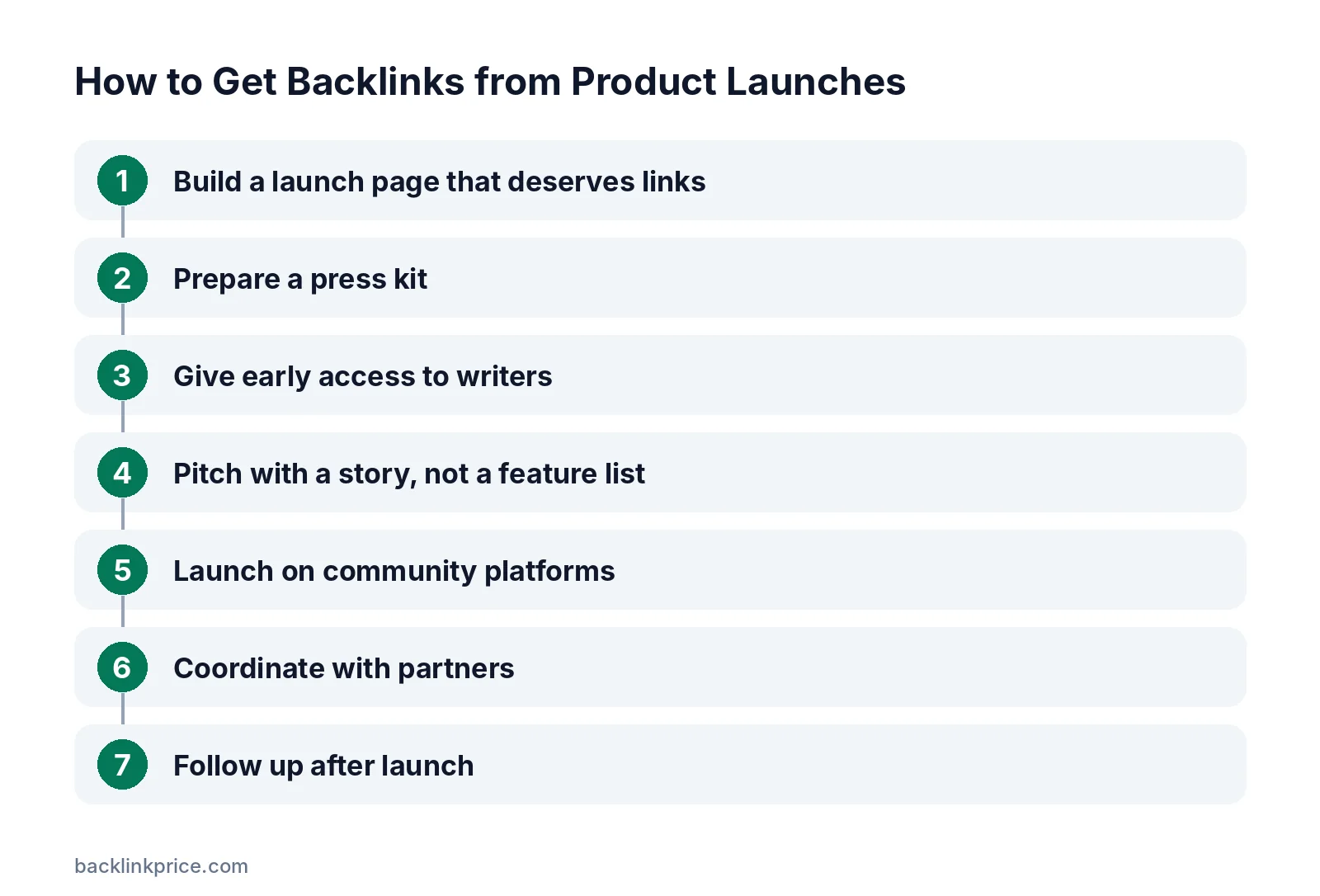
Step 1: Build a launch page that deserves links
Create one page on your site that explains what launched, who it is for, how it works, pricing, and screenshots or a demo video. This is the URL everyone should link to.
Add a short FAQ and a "press" section with logos and contact details.
Step 2: Prepare a press kit
Include a short release, founder quotes, product images, a fact sheet, and any data you can share. Host it on your site so writers can link to it.
Step 3: Give early access to writers
Offer embargoed access to journalists, newsletter writers, and reviewers 1 to 2 weeks before launch. Writers who test a product write better coverage.
For finding the right people, see how to get backlinks from journalists.
Step 4: Pitch with a story, not a feature list
Lead with the problem, the people affected, and what is different. If you have data from a beta, include it. Keep emails short and personal.
Relevance decides most outcomes. In Cision's 2025 State of the Media survey, half of journalists said they get more than 50 pitches a week, and 86% named lack of relevance as the top reason for rejecting one.
Our guide on how to write a link building outreach email covers structure.
Step 5: Launch on community platforms
List the product on platforms your audience uses, such as Product Hunt for tech products. Reply to every comment and question on launch day.
These listings bring early users who write tutorials and reviews later.
Step 6: Coordinate with partners
If the launch involves integrations or partners, agree on dates and share announcement copy. Partners often publish blog posts or changelog entries that link to your launch page.
Step 7: Follow up after launch
Track coverage, thank writers, and contact authors who mention you without linking; see how to turn unlinked mentions into links. Update the launch page with customer results after a few weeks.
Press releases and Google's rules
A press release helps journalists, but it is not a link building shortcut.
Google's spam policies list "links with optimized anchor text in articles or press releases distributed on other sites" as an example of link spam. Many wire services add nofollow to links for this reason.
Use releases to inform journalists, then earn editorial links through real coverage. Read do links in press releases count for details.
Common mistakes
These mistakes waste launch momentum.
- Pointing coverage to the homepage instead of a dedicated launch page.
- Sending pitches on launch day with no embargo period.
- Relying on a wire release for links.
- Launching with no screenshots, demo, or pricing.
- Forgetting to update directory and review profiles.
- Going quiet after launch week.
How to measure results
Measure the launch in 3 windows: launch week, first month, and first quarter.
- Referring domains to the launch page and press kit.
- Coverage pieces and newsletter mentions.
- Sign-ups and trials from referral traffic.
- Unlinked mentions you converted to links.
Use how to track backlinks to log new links each week during the launch period.
Frequently Asked Questions
When should I start outreach for a launch?
Start 2 to 3 weeks before launch day for media and 1 week before for newsletters and partners. Offer embargoed access so writers can test the product and publish on launch day. Last-minute pitches rarely get coverage.
Do press releases give backlinks?
Wire-distributed press releases usually carry nofollow links, and Google treats optimized anchor links in distributed releases as link spam. The value of a release is informing journalists, who may then write their own coverage and link to your launch page.
Is Product Hunt good for backlinks?
Product Hunt is mainly valuable for visibility, early users, and feedback. Treat any link as a bonus. The bigger benefit is the people who discover your product there and later write reviews, tutorials, or recommendations that link to you.
What page should launch coverage link to?
Create a dedicated launch page on your site and ask everyone to link to it. It gives writers all the details in one place. Later, you can update it with results and keep it as an evergreen product page.
Can small companies get launch coverage?
Yes, especially from niche newsletters, industry blogs, and community sites. Focus on outlets your customers read rather than major tech media. A clear problem, a short demo, and early access make small launches easy to cover.
Sources

The BacklinkPrice Team researches backlink prices, publisher sites and link building tools. We check prices and plans against each provider's own pages and date them, so you know how current the numbers are.
More from BacklinkPrice TeamRelated guides