How to Get on "Best Of" Lists for Links: What Actually Works
To get on best of lists, target lists that rank or get cited by AI, pitch the gap you fill with proof, and never pay for hidden placements.
To get on "best of" lists, find the lists that already rank or get cited for your category, give each author a concrete reason to add you, and make that easy to verify.
That means a short pitch with proof, such as a free trial, real customer numbers, or a clear use case the list is missing. Never pay for a hidden placement.
Key takeaways
- "Best X" blog lists were 43.8% of all page types ChatGPT cited across 750 top-of-funnel prompts in an Ahrefs study of 26,283 source URLs (December 2025).
- The lists worth chasing are the ones that already rank in Google or appear as sources in AI answers for your category.
- Authors add products when you fill a gap in their list, not when you ask for a favor.
- Paid placements must be disclosed, and paid links should carry rel="sponsored" under Google's link spam policies.
- Track three results per list: inclusion, link (and its attributes), and whether AI answers start naming you.
Why "best of" lists matter for links and AI answers
"Best of" lists matter because they now shape both search rankings and the brands AI assistants recommend. A "best of" list is an article that ranks or recommends several products for one need, such as "best CRM for small business".
In December 2025, Ahrefs analyzed 750 ChatGPT prompts and 26,283 source URLs and found that "best X" blog lists made up 43.8% of the page types ChatGPT cited. The same study found that recently updated lists were especially prominent.
Wix's AI Search Lab reported a similar pattern: 40% of commercial queries cite listicles, nearly double the share for other intents.
For link building, each inclusion can also bring a contextual link from a page that sits in front of buyers. If you want the background on why these pages get picked, read how ChatGPT chooses which sources to cite.
When this tactic is worth your time
Chasing list inclusions pays off when buyers compare options before they choose. That covers software, agencies, tools, and most considered purchases.
It works less well for products nobody compares, such as a one-off local service with no alternatives. It also struggles when your product is too new to have users or reviews to point to.
Software buyers clearly read before they contact vendors. Gartner Digital Markets' 2026 Software Reviews Preferences survey of 1,588 U.S. buyers found that most buyers research extensively and compare options first.
Use this quick test before you start:
- Search "best [your category]" in Google and in ChatGPT.
- Count how many results are third-party lists.
- If lists make up most of page one or most cited sources, the tactic fits.
Step-by-step: how to get added to "best of" lists
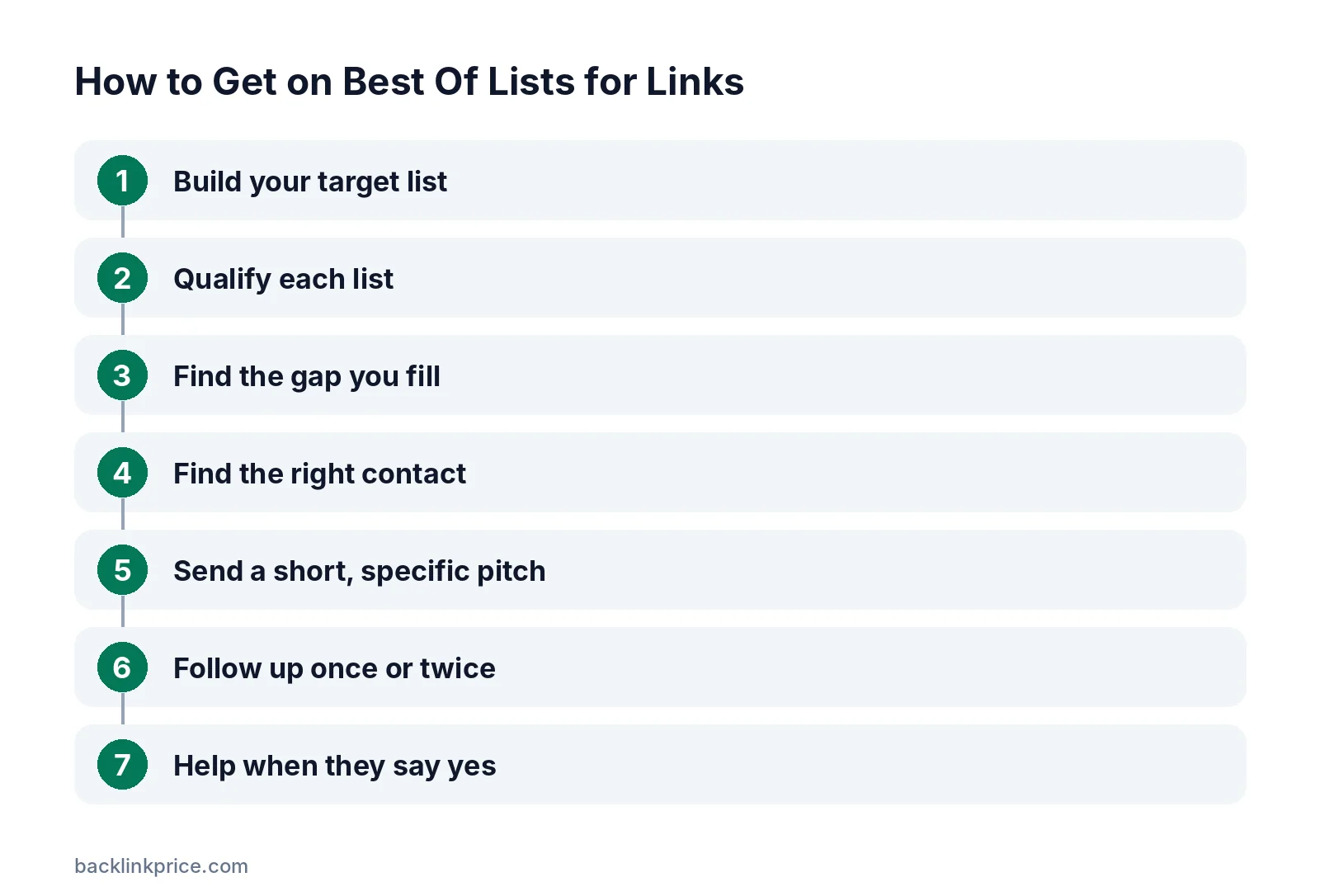
The process is research, qualify, pitch, and follow up, in that order. Skipping research is the main reason pitches get ignored.
Step 1: Build your target list
Collect every list that matters for your category. Use three sources:
- Google results for "best [category]", "top [category]", and "[competitor] alternatives".
- The sources ChatGPT, Perplexity, and Google AI Overviews show for the same questions.
- Lists that already link to two or more competitors (a link intersect in Ahrefs or Semrush finds these fast).
Record the URL, author, last updated date, and which competitors appear.
Step 2: Qualify each list
Not every list deserves a pitch. Keep the ones that are updated at least once a year, get organic traffic, and are written by a real author or editorial team.
Drop lists that look like pure link sales, with dozens of unrelated "best of" pages and no author. Our guide on how to check if a site sells links lists the warning signs.
Step 3: Find the gap you fill
Read the list properly. Note what it covers and what it misses, such as a budget pick, a tool for a specific team size, or a missing integration.
Your pitch should say, in one line, which reader the list does not serve yet and why your product serves them.
Step 4: Find the right contact
Pitch the person who updates the list, not a generic inbox. Check the byline, the author page, and LinkedIn.
For email addresses, see how to find email addresses for outreach.
Step 5: Send a short, specific pitch
Keep the email under 150 words. Include:
- The exact list URL and the gap you noticed.
- One or two verifiable facts about your product (pricing page, user count you can prove, notable customers with permission).
- Free access for testing, with no strings attached.
- A one-line product description they can paste.
For structure and subject lines, use our guide on how to write a link building outreach email.
Step 6: Follow up once or twice
Most replies come after a follow-up. In Backlinko's analysis of 12 million outreach emails, only 8.5% of emails got a response, and sending one follow-up was linked to a higher reply rate.
Wait 4 to 7 days between messages. Stop after two follow-ups.
Step 7: Help when they say yes
Send screenshots, a logo, accurate pricing, and answers to their questions quickly. Authors who test your product write better entries, and better entries get cited.
Paid placements and disclosure
Some list owners charge for inclusion, and that changes the rules you must follow. Treat a paid spot as advertising, not as an earned link.
Google's spam policies say that buying links to manipulate rankings is link spam. Google asks sites to mark paid links with rel="sponsored".
In the U.S., the FTC's Rule on the Use of Consumer Reviews and Testimonials took effect on October 21, 2024. It bans fake reviews and testimonials, and buying positive reviews.
The safe position is simple. If you pay, make sure the page discloses it and the link is qualified. Read more in are paid links against Google guidelines.
Tools, time, and cost
You can run this with free tools, but a backlink tool saves hours on research. Here is a realistic setup for a 30-list campaign.
| Task | Tool options | Time for 30 lists | Cost |
|---|---|---|---|
| Find lists in Google | Google search, search operators | 2 to 3 hours | Free |
| Find lists cited by AI | ChatGPT, Perplexity, AI Overviews | 1 to 2 hours | Free |
| Find lists linking to competitors | Ahrefs or Semrush link intersect | 1 hour | Paid plan |
| Find contacts | LinkedIn, Hunter, author pages | 2 to 3 hours | Free to paid |
| Write and send pitches | Gmail, outreach tool | 3 to 4 hours | Free to paid |
| Follow-ups and support | Email, shared doc | 2 hours per week | Free |
Expect inclusions to arrive over 4 to 12 weeks, because many authors update lists on a quarterly or yearly cycle.
Common mistakes
Most failed campaigns make the same few errors.
- Sending the same template to every author without naming their list.
- Pitching lists that have not been updated in years.
- Asking for the number 1 spot instead of a fair, accurate entry.
- Offering payment for an undisclosed placement.
- Making claims the author cannot verify, such as unsourced user numbers.
- Ignoring your own review profiles, which authors often check before adding a product.
How to measure results
Measure inclusions, links, and AI visibility separately, because each moves at a different speed.
Track these per list in a spreadsheet:
- Included or not, and the date.
- Link present, its anchor, and its rel attribute (dofollow, nofollow, or sponsored).
- Referral visits from the list in your analytics.
- Whether the list appears as a source when you ask AI assistants about your category.
For the last point, see how to track AI citations. Repeat your AI checks every month, because answers change as lists are updated.
Frequently Asked Questions
How many "best of" lists should I target at once?
Start with 20 to 40 well-qualified lists. That is enough to get several inclusions while keeping each pitch personal. Add more lists once you know which angle gets replies, then repeat the process every quarter as authors refresh their content.
Do I need a free trial to get included?
It helps a lot. Authors who can test a product write more accurate entries, and Google's review guidance rewards first-hand evidence. If you cannot offer a trial, offer a recorded demo, a sandbox account, or a call with someone who can answer technical questions.
Is it okay to pay to be on a "best of" list?
Paying is legal in many places, but it is advertising. The page should disclose the payment, and the link should carry rel="sponsored" or nofollow under Google's guidelines. Undisclosed paid placements risk penalties for the publisher and wasted money for you.
How long does it take to get added?
Most inclusions take 4 to 12 weeks. Many authors only update their lists every few months, so a good pitch may wait for the next refresh. Keep a note of each list's last update date and time your follow-up around it.
Can being on lists help me appear in ChatGPT answers?
It can. Ahrefs found that "best X" lists were the most common page type in ChatGPT's sources for top-of-funnel product, software, and agency prompts. Appearing on several well-ranked lists gives AI assistants more independent sources that mention your brand.
Sources
- Ahrefs: Do Self-Promotional "Best" Lists Boost ChatGPT Visibility? (December 2025)
- Wix AI Search Lab: The content types most cited by LLMs
- Gartner Digital Markets: 2026 Software Review Trends
- Backlinko: Email outreach study of 12 million emails
- Google Search Central: Spam policies
- Federal Register: FTC Rule on the Use of Consumer Reviews and Testimonials (August 2024)

The BacklinkPrice Team researches backlink prices, publisher sites and link building tools. We check prices and plans against each provider's own pages and date them, so you know how current the numbers are.
More from BacklinkPrice TeamRelated guides